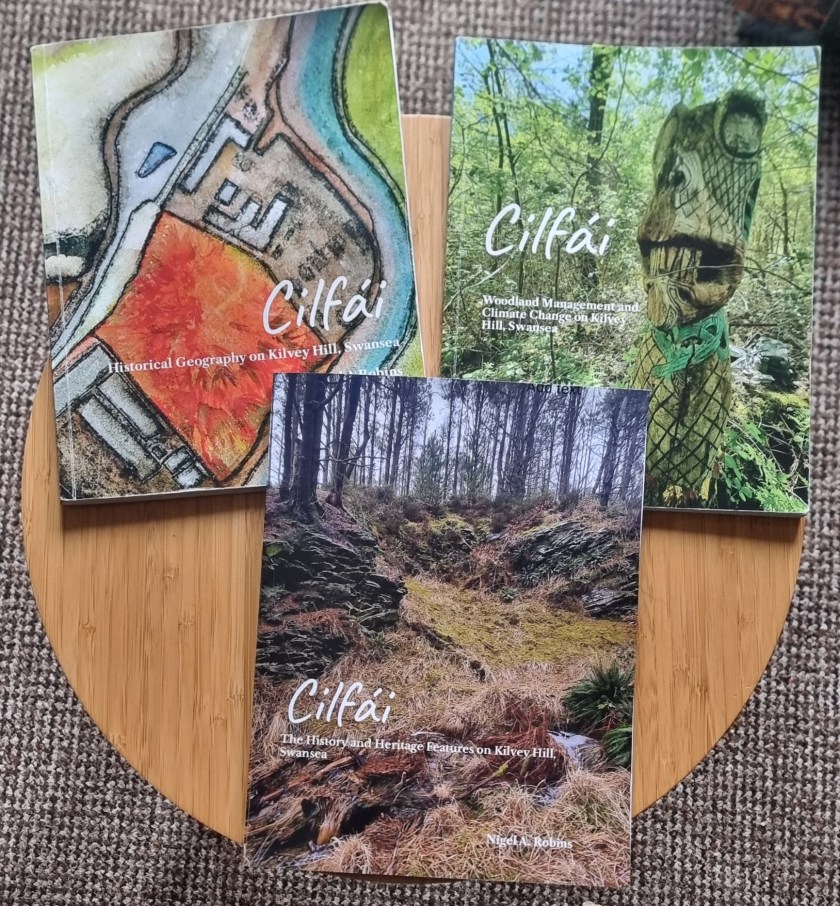
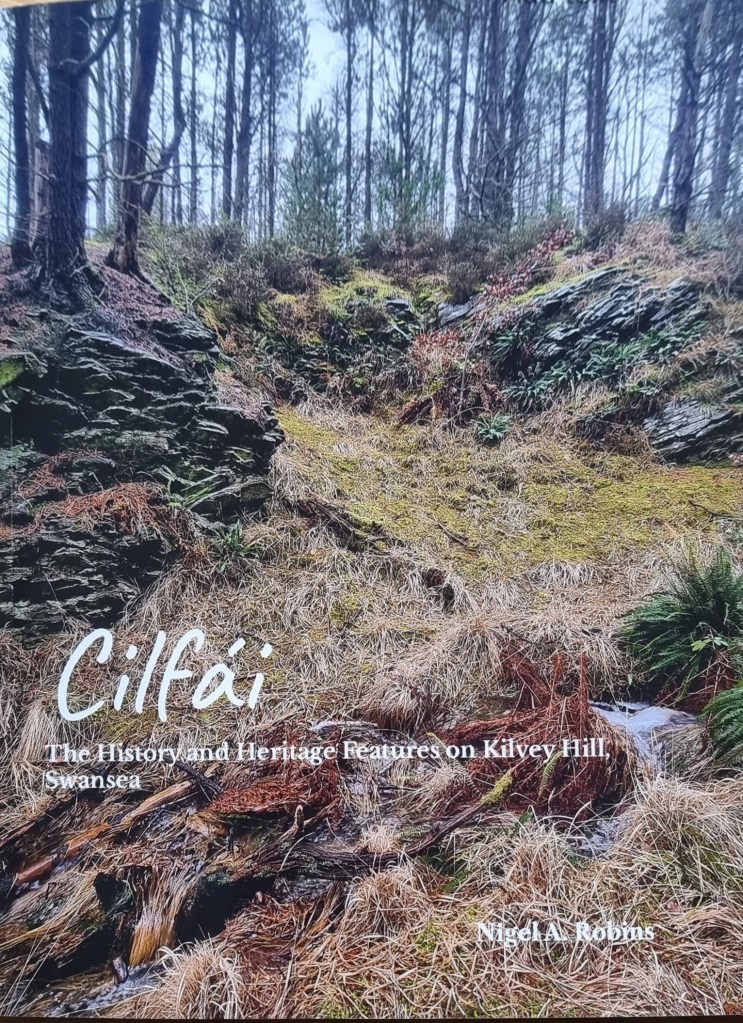
Cilfái: The History and Heritage Features on Kilvey Hill, Swansea ISBN 978-1-7393533-2-2

‘I don’t know why you all get worked up about it…there’s nothing up there’
(Swansea Council employee 2022)

This final Cilfái study was a bit more challenging than I first realised. I thought I had a good impression of the hill’s history and landscape. That was until I consulted the official records that were sadly inconsistent or often compiled with little knowledge or experience of the hill. This meant that this book and its lists were far more of a collaborative effort than the earlier books. This was no bad thing as I made or renewed friendships far and wide as spent more time on the hill connecting with the land and people. My grateful thanks and appreciation go out to all those who gave freely of their time to talk to me about their views and ambitions for the hill. This is particularly true of the features listed in the Modern History chapter, which, for many, is their whole experience of the hill. Unfortunately, the hill’s archaeological knowledge is poor, but that may be because there is more to discover, and we can be optimistic about that, as archaeologists frequently must be.

The Kilvey Woodland Volunteers are the lifeblood of the Cilfái community, and I’d like to thank Marian Francis for her support and commitment to all of us who work on the hill. Equally, the wider community who have planted so much and built The Glade and the Roundhouse and who contribute to so many well-being and craft activities on the hill have been truly inspiring in their unsung work on the hill for local people.
Once again, I need to acknowledge the help of Gerald Gabb in some of the Gwyndy story for me, and the support of library and archive services has been invaluable. The conversations with my old archaeologist friend John Andrew are always supportive. At the time of writing, I have no idea when or if the destruction threatened by Swansea Council will occur. I hope the lists in this book guide and support everybody who wants to care for and preserve what is on the hill. And yes, in answer to that nameless person who I quoted at the top of this page, there is plenty up there. You just have to care enough to look, and talk to the local community.
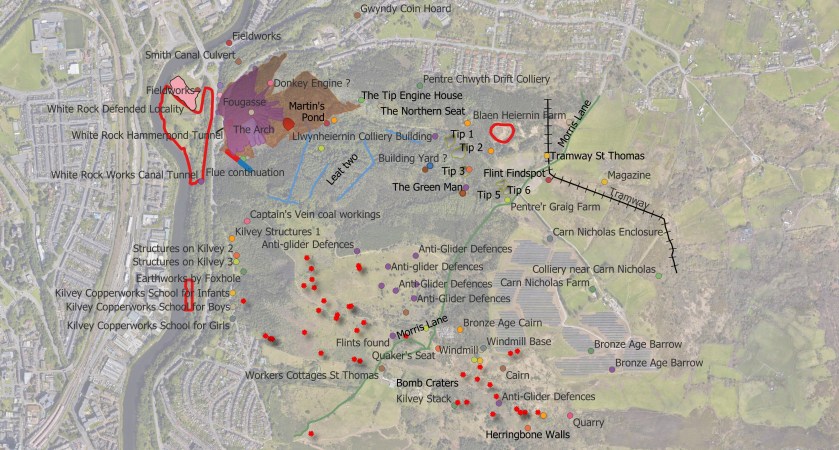
Above: Some of the heritage features of Kilvey, including some of the many bomb craters from World War Two.

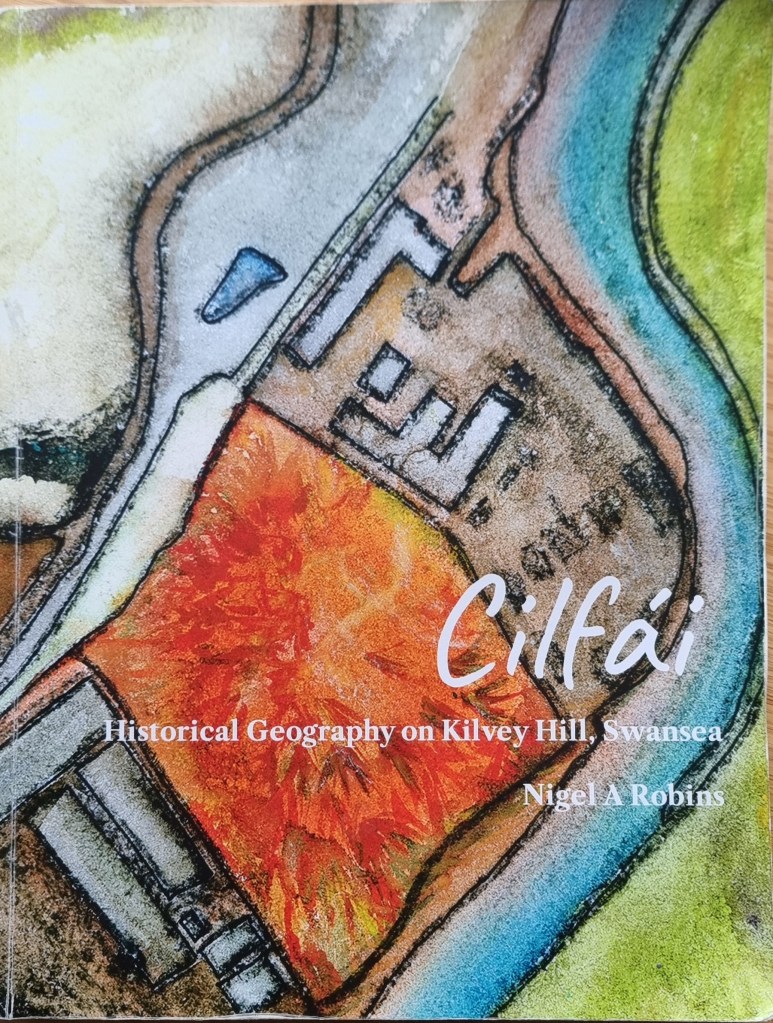
Cilfái: Historical Geography on Kilvey Hill, Swansea ISBN 978-1-7393533-0-8

This has now been reissued as a 2025 Second Edition with some updates, minor amendments and some new illustrations. I’ve also updated the copyright and EU product compliance details.

This study has been heavily reliant on past teaching notes and lessons learned from students’ questions and discussions over many years. I am indebted to all of them. Grateful thanks to the staff of West Glamorgan Archives Service and the archivists at the British Geological Survey in Keyworth who allowed me to spend time with William Logan’s original notebooks. The help of experts such as Dr John Alban and Gerald Gabb has always been beyond value and they have helped me as a sounding board and unlocking further fields of expertise which ave been so valuable. The contributions and discussions with my oldest friend John Andrew on geology and the rocks of Townhill and Kilvey have been particularly inspiring. John passed away in August 2024 and I miss his help and support terribly.

The cover of Cilfái was part of a painting of White Rock I did a while ago, mainly to show the extent of the Cae Morfa Carw waste tip (the orange land). The Tawe is on the right, and the original long workhouse of White Rock is at the top.


I must also thank the staff and colleagues at Coed Cadw/Woodland Trust who, unwittingly perhaps, spurred me on to re-explore Kilvey some thirty years after I last surveyed the land in the late 1980s. All the modern mapping was completed using the open-source QGIS application which has become a central tool as a landscape historian over the past ten years. Finally, I must mention the help and support of Kilvey Woodland Volunteers. Without the passion and commitment of the volunteer body over many years, I doubt that Kilvey would be the special place it has become. As I write this, Kilvey is under more threats from the local council and developers, and I hope this little book records a few milestones in the ongoing Kilvey story rather than an ending.


The first edition of Cilfái was remarkably successful. The aim was to fill a gap in knowledge about the Hill in the constant challenge to take care of it in the face of threats of irreversible destruction from tourist developments and an uncaring local authority. There are now many more local environmental and residents groups aware of the current value of the land and the potential loss Swansea faces if the destruction begins. This book was the first of the Cilfái trilogy, the second book covered Woodland Management and Climate Change, and the third book covered the heritage features on the hill. This book was rushed into print to address claims from the Local Authority that there was ‘not much up there’. Since 2023, I’ve taken hundreds of people on walks to view the biodiversity, history, and heritage of Cilfái, and I’ve packed out numerous community centres and halls to talk about the history. Hundreds of people have been converted to the value of the landscape we may lose.

Above: A coal adit on Kilvey was left to regenerate after about 40 years of peace. Swansea Council may be seeking to destroy this land, which they consider ‘worthless’.

Cilfái/Kilvey

I’ve now completed the information project for the Cilfái/Kilvey Hill landscape and surrounding area. The three books covering history, environment, climate change and heritage have all done phenomenally well. I’m sure that almost everyone who wanted copies of any or all of the books in the trilogy now has them. I remain amazed at the level of interest from the USA, Canada, and Australia!

I’ll be teaching Cilfái in several local places in 2025 alongside my World War Two books on South Wales and Swansea Blitz. I will also be offering open-air classroom sessions up on the Hill when the weather allows me to! I’ll post those details in the New Year.

I still have no idea about the future of the Hill, and I guess Swansea Council’s threatened destruction of the environment is about to enter the next phase in 2025. Meanwhile, I’ll continue to use the Hill and/or what survives of the woodlands as my outdoor classroom. A wonderful environment to examine heritage, climate change, woodland biodiversity and geology.

Interest in the history and geography of Cilfái continues to rise, and I’d like to thank the many educational (FE and HE) establishments and organisations for their continued support and engagement with me (and the outstanding Kilvey Woodland Volunteers) in seeking to understand the hill’s value for our local communities and as an educational and wellbeing resource.

One of the fascinating backstories of Cilfái has been the significance of the Hill in the history of coal exploration. Swansea has a particularly special place in the history of the British coal industry. Much of that rich history has been forgotten or discarded, but my next book will be about bringing that fantastic history back to life.

The Cilfái Trilogy. Bringing the uniqueness of the Hill to a wider audience!