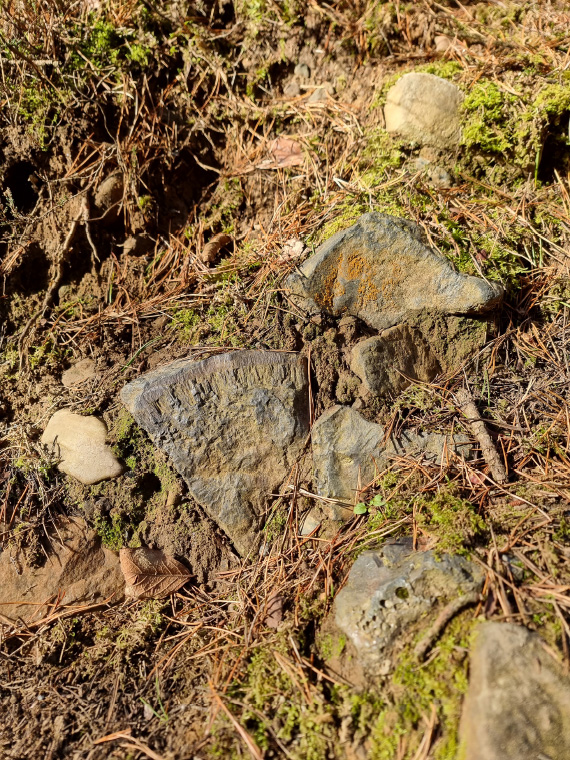
The industrial pollution phase of Cilfái’s history has left a permanent mark in the nature of the landscape. Industrial smelting waste forms a large part of the soil for over twenty percent of the woodlands around The Glade, Roundhouse, and up to Martin’s Pond. Slag takes its place amongst the native sandstone and the glacial debris from the last ice age. The structure and chemical profile of the soil is permanently altered and many trees eventually succumb to the toxicity. This is a good reason why natural regeneration should be favoured over massive new plantation of native species. Natural regeneration allows plants that are resilient to the poisons to develop. I explain more in the second Cilfái book.
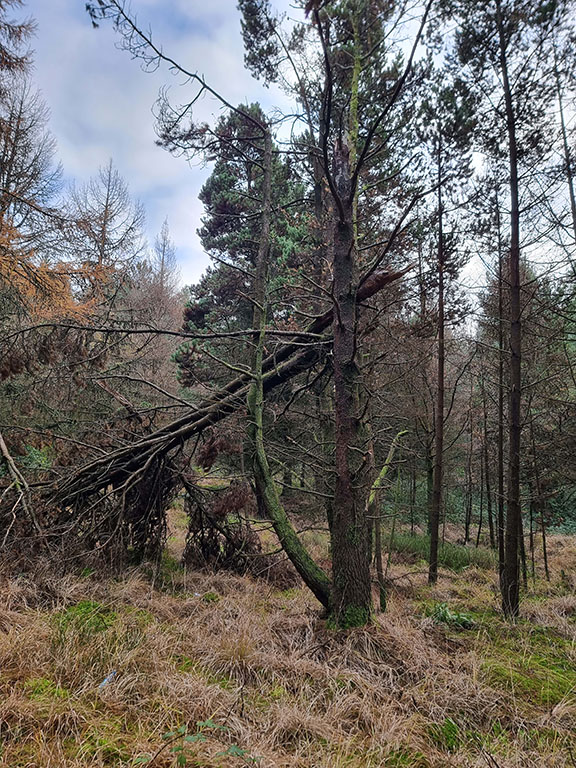
As Climate Change accelerates, the conifers are increasingly susceptible to higher windspeeds and many trees will snap forming ‘snags’ such as this one near the Steam Engine Spring.
Snags allow insects, birds, and bats into holes and crevices in the dying wood providing much needed habitat. Where it is safe to do so, features like this must be maintained.
Dead wood is a vital part of biodiversity and a recovering ecosystem. Wherever possible, we don’t ‘tidy it up’ or sell it for firewood as the Penllergare Trust used to do.
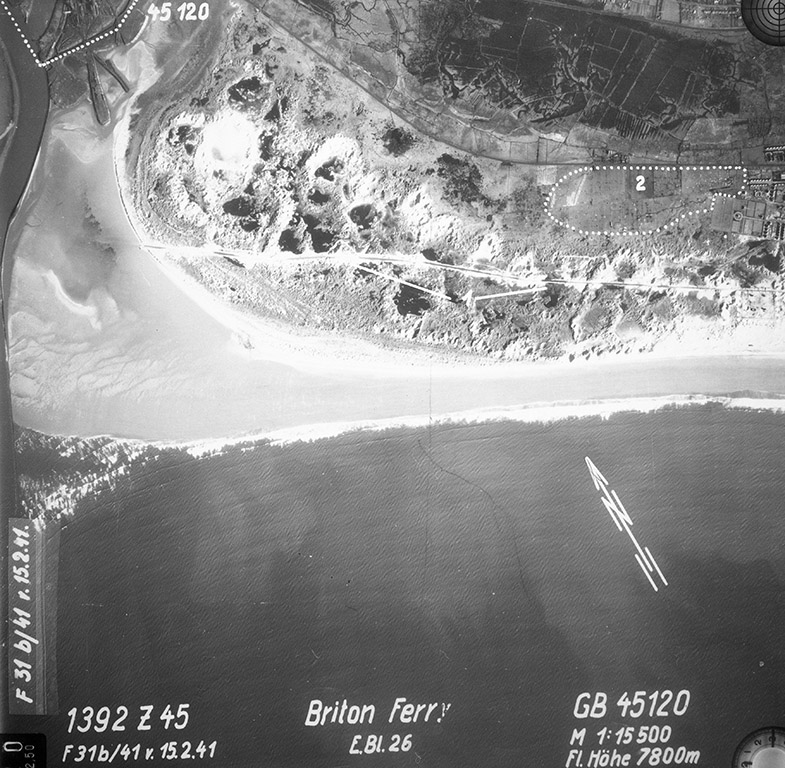
The Luftwaffe surveys of the Welsh ports are an incredible record of past landscapes that have now changed. Although the intent of the reconnaissance missions was to prepare for the bombing of the South Wales ports in 1940 and 1941, they also recorded some of the earliest and finest detail if the coastal landscape. Many of the best surviving images are explained and interpreted in Eye of the Eagle: Luftwaffe Intelligence and the South Wales Ports 1939-1941.
Below: The river mouth of the Afon Nedd and Briton Ferry in February 1941. The burrows had a road used since medieval times to allow travellers to cross the sands at low tides.
One of the reasons we know so little about the abundance or distribution of bats is the general technical difficulty of surveying and recording where they live and where they hunt. Nationally, the effort to monitor the bat population is significantly bolstered by the invaluable contribution of volunteers. Their dedication, although often underappreciated, plays a crucial role in our understanding of bat populations. However, this reliance on volunteer work, while commendable, is not without its challenges. The situation is further complicated by the need for specialized equipment and training. Although bat surveys have become a regular requirement for planning permission, the surveys remain expensive and knowledge is considered commercial and rarely shared, making understanding of bat distribution even more complex. Using specialist recording equipment means the data files for bat surveys can become very large very quickly, although the advantage is that the data is available for further analysis and verification.
I trained as a bat surveyor in the Thames Valley, where University researchers waxed lyrical about the high densities of bats along the river. One warm night we went out and didn’t detect a single one. That has never happened to me on Cilfái, where bat presence can be staggering on many nights.
Bat surveys have become high cost as surveyors seek to extract as much income from the work as possible. It is unfortunate, as much needed information then becomes restricted or unshared. That greedy attitude led me to share as much as I have on the bat presence on the hill in the second Cilfái book. Cilfái: Woodland Management and Climate Change on Kilvey Hill, Swansea.
On Cilfái, I use a combination of a handheld detector and automatic recorders, which give me a sample of several nights at various locations. This lets me hear the bat calls as they hunt and analyse the recordings at home. I use the classic handbook for techniques Jon Russ wrote (Russ 2012). I use Anabat Express (or equivalent) passive bat recorders and process the data with Anabat Insight Version 2. Over time, this gives me an understanding of the ‘hotspots’ of activity across the hill. I only get snapshots of what is happening, and I cannot realistically project what I know into the overall picture of bats on the hill. That will take a few years. I can assume that our ‘Year Zero’ in 1970 had no bat presence and that everything I see and hear in 2023 is the product of fifty years of recovery. However, realistically, the woodland only began its recovery in the mid-1990s.
The hotspots on the hill are where the food is. Generally, these are the open spaces where previous burning or wind damage has opened up the forest canopy and allowed a wider range of native plants to prosper. Some of these open spots are also good for birdlife. On a warm autumn evening, the air in the hotspots is thick, and flying insects attract the bats. I have evidence of a large presence of Common Pipistrelle (Pipistrellus pipistrellus) and Noctule (Nyctalus noctula). It is possible that hidden in my recordings is some evidence of the Brown long-eared bat (Plecotus auritus), only further data collection will confirm.
Although I can track and monitor activity, it remains immensely difficult to understand hibernation and roosting sites. I am slowly building up a library of bat presence data across the hill.
Russ, John. 2012. British Bat Calls: A Guide to Species Identification (Exeter: Pelagic).
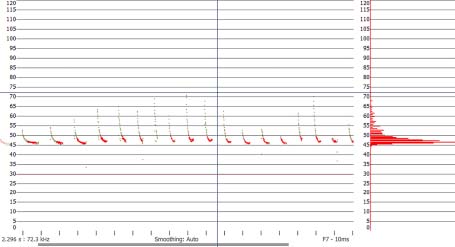
Below: Although it looks a bit technical, it is the nature of bat survey work that we prepare this kind of evidence. The land above Foxhole and the Glade is very busy with bats and clearance of trees will definitely cause problems for the population that has re-established up there. On the night this recording was made I had hundreds of similar records. You can see more evidence in the Cilfái book.
This is a recording of a Common pippistrelle hunting on the woodland edge above Foxhole in September 2023. Temperature above 20 Celsius (Analook F7) compressed with split-screen option Cycles, showing the characteristic call shape of a hunting pippistrelle.
Below: Me bat surveying on the threatened land above Foxhole September 2023
We don’t have any ancient woodland on Cilfái. The last of it was killed off in the 1750s by industrial pollution. The coal industry on the hill probably removed most of the bigger trees before that as coal mining consumed massive quantities of timber. Both Cilfái and Townhill were cleared of their natural woodland by the 1300s (Robins 1990: 4–8).
1970 marked the new beginning of woodland on the Cilfái woodland site. We know that the Scots and Monterey pines on the western side were planted alongside efforts by the Forestry Commission to reestablish forestry on the upper slopes of the west side (Robins 2023a: 62–77, 2023b: 55–58).
Although the landscape of ancient woodland has disappeared, Swansea does have some incredible surviving old trees in Singleton Park and Penllergaer (Penllergare) Country Park. The trees in Singleton survived being part of farmland in the 1600s and were incorporated into the estate of the Vivian family in the 1800s (Morris 1995: 5–26).
The Penllergaer Country Park has some incredible survivors who survived the devastation of the coal mining period between 1500 and 1790 and became incorporated into the private parklands of the Dillwyn Llewelyn family. I wrote about some of the trees in Swansea History Journal a while back (Robins 2021).
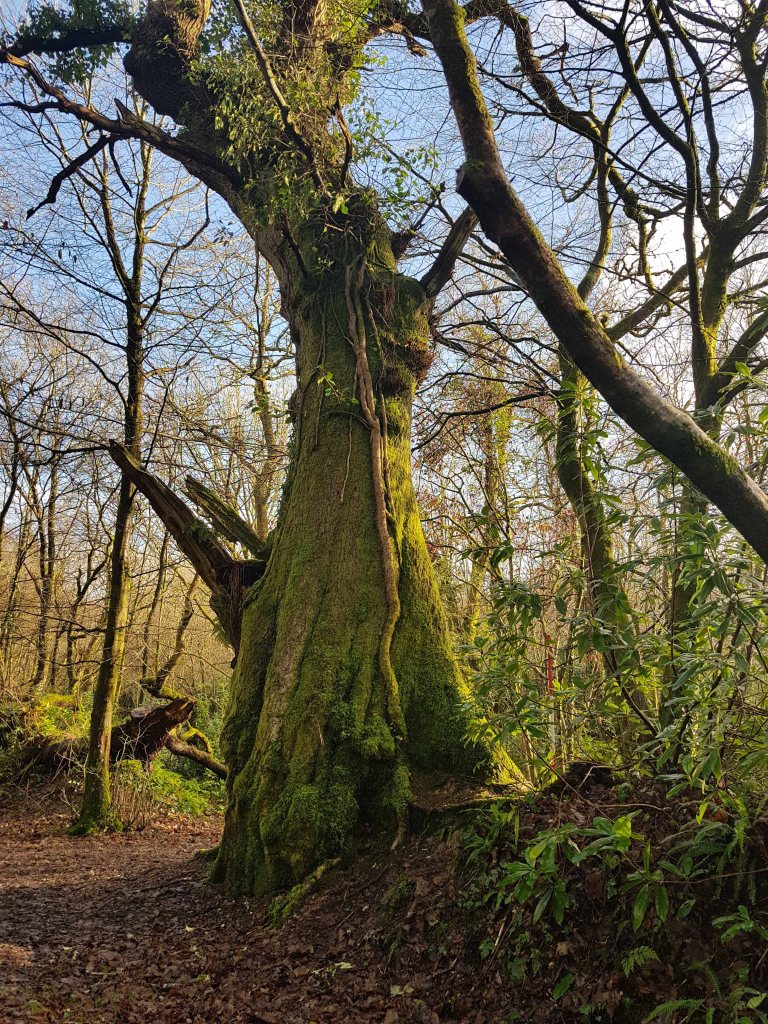
The trees of Cilfái are special because we know how old they are and what they have gone through to survive today. The trees of Nyddfwch are special because they are far older but have also survived the ravages of industrialisation and human interference.
Morris, Bernard. 1995. The Houses of Singleton: A Swansea Landscape and Its History (Swansea: West Glamorgan Archive Service)
Robins, Nigel A. 1990. The Enclosure of Townhill: An Illustrated Guide (Swansea: City of Swansea)
Before World War Two, the Luftwaffe intelligence assessment teams under Professor Dr. Heinrich Steinmann were interested in electricity supply. Steinmann believed that the vulnerabilities of the electricity generation and supply industries made extremely valuable strategic targets. Swansea’s power stations were particularly interesting due to their importance in the South Wales power generation network.
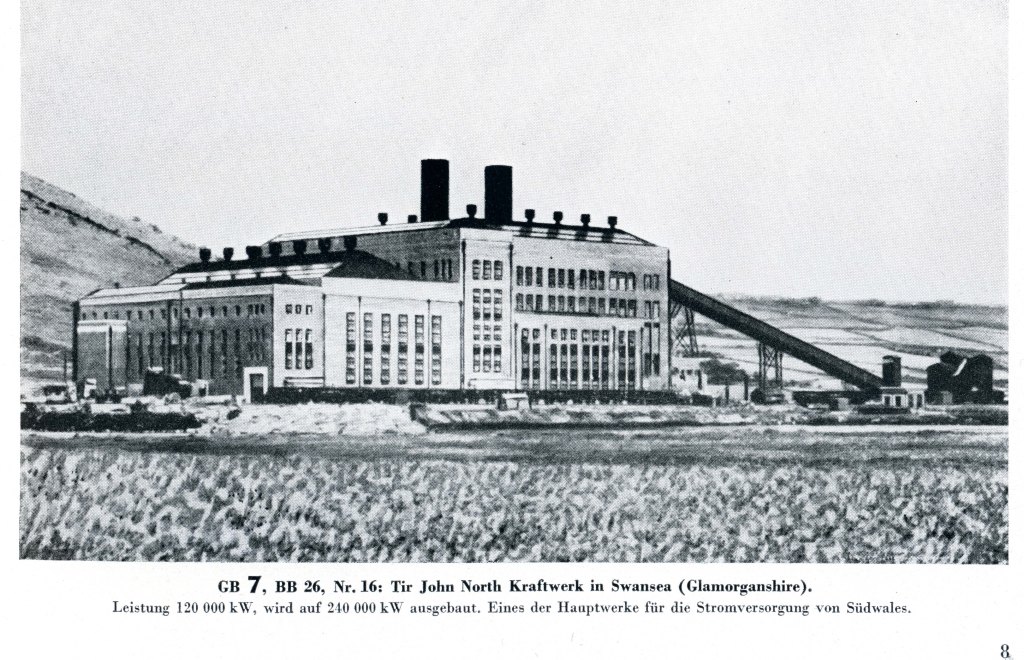
Swansea had two power stations, the Strand Power Station (opened in 1900) and Tir John Northeast of Kilvey (opened in 1935).
As a very modern and efficient power station, Tir John was identified as a strategic target as part of the Study Blue research into conducting an air war against Britain. In the Luftwaffe target lists, Tir John was assigned Target number GB 50 56. The full story is in Eye of the Eagle: Luftwaffe Intelligence and the South Wales Ports 1939-1941.
Below: a 1930s illustration of Tir John North power station (Kraftwerk) from German intelligence records.
One of the big threats to a recovering woodland is habitat fragmentation. This is a huge problem for wildlife in Wales. I covered this in the second Cilfái book (Cilfái: Woodland Management and Climate Change on Kilvey Hill, Swansea). It is reasonable to assume that a big woodland is better for biodiversity and the environment than a small one. After two thousand years of habitat destruction in Wales we are left with one of the poorest environments in Europe. The woodlands we have are constantly being threatened with further subdivision as roads and houses are built in ever remote or pictureesque areas.
The woodland that has recovered since 1970 will now be fragmented further by the foreign tourism development which will cut through the centre of the biodiversity area. The impact on the recovering wildlife will be immense. The impact will be change and a reduction in opportunities for wildlife and plants on the vital central area of the hill. Fewer opportunities to live will result in fewer species and reduced biodiversity. That is habitat fragmentation.
In numbers, the 102 hectares of woodland and open access space we now have on Cilfái will be reduced to about 29 hectares of woodland. As a comparison, the country park of Penllergare (near Junction 47 on the M4), has about 67 hectares of mixed woodland and Singleton Park has about 11 hectares of (badly fragmented) woodland. So, yes, the loss of Cilfái woodlands is significant.
It may not necessarily be all doom and gloom. Swansea Council and the tourism developers will hopefully be obliged to produce a series of habitat recovery and restoration plans for various tracts of land that may be leased to the Company but will not be built upon. I assume pressure will be put on Welsh Government to provide a large sum of money for ‘native’ woodland restoration. As everybody who has a say is committed to cable cars and adventure tourism, I’m sure the money will come…it has to.
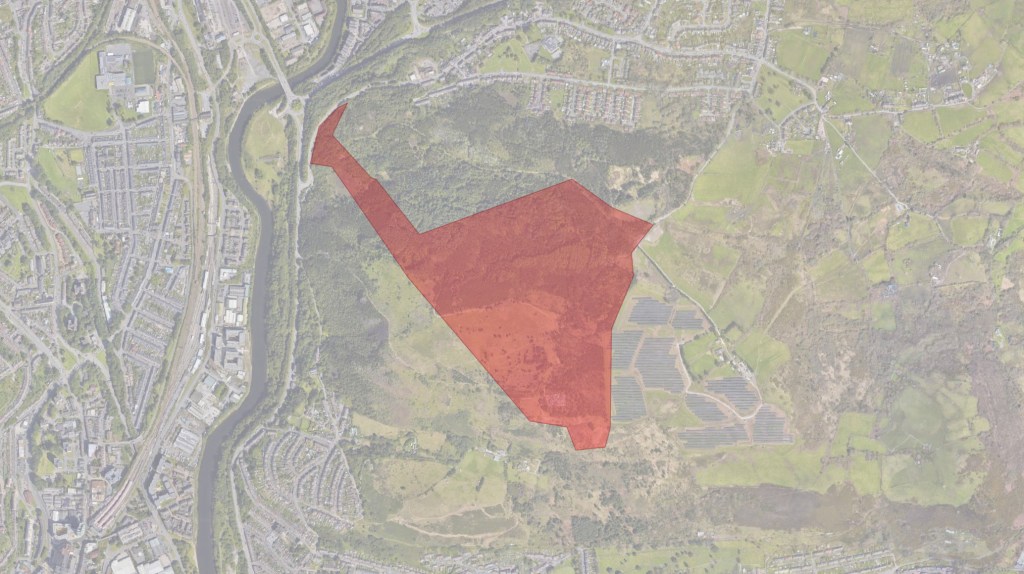
Below: The area of concern on Cilfái is coloured red here. A large chunk of this is the original Forestry Commission land (now NRW). A mixture of coniferous forest, fire damage and fantastic natural regeneration. Full of bats and birds. The contract ecologists bought in by the tourism firm will seek to devalue the quality of the environment and frame it as a place that is worthless and ripe for redevelopment.
You can always contact me to buy the Cilfái books. Send me a message on FB or use WhatsApp or LinkedIn. Or you can email me at my Gmail address. Eye of the Eagle will be available at an illustrated Bo0k Launch talk at Swansea Central Library in early June. I will probably do some talks on the air war over Wales later in the summer.
You can also buy copies of the Cilfái books at the lovely little shop in Swansea Environment Centre. It’s the only shop in Swansea that stocks them.
If you want to buy the books online, the easiest way is to buy them direct from lulu.com because these are the people who print them. In fact if you use Amazon all they actually do is contact lulu. So cut out the middle man and go straight to lulu.
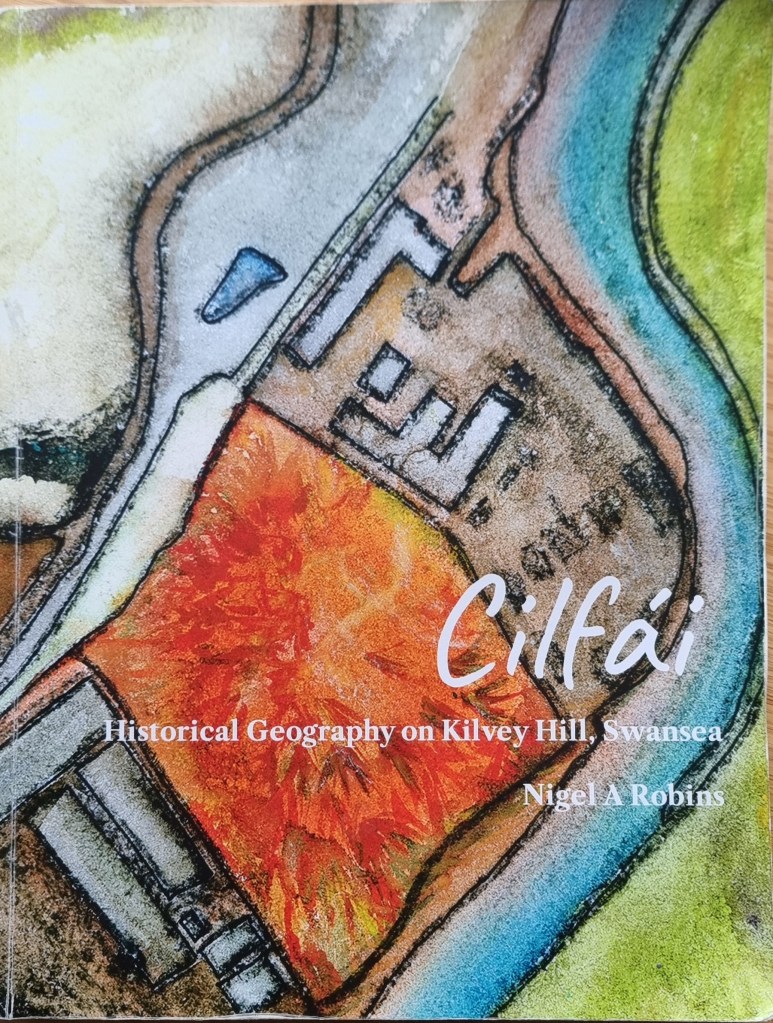
So you can buy Cilfái: Historical Geography on Kilvey Hill, Swansea. This is the history book of the trilogy and it covers the biggest topics in the history of the Hill. So that is Coal, Copper, Pollution, Restoration and Repair and the Nature Recovery. This one also includes Annexes covering the legal background to White Rock Copper Works from 1737, and the Geological history and the pioneering explorations of William Logan. 126pp, fully indexed and referenced.
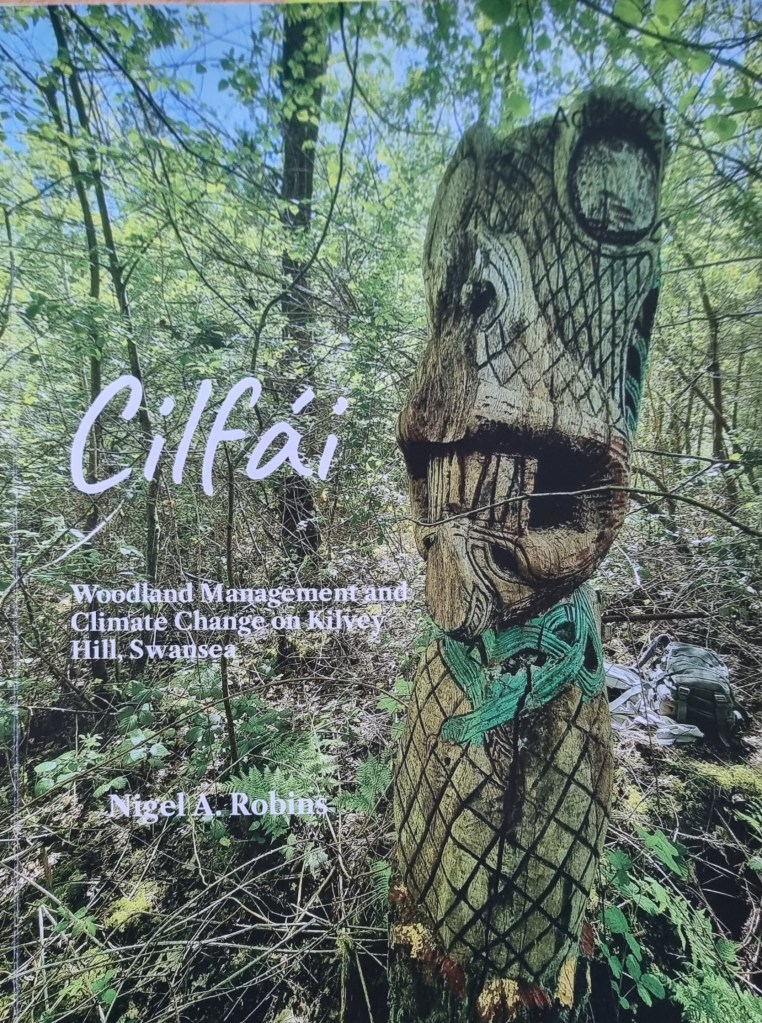
The second book of the trilogy is Cilfái: Woodland Management and Climate Change on Kilvey Hill, Swansea. This one covers the environmental issues faced by the hill and the woodlands. A lot of this one reflects my past government work as a programme reviewer for Defra, DCMS and Historic England, particularly where matters of the environment are concerned. I’m a qualified ecological surveyor and have been involved in a number of large environmental schemes since the 2010s. This book is built around my ecological surveys of the Hill and you will see a lot of Annexes here showing how we create Species and Habitat Action Plans for conservation, My records of everything I found within 1 km of The Glade (between 2010 and 2023) including Mammals, insects, Invasive Species and Reptilees and Amphibians. I also include my Open Mosaic Habitat plant list (including bombsite plants). I have produced a sample copy of a standard Woodland Management Plan to show people how to prepare a good conservation plan and I finish up with my discoveries and monitoring of bat populations on the Hill. This book also has discussions of landscape resilience and climate change issues as we saw them in UK Government.130 pp, fully indexed and referenced.
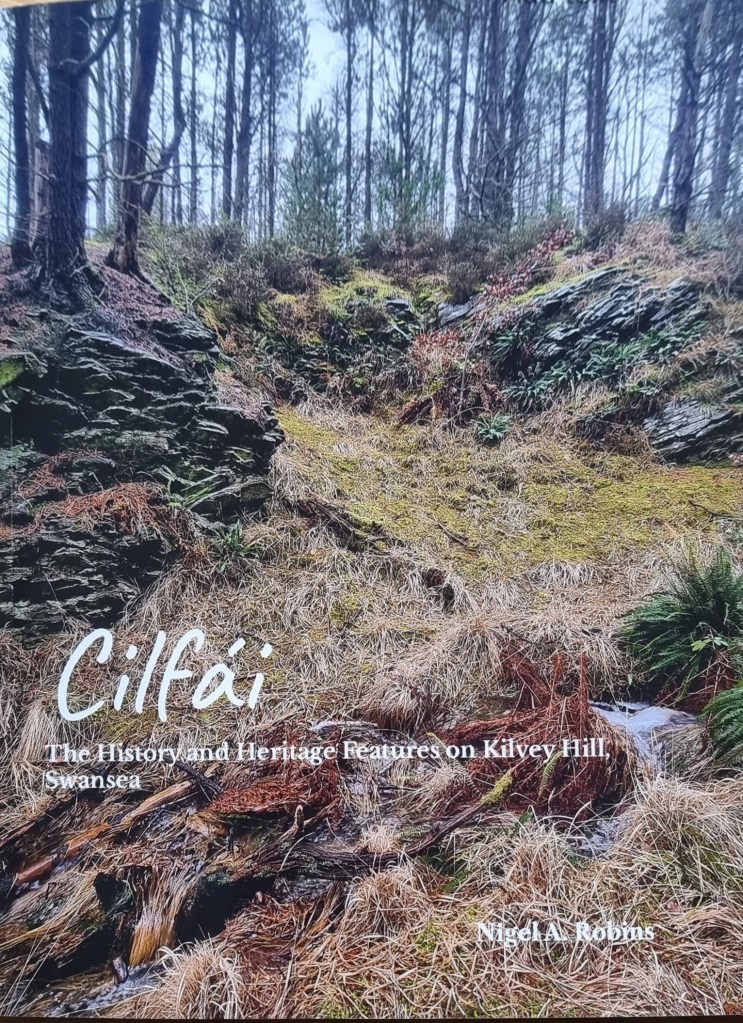
The final Cilfái book is Cilfái: The History and Heritage Features on Kilvey Hill, Swansea. This is based on my new surveys of all the heritage and historic features on the Hill. I spent a couple of years working for UK Parliament, chiefly as a heritage researcher so I picked up al ot of experience working with Parlamentary conservation departments, Historic England and Scottish Heritage. When I reviewed the current records of heritage and archaeology for the hill, I could see they were incomplete or needed updating. This book does that, and I’ve added maps and What3Words locations of all the heritage features on the Hill from the prehistoric sites, coal and copper industries up to the present day with The Green Man. I’ve also added a number of heritage featurews to the list that aren’t on the official lists. All this empasises the point about how special Cilfái actually is.
A lot of people know me as a historian specialising in World War Two and my latest book is a revised and much enlarged version of a book I originally published in 1993. Eye of the Eagle: Luftwaffe Intelligence and the South Wales Ports 1939-1941 takes me back to my original research field as a Historical Geographer investigating landscape history. Using Luftwaffe aerial photographs to study Gower landscape sent me in a different direction as I tried to understand the history behind German military intelligence activities in South Wales. Over many years I amassed a large collectionn of Luftwaffe intelligence which portays the reality of the war oiver Wales from the German viewpoint. It also provides a fantastic insight into the activities of the ports of Swansea, Cardiff, Barry and Llandarcy in their finest hour as they supported the nation’s defence and resilience. Using a combination of Luftwaffe intelligence documents and maps and local records from the 1930s, this book examines the reality of why the ports were bombed. A4 size, 170 pp, fully indexed and referenced.
My latest book will cover a bit about the history of the Luftwaffe intelligence of South Wales in the early years of World War Two. It’s been an interesting journey. The records have been mainly in German and it’s been great fun to work with old maps again as opposed to modern GIS systems which have taken up so much of my time looking at Cilfái.
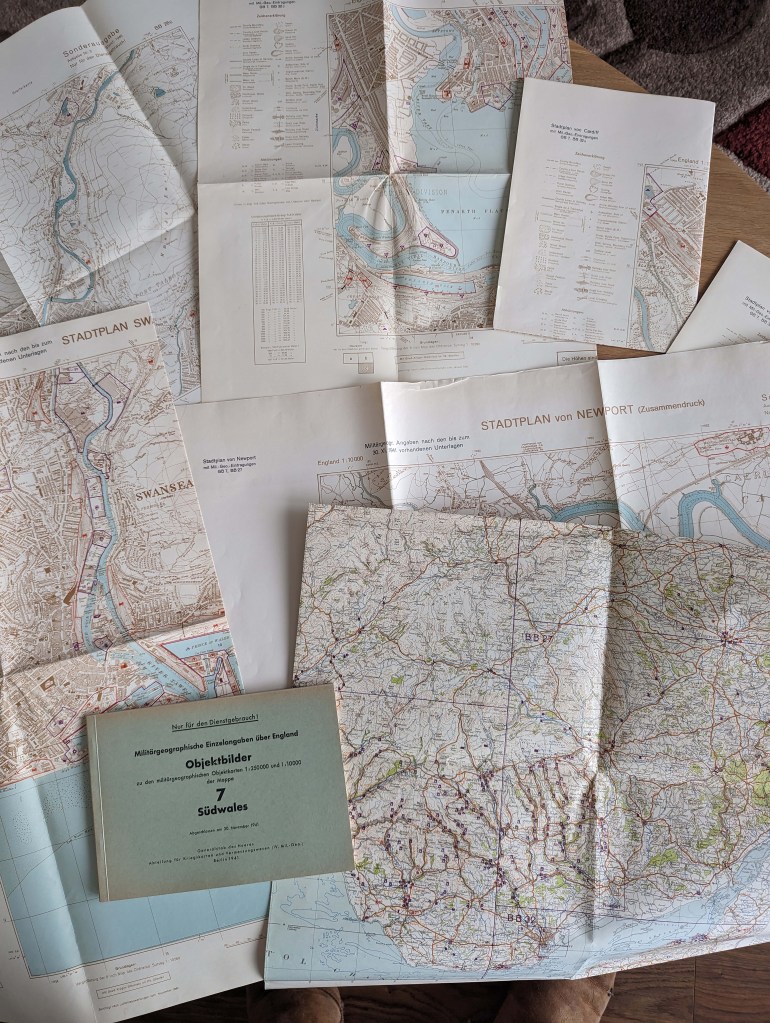
Regardless of how much of a stupid idea it was, the German armed forces were ordered to prepare for an invasion of Britain in 1940. This they duly did in a thorough and orderly way. Some of the documents from that time have survived, although most were destroyed at the end of the War in 1945. I was able to get my hands on a series of Luftwaffe intelligence files and the portfolio of invasion plans of South Wales, which cover in detail why Swansea and Cardiff were bombed. They also show up the gaps in knowledge that often made bombing a waste of lives, money, and time. I can now explain the reasons behind the air attacks on Swansea and Cardiff, and what they were aiming for.
I’ll be doing a series of talks next month to launch the book. I’ll announce them here, but if you want to know more, you can always contact me.
Below: A German military information pack covering South Wales from 1941.
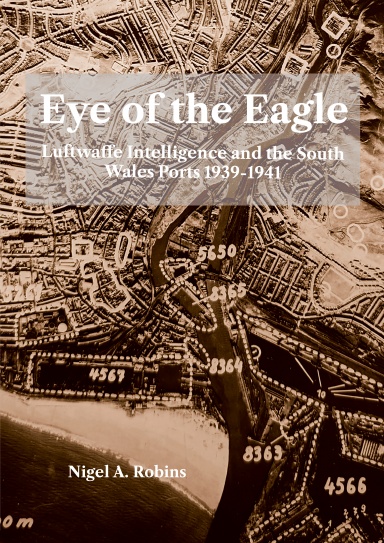
My new book on the history of the Blitz bombing of Swansea and the other South Wales ports is now available from me.
This is the second edition of Eye of the Eagle, the first edition was published in 1993!
I’ve completely rewritten the history based on years of research in German Air Force sources and I’ve looked at the other ports the Luftwaffe attacked in 1940 and 1941. Over the years I’ve collected a large range of intelligence materials which are rarely seen because they were often destroyed at the end of the war.
In this history I have concentrated on Luftwaffe intelligence maps, photographs and other sources to give the real reasons why Swansea and the other ports were attacked and dispell some of the rumours from the past. I’ve also looked at the U-boat campaign against Swansea and Cardiff and included translations of key German war diaries and Luftwaffe intelligence records. I’ve described in detail the U-boat mining of the Scarweather lightship and the U-boat attack on Swansea.
Intelligence records are often difficult to understand so I’ve added a detailed examination of how photographs were taken in the preparation for invasion and the Blitz attacks on the ports.
I’ve made this book a big A4 size to take full advantage of the many maps and images that show Swansea and the ports as seen from the German point of view. Over 130 illustrations, many in colour.
Chapters: 1. Understanding Intelligence and Reconnaissance (The Munich Crisis, The decision to bomb Swansea, the bombs and the aftermath as seen by the Luftwaffe cameramen), 2. The history of the South Wales ports between 1933 and 1941 (The ports as targets, how they were selected, and how they fought their war). 3. Reconnaissance over Wales (the Units and aircraft), Detailed illustrated chapters on 4. Newport, 5. Cardiff, 6. Penarth, 7. Barry, 8. Port Talbot, 9. Llandarcy Oil Refineries, 10. Briton Ferry, and 11. Swansea, With Annexes on the U-boat mining of the Scarweather Lightship, Descriptions of the Luftwaffe intelligence records, and other information on the bombs that were dropped on the ports.
Eye of the Eagle: Luftwaffe Intelligence and the South Wales Ports 1939-1941, Nigel A. Robins, Size: A4, Paperback, 170 pages. Price £16.99.
Available from Nyddfwch Publishing, Swansea, or contact the author on nrcontact30@gmail.com. Or you can contact me here.
 Nigel Robins