Most of the documents and other evidence about how Swansea coped during the war have not survived. As I said earlier, we have a lot of photographs, but understanding how people managed is harder to explore. My earlier post discussed the role of the ARP Controller Hywel Lang Lang-Coath. I looked through the available evidence to reconstruct the communication processes people needed to work through the awful problems the bombing caused.
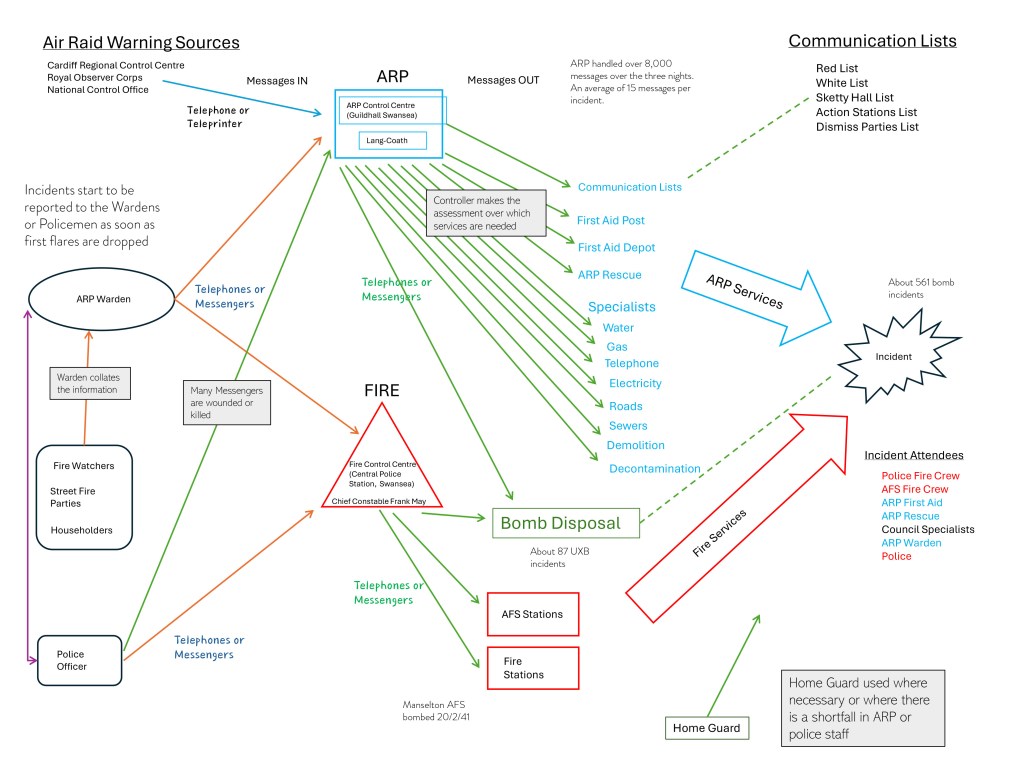
One of the most important roles was the Air Raid Warden, who was expected to act as first-line help, assess the problems a bomb or fire had caused and ensure both the police and the ARP control knew about the problem. Wardens had to be special people, confident, capable, and able to prioritise problems on the spot. Nearly twenty per cent of wardens were women.
Below is my reconstruction of the communication flows between the warden and the fire control at Swansea Central Police Station and ARP Control in the Guildhall. You can see how complex the ARP role was and how many decisions Lang-Coath had to make. Once the telephone lines were destroyed, all messages were carried by teenagers on bikes or motorbikes, or even just running through the bombs and fires. A number of Messengers died trying to get their messages to the Guildhall.
You can buy the book here: Y Tân (lulu.com)
 Nigel Robins