Although there is a publicity fanfare about Copper in Swansea, it is coal that is in the heart of Swansea’s history. There may be two thousand years of coal workings around the city and west to Crofty. Beyond that, the rocks of Gower change so there is no coal mining.
The mining of coal was a part of every farm and farmworker’s life before the Industrial Revolution in the 1750s. Coal often outcropped on the surface and small scrapes or pits still survive all across Swansea. The country park of Penllergare is an invention of the mid 1800s, before that the Llan valley was devastated by coal workings. The valley is still full of pits and collapsed tunnels. Cilfái’s coal was mined from medieval times, and Swansea’s earliest coal mining records are actually Cilfái coal mining above Foxhole. I discuss the early history of coal in Cilfái: Historical Geography.
Cilfái had three good coal seams running west-east across the hill. These were the Hughes Vein, Captains Vein, and the Foxhole Vein. The Hughes and Captains yielded a good-quality bituminous coal which was used in the copper smelters of White Rock and Middle Bank. The Foxhole Vein was more of a problem, it tended to vary in thickness and quality so mining it was often frustrating as it would disappear and then reappear further up the hill. The top of Cilfái is marked with excavations from the 1700s where men had dug to try and get a better access to good coal from the Foxhole. They never found it, so the Foxhole Vein was called ‘lumpy’…unreliable.
Local colliers on Cilfái knew all about the problems of mining on the hill and the knowledge was passed down the generations. It wasn’t until 1837 when William Logan started talking to the colliers and mapping their knowledge, that we begin to have detailed knowledge of the coalfield under Swansea and Morriston
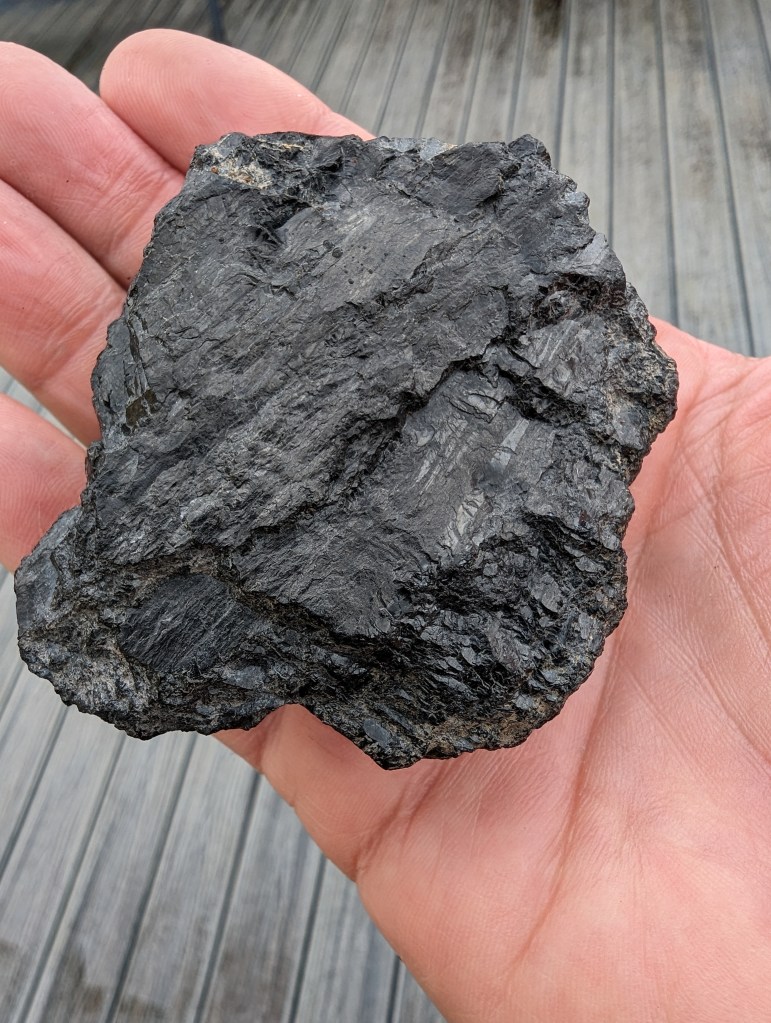
Below: Coal from the Hughes Vein above White Rock. A lustrous black coal that shines like a jewel. You can see the layers of harder vitreous coal that were often the source of better quality fires. The nature of layers in the coal was only finally understood in the early 1900s by Dr Marie Stopes, Britain’s pioneering palaeobotanist.
 Nigel Robins