Heritage Data Requirements

Nigel A Robins (2022) Heritage digital asset management data requirements. Zenodo. doi:10.5281/zenodo.6912783. https://zenodo.org/records/6912783

This is my work list for the Heritage Data Requirements Strategy for the Palace of Westminster Restoration and Repair. This is an outline of the work, most of which was completed. This evolved into a fairly detailed Heritage AIM, although the final execution of any plan was never completed.

This script provided the basis for several other projects that were perhaps more successful, or at least easier to work alongside.

Analysing the ‘as-is’ situation, via intensive and sometimes exacting canvassing and fieldwork, highlighted many problems with current cataloguing standards and the extent of deployment of systems and staff capabilities (the current minimum inventory standard of core information for Axiell Emu). All very difficult challenges. The original data fields (Data fields on the card box system) were too focused on legacy data and staff skills from earlier decades. The recognition of what HBIM users could need (HBIM Users could need, Business Need) was difficult for conservation staff who were worried about job security.

After the BA fieldwork, some alternative schemes were mooted (New Scheme?). A certain amount of tension emerged between current users of Spectrum 5.0 and the IT managers (who knew very little about Heritage CMS). A decomposition of Spectrum 5.0 was essential to highlight exactly where issues with data security and staff attitudes were likely to clash. At this point, I thought it advisable to introduce BIM elements (Semantic Information Levels). This was an attempt to establish consensus on what was needed. IT staff were poorly grounded in the realities of building conservation and found it challenging to understand concepts such as Levels of Detail, including discussions of scale.
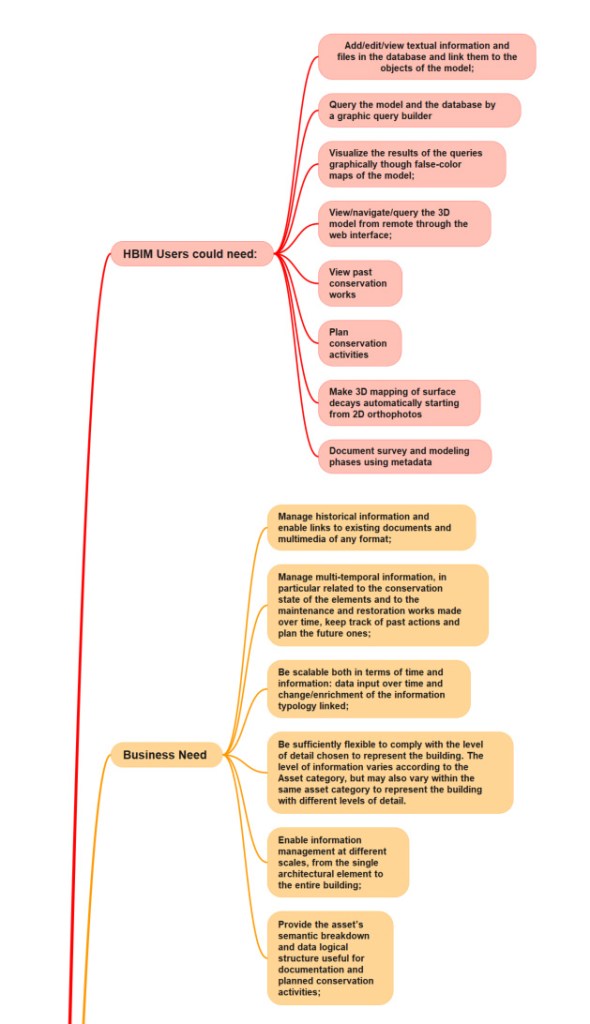
Above: Extract of Heritage Data Needs. Click for full document.

Continued canvassing and fieldwork led to identification of a pick list of data fields (Data Fields). Decomposition of data fields resulted in a scratch list of risks (Risks) which proved pleasingly accurate when I was able to discuss with other institutions and organisations.

Above: The initial risks which were subsequently enlarged into a risk register. Click for the full document.

Metadata proved a challenge as agreeing a helpful starter list was remarkably difficult. Again, much of this was due to a lack of experience amongst IT staff who remained blissfully unaware of FISH (https://heritage-standards.org.uk/) or Getty AAT.

Finally, Use Cases were completed (Potential Use Cases). The initial work was via a set of personas, again some of these concepts were novel to staff and great care had to be taken to introduce concepts gradually. The detailed use cases were assembled using conventional requirements gathering and design definition processes (via BABOK sec. 7 etc.).
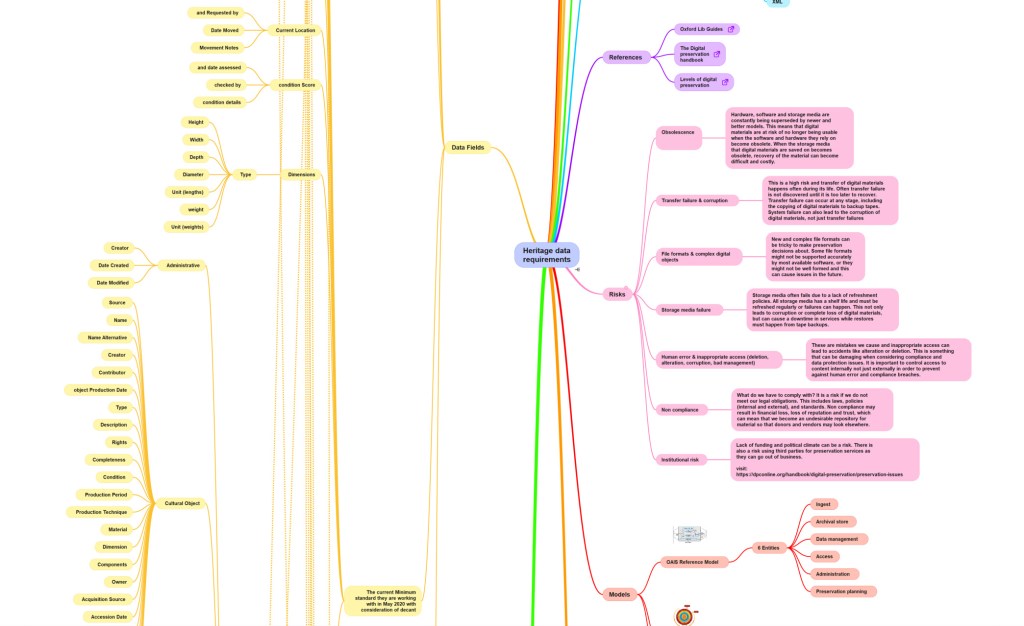
Above: Extract from Heritage Data click for the full document.

Saving the Environment: The importance of Information

When I worked for the Government, I did some tours of duty in environmental activities. Over the years, I monitored programmes on the health of Honeybees, parks protection in Greenwich’s ancient woodlands, Restoration of the environment in the Olympic site in East London, and several small conservation programmes on security sites for the MOD, where fencing things off from the general public did wonders for the local biodiversity. In all of that, I learned that data and information are vital. Far too often I heard the comment ‘there’s nothing there!’, often from gentlemen in their fifties whose only interest in nature was how to kill it or cut it down. When I got to a position of some influence, I could slow down or even reverse developments by insisting on a good quality ecological survey before any construction work. Sometimes, this was deeply unpopular as the construction industry usually has little interest in conservation or environmental care…what we see of due diligence by building firms is there because the Law forces them. This will definitely be an issue in Cilfái with the Skyline development. That tourist firm will promise anything in the planning permission stage but quietly ignore it in the building phase, knowing very well that Swansea Council does not have the resources to monitor and enforce anything. We as volunteers will need to monitor the destruction to try and ensure it is kept to the promised minimum. In December 2022, I prepared the first of a series of ecological protection documents based on my time in Whitehall. The key one is called an Ecological Constraints and Opportunities Plan (ECOP for short). I did one for Cilfái based on what we knew at the time. It proved quite popular and still is, judging from the large number of downloads it still gets from all over the country. Eventually, the ECOP evolved into the second book Cilfái: Woodland Management and Climate Change on Kilvey Hill, Swansea. I published all my survey notes and plans going back over about ten years of tree and animal survey, including all my work on the Hill. So, the book has an explanation of the data covering the Hill and lists of bats, birds, plants and animals I found or saw presence of. I also included the wonderful observations made by Carl Squires over many years of walking the Hill. I also added some of my Climate Change risk analysis from my time working for UK Parliament. Below: A mash-up of some of the Cilfái data from my surveys and explorations.  It is complex because ecology always is. The red dots are dead or dying trees, the dotted lines and light green stripes are areas for better bird habitat, Yellows and oranges are different types of open land, and darker greens are the Forestry Commission plantation trees. The red lines show the ghost of the coming area of Skyline destruction.