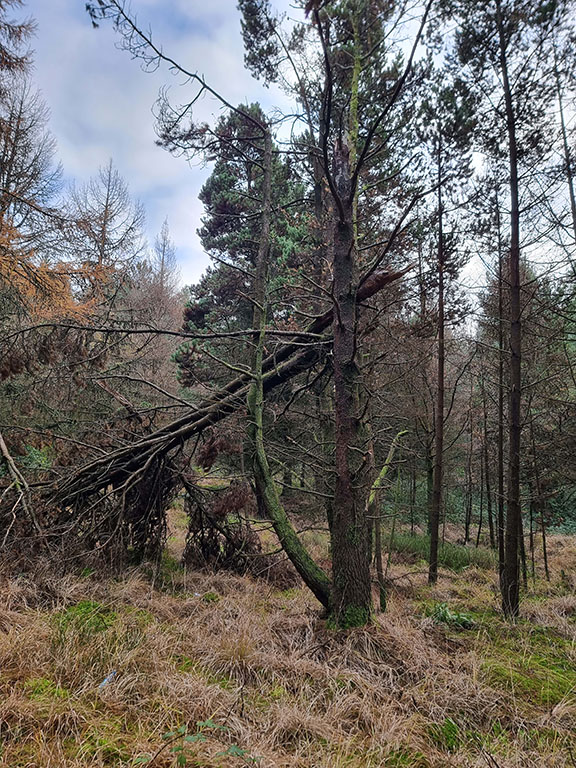
As Climate Change accelerates, the conifers are increasingly susceptible to higher windspeeds and many trees will snap forming ‘snags’ such as this one near the Steam Engine Spring.
Snags allow insects, birds, and bats into holes and crevices in the dying wood providing much needed habitat. Where it is safe to do so, features like this must be maintained.
Dead wood is a vital part of biodiversity and a recovering ecosystem. Wherever possible, we don’t ‘tidy it up’ or sell it for firewood as the Penllergare Trust used to do.
One of the reasons we know so little about the abundance or distribution of bats is the general technical difficulty of surveying and recording where they live and where they hunt. Nationally, the effort to monitor the bat population is significantly bolstered by the invaluable contribution of volunteers. Their dedication, although often underappreciated, plays a crucial role in our understanding of bat populations. However, this reliance on volunteer work, while commendable, is not without its challenges. The situation is further complicated by the need for specialized equipment and training. Although bat surveys have become a regular requirement for planning permission, the surveys remain expensive and knowledge is considered commercial and rarely shared, making understanding of bat distribution even more complex. Using specialist recording equipment means the data files for bat surveys can become very large very quickly, although the advantage is that the data is available for further analysis and verification.
I trained as a bat surveyor in the Thames Valley, where University researchers waxed lyrical about the high densities of bats along the river. One warm night we went out and didn’t detect a single one. That has never happened to me on Cilfái, where bat presence can be staggering on many nights.
Bat surveys have become high cost as surveyors seek to extract as much income from the work as possible. It is unfortunate, as much needed information then becomes restricted or unshared. That greedy attitude led me to share as much as I have on the bat presence on the hill in the second Cilfái book. Cilfái: Woodland Management and Climate Change on Kilvey Hill, Swansea.
On Cilfái, I use a combination of a handheld detector and automatic recorders, which give me a sample of several nights at various locations. This lets me hear the bat calls as they hunt and analyse the recordings at home. I use the classic handbook for techniques Jon Russ wrote (Russ 2012). I use Anabat Express (or equivalent) passive bat recorders and process the data with Anabat Insight Version 2. Over time, this gives me an understanding of the ‘hotspots’ of activity across the hill. I only get snapshots of what is happening, and I cannot realistically project what I know into the overall picture of bats on the hill. That will take a few years. I can assume that our ‘Year Zero’ in 1970 had no bat presence and that everything I see and hear in 2023 is the product of fifty years of recovery. However, realistically, the woodland only began its recovery in the mid-1990s.
The hotspots on the hill are where the food is. Generally, these are the open spaces where previous burning or wind damage has opened up the forest canopy and allowed a wider range of native plants to prosper. Some of these open spots are also good for birdlife. On a warm autumn evening, the air in the hotspots is thick, and flying insects attract the bats. I have evidence of a large presence of Common Pipistrelle (Pipistrellus pipistrellus) and Noctule (Nyctalus noctula). It is possible that hidden in my recordings is some evidence of the Brown long-eared bat (Plecotus auritus), only further data collection will confirm.
Although I can track and monitor activity, it remains immensely difficult to understand hibernation and roosting sites. I am slowly building up a library of bat presence data across the hill.
Russ, John. 2012. British Bat Calls: A Guide to Species Identification (Exeter: Pelagic).
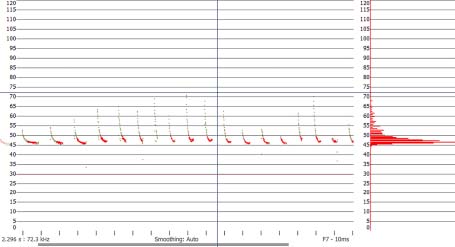
Below: Although it looks a bit technical, it is the nature of bat survey work that we prepare this kind of evidence. The land above Foxhole and the Glade is very busy with bats and clearance of trees will definitely cause problems for the population that has re-established up there. On the night this recording was made I had hundreds of similar records. You can see more evidence in the Cilfái book.
This is a recording of a Common pippistrelle hunting on the woodland edge above Foxhole in September 2023. Temperature above 20 Celsius (Analook F7) compressed with split-screen option Cycles, showing the characteristic call shape of a hunting pippistrelle.
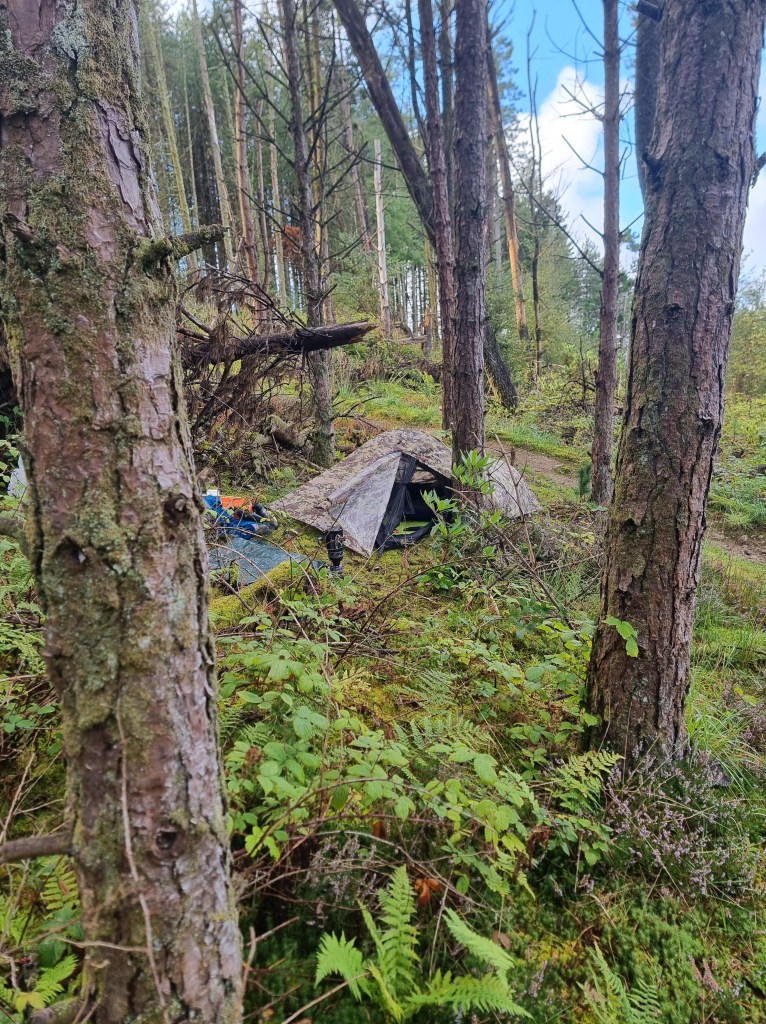
Below: Me bat surveying on the threatened land above Foxhole September 2023
One of the big threats to a recovering woodland is habitat fragmentation. This is a huge problem for wildlife in Wales. I covered this in the second Cilfái book (Cilfái: Woodland Management and Climate Change on Kilvey Hill, Swansea). It is reasonable to assume that a big woodland is better for biodiversity and the environment than a small one. After two thousand years of habitat destruction in Wales we are left with one of the poorest environments in Europe. The woodlands we have are constantly being threatened with further subdivision as roads and houses are built in ever remote or pictureesque areas.
The woodland that has recovered since 1970 will now be fragmented further by the foreign tourism development which will cut through the centre of the biodiversity area. The impact on the recovering wildlife will be immense. The impact will be change and a reduction in opportunities for wildlife and plants on the vital central area of the hill. Fewer opportunities to live will result in fewer species and reduced biodiversity. That is habitat fragmentation.
In numbers, the 102 hectares of woodland and open access space we now have on Cilfái will be reduced to about 29 hectares of woodland. As a comparison, the country park of Penllergare (near Junction 47 on the M4), has about 67 hectares of mixed woodland and Singleton Park has about 11 hectares of (badly fragmented) woodland. So, yes, the loss of Cilfái woodlands is significant.
It may not necessarily be all doom and gloom. Swansea Council and the tourism developers will hopefully be obliged to produce a series of habitat recovery and restoration plans for various tracts of land that may be leased to the Company but will not be built upon. I assume pressure will be put on Welsh Government to provide a large sum of money for ‘native’ woodland restoration. As everybody who has a say is committed to cable cars and adventure tourism, I’m sure the money will come…it has to.
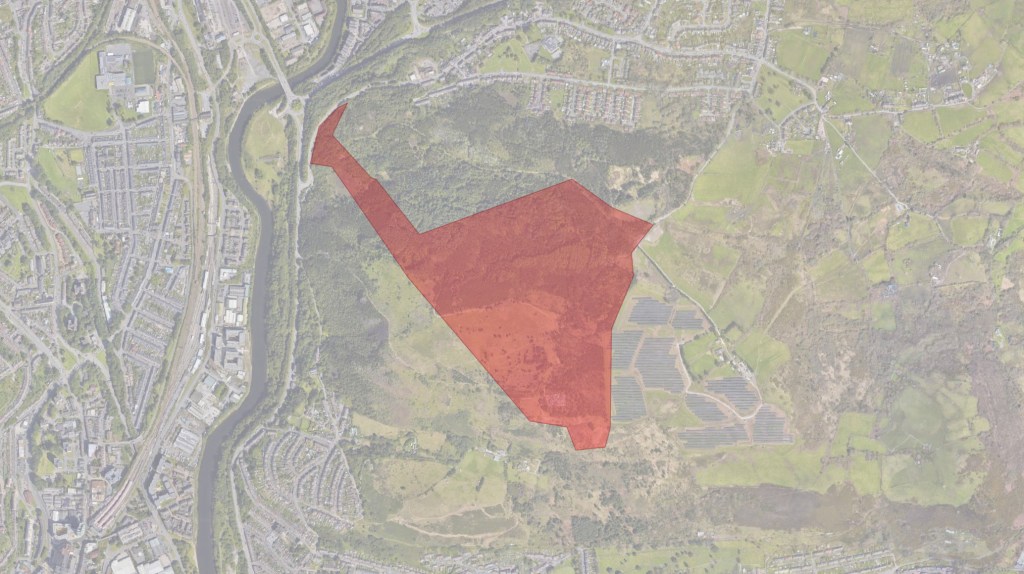
Below: The area of concern on Cilfái is coloured red here. A large chunk of this is the original Forestry Commission land (now NRW). A mixture of coniferous forest, fire damage and fantastic natural regeneration. Full of bats and birds. The contract ecologists bought in by the tourism firm will seek to devalue the quality of the environment and frame it as a place that is worthless and ripe for redevelopment.
When I worked for the Government, I did some tours of duty in environmental activities. Over the years, I monitored programmes on the health of Honeybees, parks protection in Greenwich’s ancient woodlands, Restoration of the environment in the Olympic site in East London, and several small conservation programmes on security sites for the MOD, where fencing things off from the general public did wonders for the local biodiversity.
In all of that, I learned that data and information are vital. Far too often I heard the comment ‘there’s nothing there!’, often from gentlemen in their fifties whose only interest in nature was how to kill it or cut it down. When I got to a position of some influence, I could slow down or even reverse developments by insisting on a good quality ecological survey before any construction work. Sometimes, this was deeply unpopular as the construction industry usually has little interest in conservation or environmental care…what we see of due diligence by building firms is there because the Law forces them. This will definitely be an issue in Cilfái with the Skyline development. That tourist firm will promise anything in the planning permission stage but quietly ignore it in the building phase, knowing very well that Swansea Council does not have the resources to monitor and enforce anything. We as volunteers will need to monitor the destruction to try and ensure it is kept to the promised minimum.
In December 2022, I prepared the first of a series of ecological protection documents based on my time in Whitehall. The key one is called an Ecological Constraints and Opportunities Plan (ECOP for short). I did one for Cilfái based on what we knew at the time. It proved quite popular and still is, judging from the large number of downloads it still gets from all over the country. Eventually, the ECOP evolved into the second book Cilfái: Woodland Management and Climate Change on Kilvey Hill, Swansea.
I published all my survey notes and plans going back over about ten years of tree and animal survey, including all my work on the Hill. So, the book has an explanation of the data covering the Hill and lists of bats, birds, plants and animals I found or saw presence of. I also included the wonderful observations made by Carl Squires over many years of walking the Hill. I also added some of my Climate Change risk analysis from my time working for UK Parliament.
Below: A mash-up of some of the Cilfái data from my surveys and explorations. It is complex because ecology always is. The red dots are dead or dying trees, the dotted lines and light green stripes are areas for better bird habitat, Yellows and oranges are different types of open land, and darker greens are the Forestry Commission plantation trees. The red lines show the ghost of the coming area of Skyline destruction.
In the early spring of 1941, two people followed in the footsteps of the bomb disposal teams, firefighters and council workers as they worked through the shattered ruins of Swansea’s blitzed town centre. The first was artist Will Evans, who was keen to document the chaos of ruins and the loss of the heart of the town. Evans left a legacy of vivid watercolours that are well-known. However, the other person was naturalist M. H Sykes, who is less well known. Sykes was a member of the Swansea Scientific and Naturalist Society (SSFNS), and she was a competent botanist with a keen eye.
The ’Three Nights’ Blitz’ inflicted grievous damage on Swansea. The air raids and the ensuing fires created over 16 hectares of broken buildings and rubble at the heart of Swansea. It must have been horrendous.
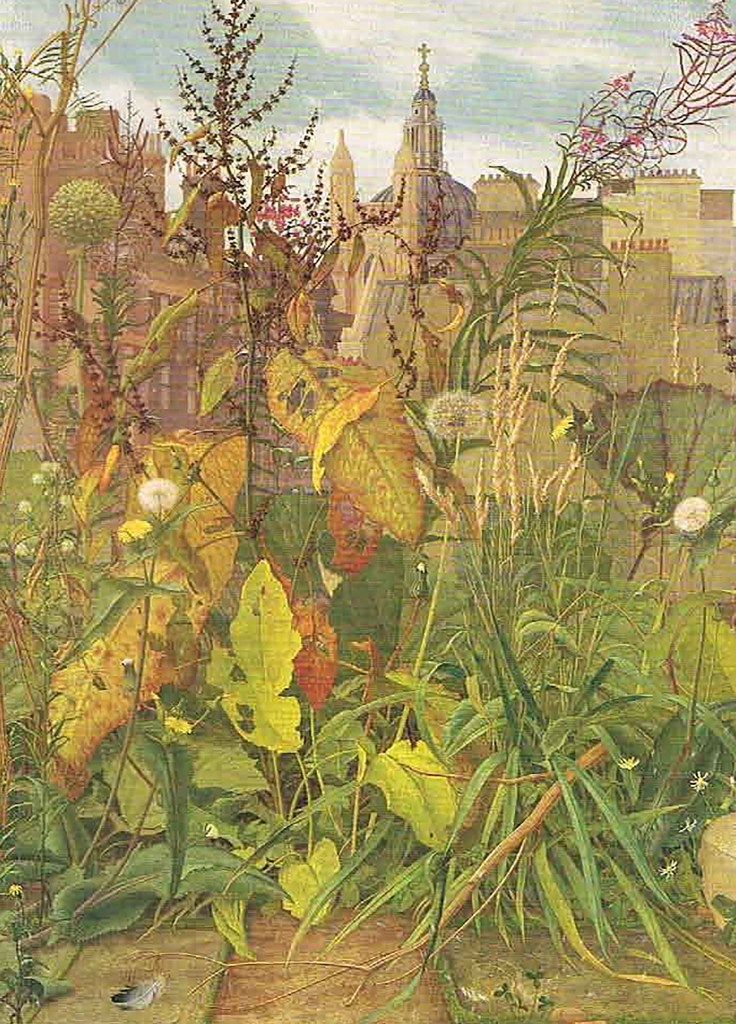
In 1941, across the country, botanists realised that the blitzed landscapes would soon offer a unique opportunity to witness a comparatively rare phenomenon. This was the emergence of ‘spontaneous vegetation’, the pioneer plants that would arise on the broken brick and rubble. The phenomenon was first recorded amongst the ruins of London after the Great Fire in 1666. In 1941, expanses of ruins reappeared in London and blitzed towns such as Swansea along with the newly christened ‘bombsite flora’.
My article on the bombsite floras of Swansea is forthcoming in the next edition of Swansea History Journal published by the Royal Institution of South Wales http://www.risw.org/publications.htm
Coming soon.
Image: Eliot Hodgkin was one of the very few artists attracted to the contrasts between the brutality of the war ruins and the vegetation that covered them. This is an extract from one of his most notable blitz flora studies of ruins at St Paul’s in London in tempera. Hodgkin was a master of detail and captured the shape and form of many of the blitz plants at their best. The original is in the Imperial War Museum collection.

 Nigel Robins