Most of the documents and other evidence about how Swansea coped during the war have not survived. As I said earlier, we have a lot of photographs, but understanding how people managed is harder to explore. My earlier post discussed the role of the ARP Controller Hywel Lang Lang-Coath. I looked through the available evidence to reconstruct the communication processes people needed to work through the awful problems the bombing caused.
One of the most important roles was the Air Raid Warden, who was expected to act as first-line help, assess the problems a bomb or fire had caused and ensure both the police and the ARP control knew about the problem. Wardens had to be special people, confident, capable, and able to prioritise problems on the spot. Nearly twenty per cent of wardens were women.
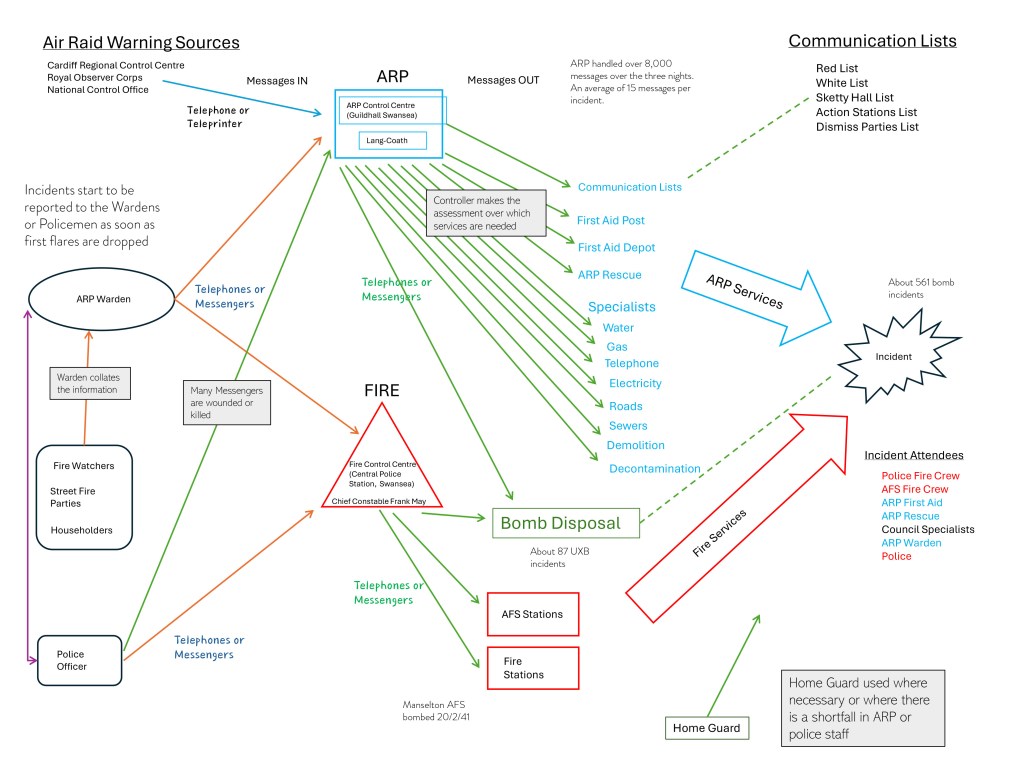
Below is my reconstruction of the communication flows between the warden and the fire control at Swansea Central Police Station and ARP Control in the Guildhall. You can see how complex the ARP role was and how many decisions Lang-Coath had to make. Once the telephone lines were destroyed, all messages were carried by teenagers on bikes or motorbikes, or even just running through the bombs and fires. A number of Messengers died trying to get their messages to the Guildhall.
Above: My reconstruction of the communications during the three nights’ blitz of February 1941. The blue shows the complexity of all the services that had to be sent to deal with a bomb explosion or fire.
Various social media pages regularly post pictures of the Swansea Blitz damage. What is less well-known is how Swansea Council dealt with the disaster. As the local authority, it fell to the Council to lead the town’s civil defence. Whereas the police and fire brigade were already recognised in their duties, the new type of war on civilians needed a new set of approaches and a new organisation…Air Raid Precautions (or ARP).
Traditionally, the local authority’s head of administration, often called the Town Clerk, was appointed as the Controller of ARP. In Swansea, this esteemed role was held by the renowned Hywel Lang Lang-Coath. With over thirty years of experience and an intimate knowledge of Swansea, Lang-Coath, originally from Bridgend, wielded significant influence over the County Borough’s administration.
When the bombing came, Swansea’s Chief Constable dealt with the policing and fires, but Lang-Coath had to oversee everything else. This meant that he had to make the decisions on water supply, gas mains, telephone repairs, electricity cables, roads, sewers, demolition of bomb-damaged buildings, decontamination of food supplies, feeding bombed-out families, issuing emergency ration books and sending ambulances and first aid to bombed areas of Swansea. Many Swansea councillors didn’t like him and were jealous of his control and power. They wanted to be part of the process. Lang-Coath refused and focussed on saving lives and looking after the bomb victims and prioritised the emergency services to support people at the worst time in their lives. Many people can be grateful that Swansea councillors were prevented from playing petty party politics at the worst point in Swansea’s recent history.
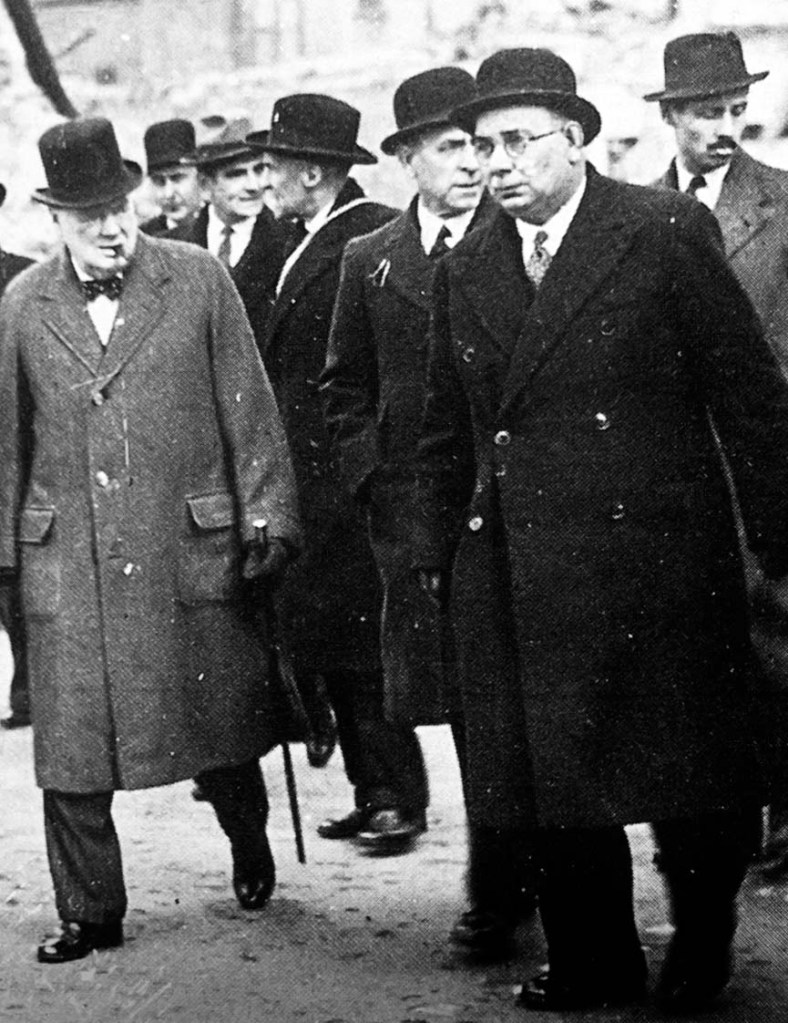
Above: Lang-Coath seen between Winston Churchill and the Mayor Tom James during his visit to the blitzed areas on 11 April 1941. The visit was pure political theatre for Churchill, and his entourage included the newly installed American Ambassador John Winant and Averell Harriman who was President Roosevelt’s ‘Aid for Britain’ director. The devastated scenes were used by Churchill to show the Americans the reality of the bomb attacks and both men submitted their impressions directly back to the President. Lang-Coath is in a typical pose, looking off-camera probably checking the whole event was going smoothly. (Printed source).
Just starting a new research project on the 1940s incendiary bomb attacks on Swansea. Although a few books have been written on wartime Swansea, the reliability can be suspect because of the lack of documentary records. The primary source is still John Alban’s keystone work on some of the archival sources that survived (Alban 1994). The response of a local authority to the challenges of an intense air attack varied widely across the country and has been the subject of a growing body of research, such as this thesis from 2020 (Wareham 2020)In this study, the author examines Cardiff Council’s response to wartime life and air attacks. It’s a mixed bag of successes and failures as the Council struggled to meet the challenges of maintaining services under air attacks. Some local authorities did little to meet their responsibilities, and civilians have died in various towns where bomb shelters, services and food supplies were poorly managed. As historians, we are not helped by the limited nature of the official history of civil defence, which barely investigated matters outside London (O’Brien 1955).
Swansea’s air raid precautions and defences worked well, and senior members of the Churchill government and officials of various agencies praised the efficiency of their response. However, local Swansea politicians criticised them and insisted on complaining that the ARP staff did not sufficiently recognise their role as politicians even amid incredible tragedy of 1941 (Alban 1994: 59–61).
Understanding the situation faced in the Blitz of February 1941 relies heavily on understanding the role of the ARP Controller, who led the entire local authority response to the bombing. For Swansea, this was the Town Clerk Howell Lang Lang-Coath. He was a veteran of over thirty years of Swansea’s local government processes, but at the end of his career, at sixty-six years old, his leadership and authority did much to save lives during and after the raids.
Understanding his role and effectiveness relies on understanding his communication flows and processes as he managed the ARP response from his control room in the Guildhall in Swansea. The dearth of contemporary records has meant I have had to reconstruct the communication flows from a wide range of local sources. Here’s my first pass through the information. Imagine having a small team of secretaries having to deal with over 8,000 messages for 561 incidents and controlling First Aid, Alarms, ARP staff, Rescue, Ambulances, Gas, Electricity and Water supply in an era where communications were unreliable telephones and a network of messengers in cars and on bicycles (often teenagers).
The police forces of the country were unwilling to share or modify their status and their responsibilities even during the hardest times of the war and a dual response method was imposed on the country where ARP and Fire services were managed separately. The success of this approach depended on the personal qualities of the ARP Wardens. You can see this on the diagram with different communication flows to ARP Control (at The Guildhall) and the Fire Control Centre (at Central Police Station).
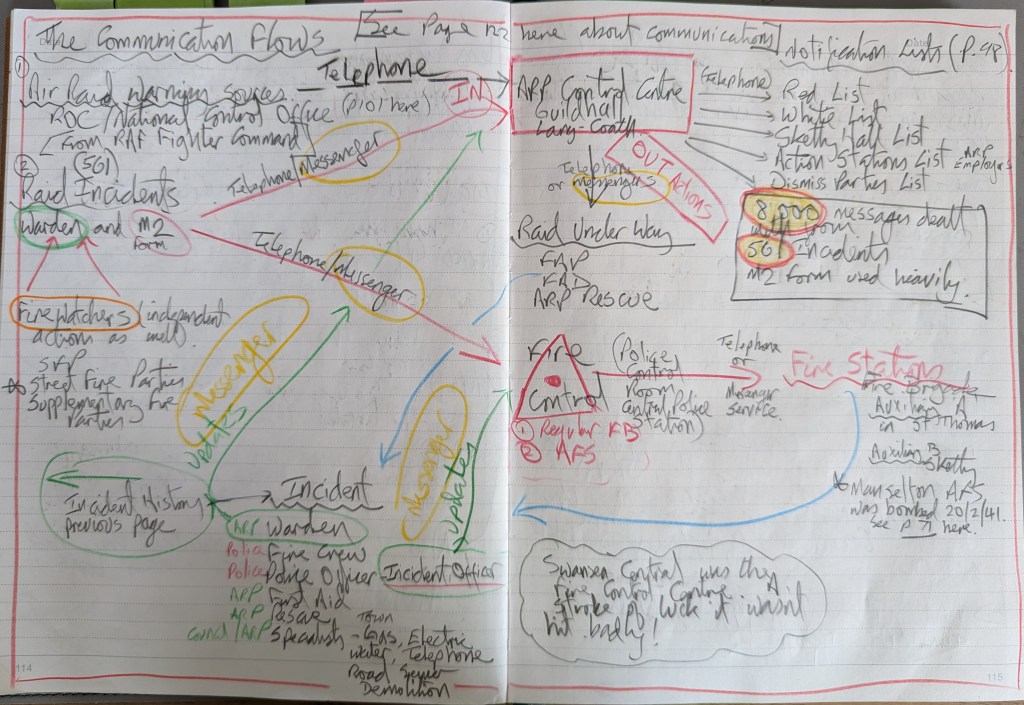
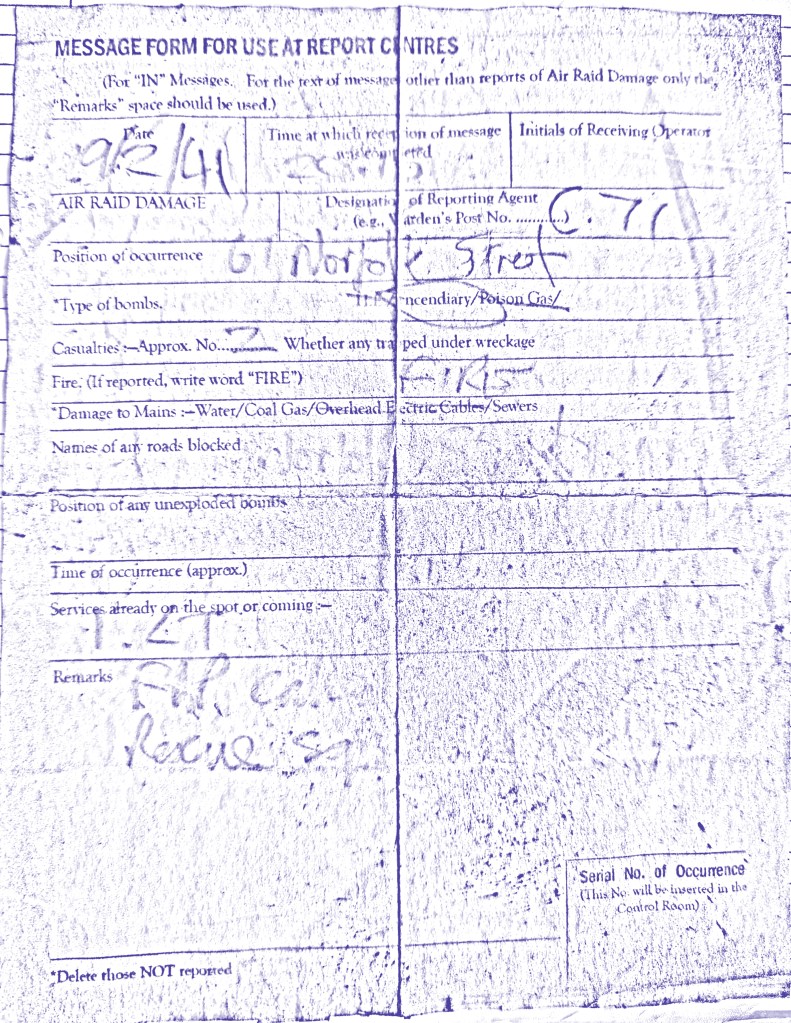
One of the surprises was the efficiency of the ARP M2 Reporting Form which allowed structured information at the correct level of detail to be quickly transmitted or passed to the staff andv the ARP Control Centre.
Alban, J.R. 1994. The Three Nights’ Blitz: Select Contemporary Reports Relating to Swansea’s Air Raids of February 1941, Studies in Swansea’s History, 3 (Swansea: City of Swansea)
O’Brien, Terence H. 1955. Civil Defence (London: HMSO)
Wareham, Evonne Elaine. 2020. ‘Serving the City: Cardiff County Borough in the Second World War’ (unpublished PhD, Cardiff: Cardiff University)
Above: The story so far on understanding the relationships between ARP Warden, Police, AFS, and the ARP Control Centre.Above: A rough copy of the ARP M2 Reporting Form which was instrumental in allowing effective incident communication. People gave their lives moving these forms through the streets of the blitzed town in February 1941.
 Nigel Robins