More on Swansea Valley photogrammetry

For many projects in restoration and landscape, there has been a tendency to overemphasise gee-whiz graphics at the cost of scholarly historical analysis. The project here puts the technology back where it belongs, in the background of support for investigation and analysis.

The rapid development and delivery of this project is almost complete. The proof of concept of quick and cheap photogrammetry is complete, and we explored various features of various sizes. Budget constraints in the broader London-based programme meant that the planned exploitation phase won’t take place there. The plan was to explore some large, immoveable sculptures and statues at risk of damage by surrounding building renovation. Instead, I’ll work in South Wales on a series of local history and geography projects.

Costs were remarkably low (which we believed they would be). It is satisfying to use new technologies to reduce costs and fight against the gradual cost inflation and scope creep of using these types of technologies in small history or geography projects. In researching the business case for this, I learned of several local authority projects where high costs for archaeological surveys, often incorporating expensive drone surveys and extraordinary labour costs, skewed project delivery budgets almost to the cancellation of the projects. I experienced the same issues working on the restoration of the Palace of Westminster, where incredible finances and resources were expended on expensive lidar and photogrammetry products that were who;;y unsuitable for the problems and frequently misled managers into thinking that such products were essential elements of the restoration at RIBA Stages 1 and 2 .

For many projects in restoration and landscape, there has been a tendency to overemphasise gee-whiz graphics at the cost of scholarly historical analysis. The project here puts the technology back where it belongs, in the background of support for investigation and analysis.

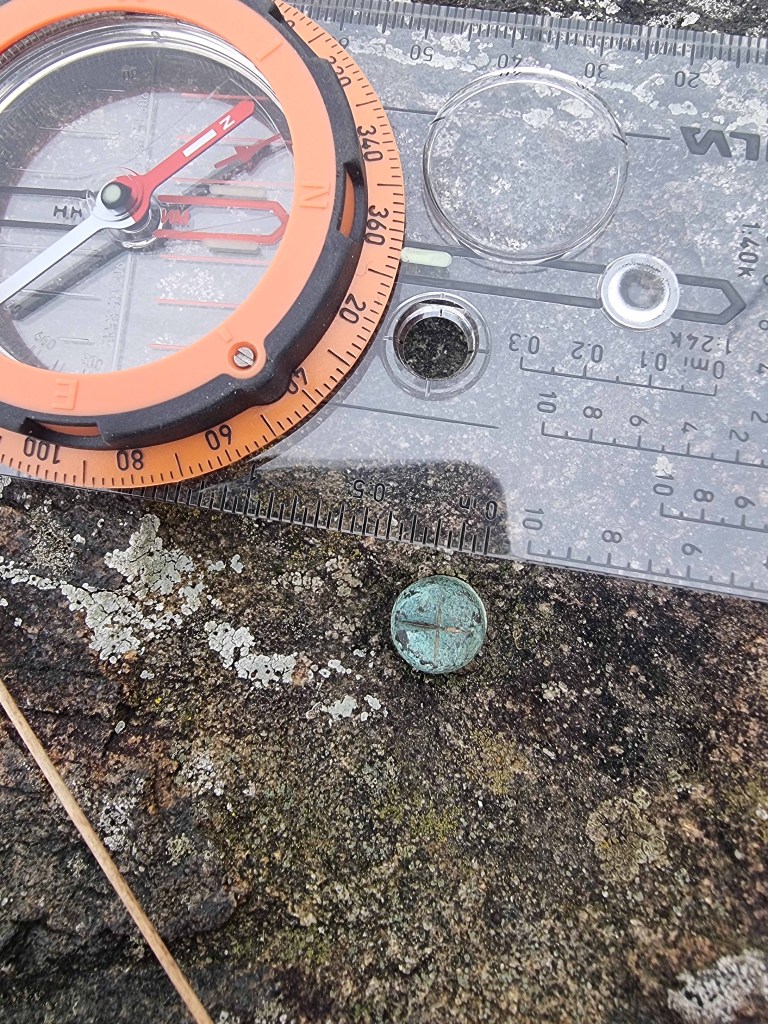
Above: A test scan of a significant rock exposure on Cilfái Hill in Swansea. Upper Carboniferous Pennant Sandstone with a forty-degree dip north. This is an exposure in an area where William Logan and Henry De la Beche discussed the general stratigraphic layout of the South Wales Coalfield. Some of the exposures have copper nails struck into the rock, which may have been part of Logan’s levelling work in the late 1830s. These exposures are at risk of destruction by Swansea Council’s tourism redevelopment of the area, so it is good to get a good scan of them before they are destroyed.
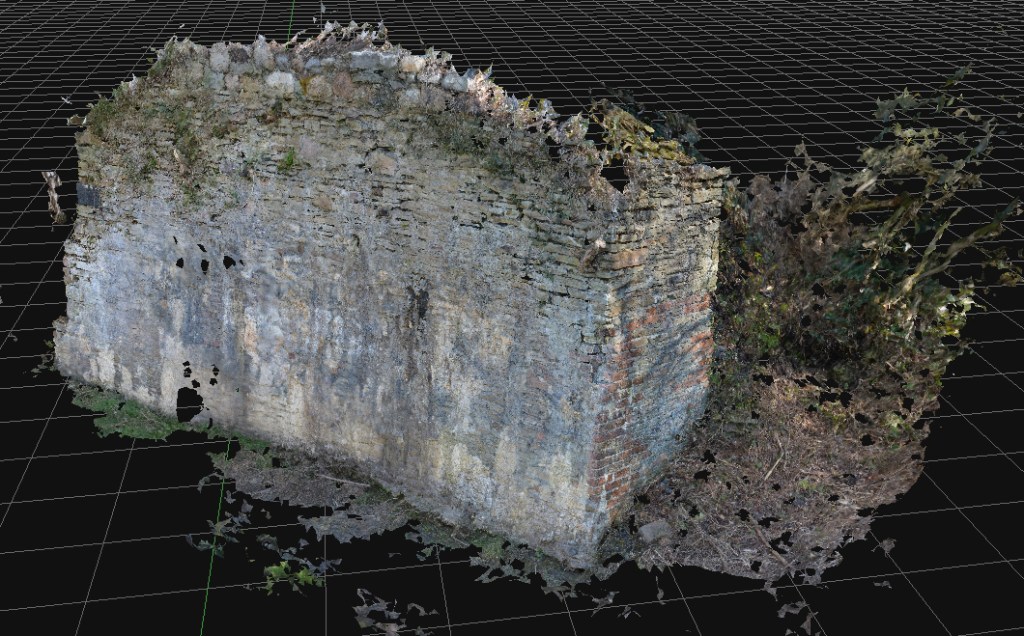
Above: An old coal loading dock in the Lower Swansea Valley, known as a ‘Staith’. Probably dating from the 1740s, this was built to make loading coal into ships in the river easier. The coal came down the east-side tramways and later the canal. This is a scheduled ancient monument but has been neglected by Swansea Council and is now deteriorating. Ironically, the monument’s destruction has been accelerating because of the encroaching woodland and the dumping of industrial waste. This structure is incredibly rare; there may only be two others in Wales, and they are also in the Lower Swansea Valley. Again, this is a low-cost photogrammetric scan taken as an emergency whilst extensive finances are expended elsewhere in the Valley on Council-led projects.

Costs are kept low by avoiding the use of drone technologies, using older and previously-used professional cameras bought cheaply on Ebay, and new software costing a few hundred Euros.

The next steps are researching the history of coal industry structures in the valley, followed by some investigation of some World War Two remains on Cilfái.
More photogrammetric research on small landscape features

The concept of quick and cheap photogrammetry is now proven, and simple work like this can be comparable to expensive archaeological surveys, which cost far more, often a hundred times more than current archaeological firms charge.

As I said earlier, the purpose of this project was a proof of concept on using photogrammetry as cheaply as possible to allow quick and accurate reconnaissance and survey of small features that generally would not be investigated or be too expensive to survey using current high-cost photogrammetry, drone and lidar techniques.

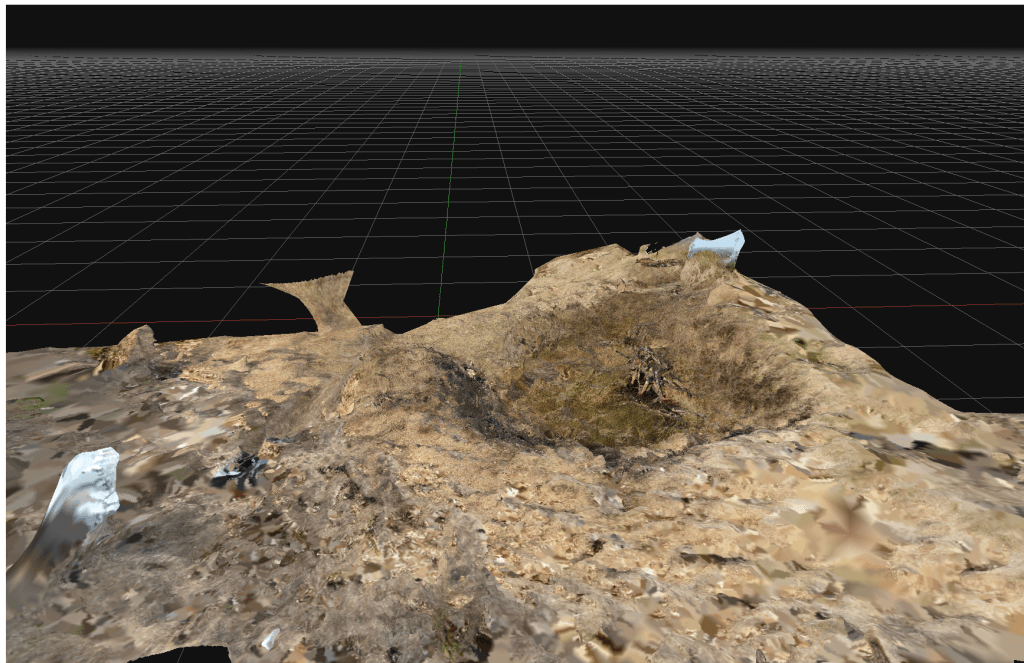
This example is a bomb crater on Kilvey Hill. The crater was most likely created in the January 1941 attack on the town. The crater is from a large calibre bomb (possibly 250kg) that has penetrated some way into the soft, marshy ground and then detonated.

In the 84 years since the detonation, the crater has softened with the crater lip mostly eroded. The crater frequently fills with water and has a different botanical nature to the surrounding grassland. This crater is a local biodiversity hotspot, allowing moisture to be present all year round and providing better protection from excessive temperatures. A large pine in the centre of the crater has died providing a reservoir of dead wood.

Above an extract from an initial 3D model of one of the Kilvey bomb craters, 2025.

The concept of quick and cheap photogrammetry is now proven, and simple work like this can be comparable to expensive archaeological surveys, which cost far more, often a hundred times more than current archaeological firms charge.

Microhistory on Cilfái

These days we are often in a situation where we are forced to rely on the opinions of staff in various organisations to tell us what ‘history’ or ‘ecology’ or ‘biodiversity’ are. In and around Swansea, we have Cadw to judge what is ‘significant’ for heritage, an Archaeological Trust to tell us what is important under the ground, and a host of private companies employed by building developers to tell us what plants and animals are important. Unfortunately all these organisations can be flawed when it comes to understanding what matters to local communities. It is a deeply unsatisfactory situation. You’d expect local politicians to be more in tune with their communities, after all they were elected to do just that. However, the strong whipping of Swansea Labour Councillors over the Cilfái developments shows how impotent local politics actually is in the face of corporate ambitions.

Communities always change and their interests and viewpoints can also evolve. The toppling of the statue in Bristol shows what can happen when frustration with politics boils over. Closer to home, the issues with the General Picton memorials are an interesting response from the cultural sector who sometimes have strong impulses to react to changing community values.

The identification of heritage and cultural features on Cilfái is clearly inconvenient to politicians and tourism developers. The neat packages of the Hafod-Morfa tourist attraction are predictable, grant-friendly, and a big hit with local builders. Not so much the ‘informal’ heritage of Cilfái. The hill is packed with history above and below ground but that won’t matter to Councillors. Features with the unfortunate characteristic of ‘being in the way’ will be dug up, destroyed or removed. It is ironic that a tourism firm from New Zealand (a country that is barely 100 years old) is leading the destruction of our heritage, much older than that little country.

What tends to get lost first are the little things, the things that people enjoy. They often get thrown away because we as residents are told they aren’t significant by the organisations that ironically are there to serve us.

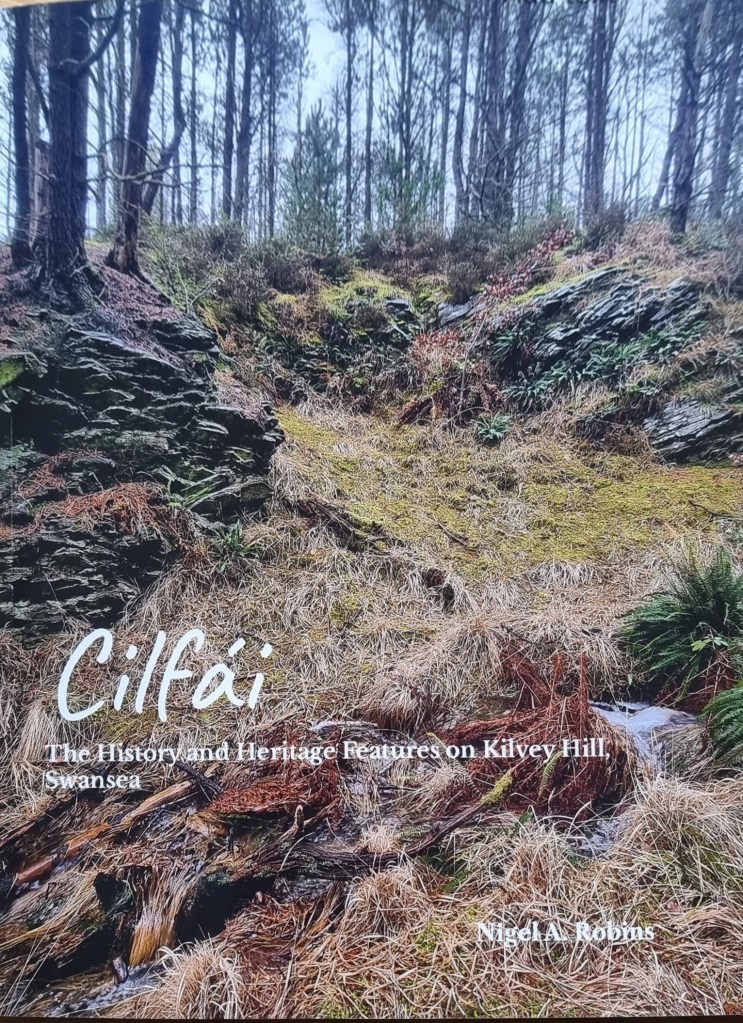
Here’s one that will probably be brushed away by a careless Skyline bulldozer. A little copper nail hammered into a rock in the danger zone. It was probably put there by William Logan as part of the early exploration of coal seams on the hill in the 1820s. I found his notebooks that told me about it. It remains as a little memorial to all the hard work and industry from pioneers in the past. The story is covered in Cilfái: History and Geography and Cilfái: Heritage Features