Castle Gardens: The site of Ben Evans

Although we now know Castle Gardens as an ugly concrete space in the centre of town, that area of land has been central to Swansea’s history for centuries.

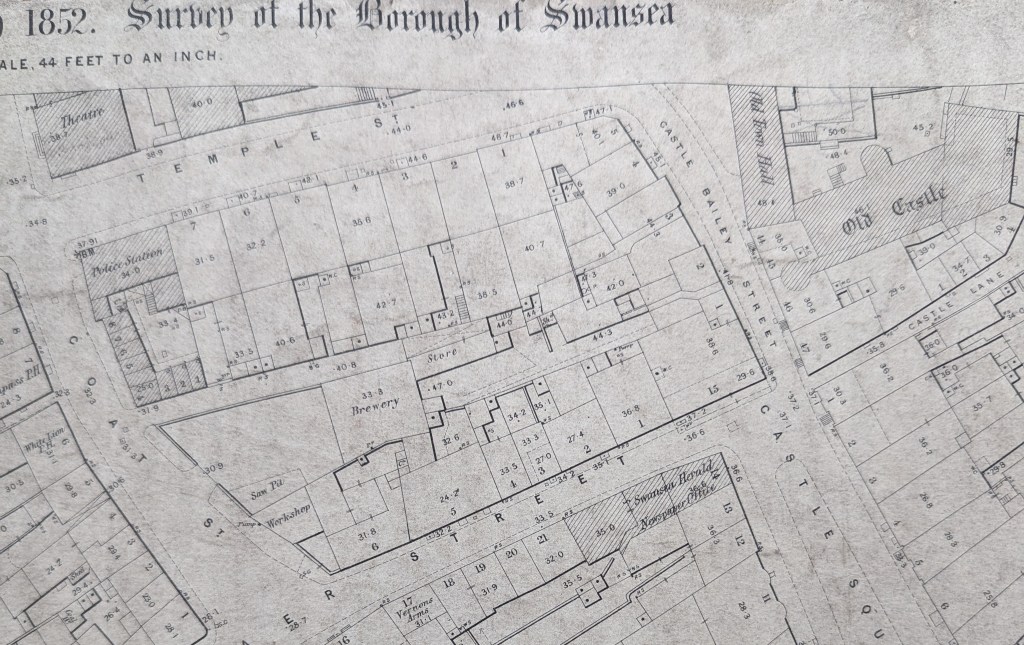
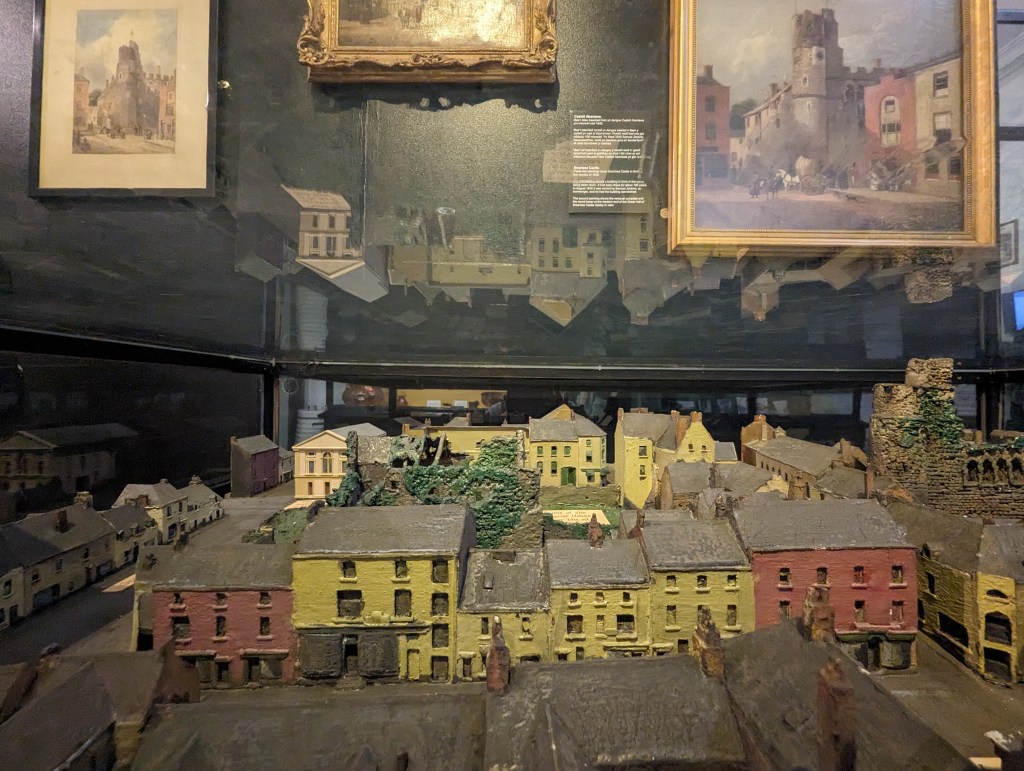
Originally part of the inner ward of Swansea Castle, the space has over the years held many buildings starting with the Plas House built in the 1300s. You can see a fantastic model of the area in Swansea Museum which was made in the 1820s. The streets that defined the Plas House block are part of Swansea’s long history. Temple Street to the north which once held the Three Lamps Inn, Goat Street to the west which held the original police station, and Caer Street to the south, which is (sort of) still there.

Pride of place has to go to Castle Bailey Street to the east which originally was a big space in front of the castle. By the 1890s, the site was the home of the various properties that made up the Ben Evans department store. Understanding the layout and contsruction of the store is an important part of understanding how it caught fire and burned so easily in February 1941.

For the book I reconstructed the various eras of building on the block to understand more about how the space was used. I used methods from the 1940s when architects and fire engineers were reviewing the incendiary attacks on Britain and looking to learn lessons to destroy German towns and rebuild Swansea after the war. Understanding Castle Gardens is a chapter in my book.

You can buy online here: Y Tân (lulu.com)

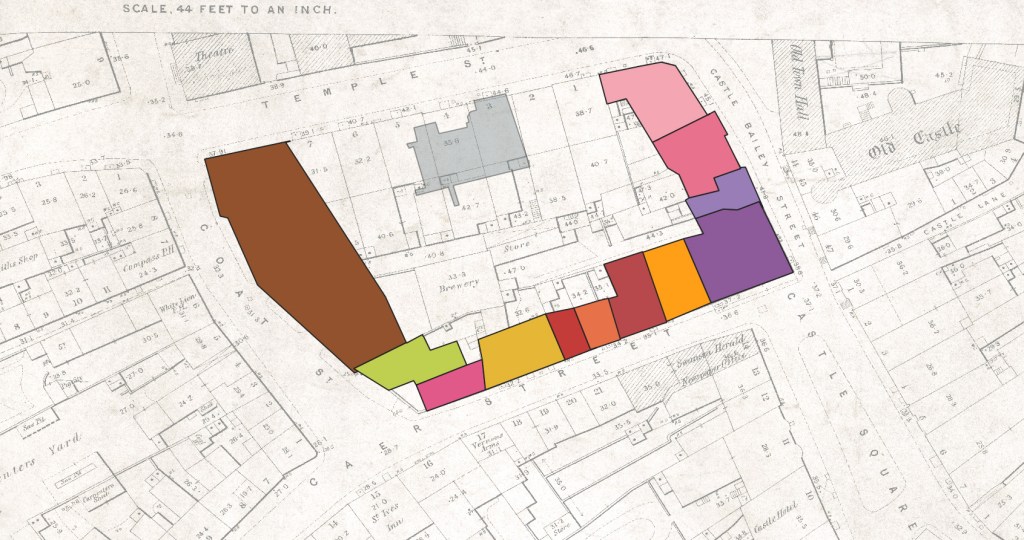
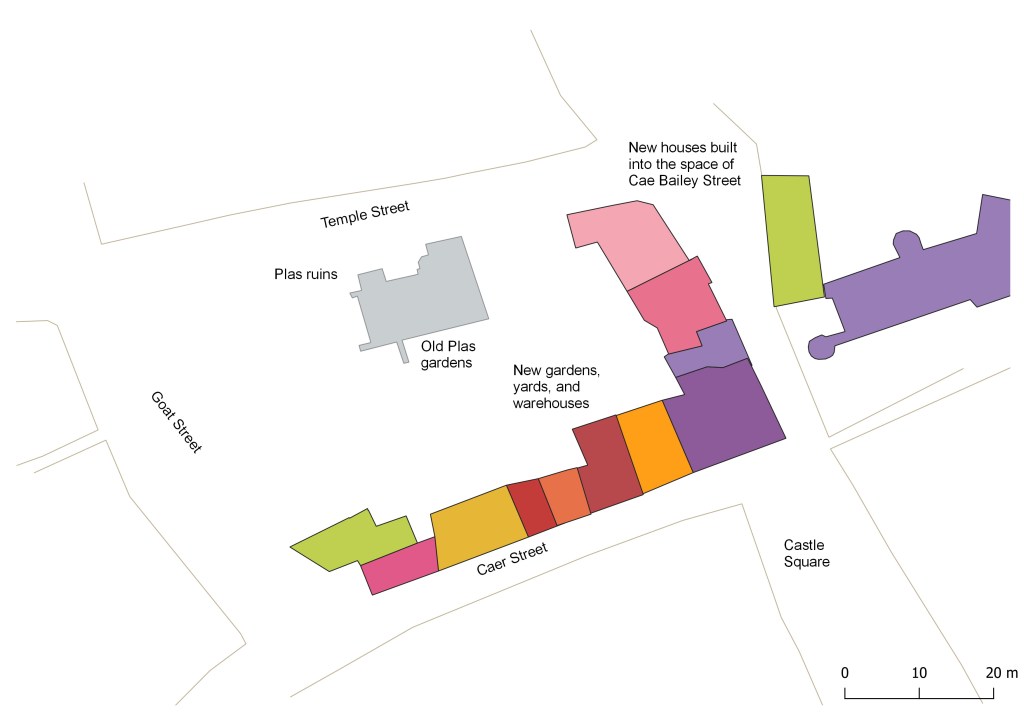
Above: Part of my reconstruction of the Castle Gardens block in central Swansea. By the 1840s, houses and shops were built on Castle Bailey Street and Caer Street. They built around the remains of the house and garden of the Plas House. Eventually, commercial pressures led to the destruction of the Plas and the construction of more houses and shops on Temple Street.
Above: A rare map of the Castle Gardens block in the 1850s.

Y Tân (The Fire): A History of Destruction, Swansea 1941

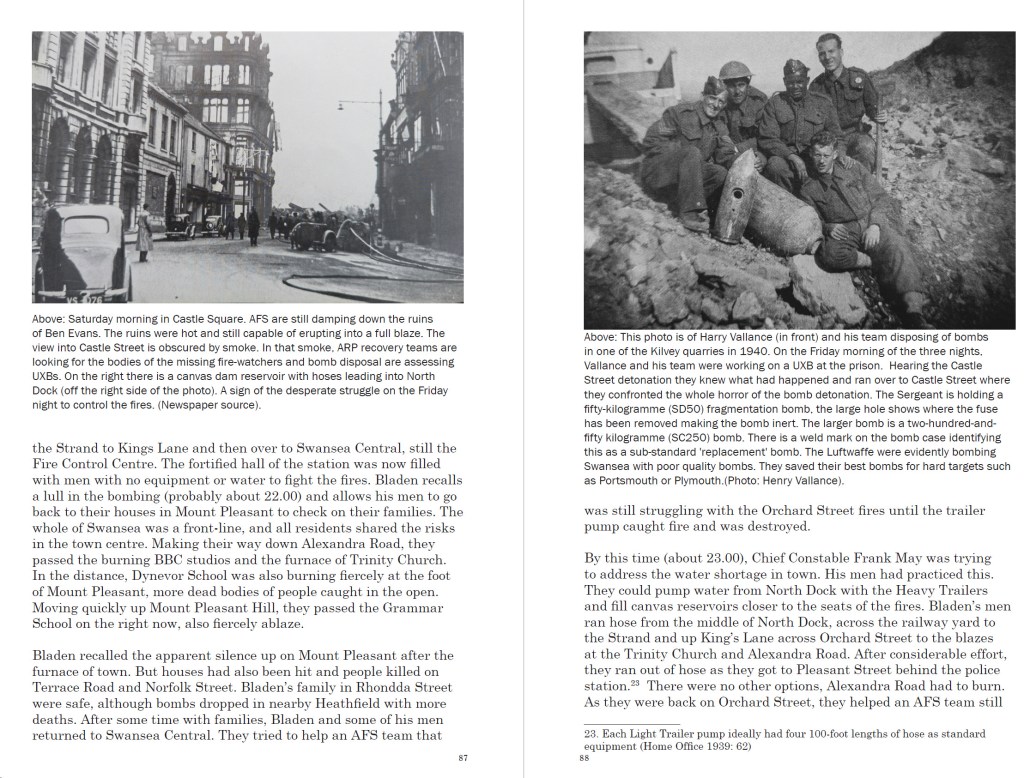
One of my longer-term projects. This originally started as a small article about the death of my grandfather, Jack Bowers. Jack died fighting fires in Castle Street on the third night of the February 1941 bombing of Swansea. It was a family tragedy and coloured the lives of my mother and aunt for the rest of their lives. My research went further and broader as I tried to understand the nature of the air attacks and what happened to people on the ground. I also looked at the history of the rubble that was left, including the history of Castle Gardens and Ben Evans the famous Swansea department store.

Here’s the blurb on the back cover:

“In World War Two, Swansea was regularly attacked by the German Air
Force. The worst attacks were over three nights in February 1941. The
bombs and fires transformed the centre of the town, and the author’s
grandfather was killed as a volunteer firefighter.
This book explores the events of the three nights, the loss of the
author’s grandfather, how the fire was used to destroy the town and the
consequences of the raids for the future of Swansea. Swansea Blitz was
an early example of a firestorm and became a template for attacks on
many European towns and cities in 1942 and 1943.

The author reconstructs the events of the three nights and includes
eyewitness descriptions from some of the people who worked to save
lives and property. The book also includes an analysis of the loss of
the Ben Evans department store and the detailed history of the land
we call Castle Gardens. With technical details of the bombs and
explosives that were used to attack the town and the history of the
bomb disposal teams that worked to save Swansea.


Based on meticulous research this fully referenced book examines the
vulnerability of the town to air attacks, the technical background of
the incendiary bombs, the events of the three nights of terror, the
ecology of the devastated town centre and the aftermath of
rebuilding.”

Details

Publication Date:Aug 5, 2024

Language:English

ISBN9781739353346

Category: History

Pages:160

Paperback Perfect Bound

Interior Color Color

Dimensions

Digest (5.5 x 8.5 in / 140 x 216 mm)

Air Raids and Communication during air attacks on Swansea, 1941

Just starting a new research project on the 1940s incendiary bomb attacks on Swansea. Although a few books have been written on wartime Swansea, the reliability can be suspect because of the lack of documentary records. The primary source is still John Alban’s keystone work on some of the archival sources that survived (Alban 1994). The response of a local authority to the challenges of an intense air attack varied widely across the country and has been the subject of a growing body of research, such as this thesis from 2020 (Wareham 2020)In this study, the author examines Cardiff Council’s response to wartime life and air attacks. It’s a mixed bag of successes and failures as the Council struggled to meet the challenges of maintaining services under air attacks. Some local authorities did little to meet their responsibilities, and civilians have died in various towns where bomb shelters, services and food supplies were poorly managed. As historians, we are not helped by the limited nature of the official history of civil defence, which barely investigated matters outside London (O’Brien 1955).

Swansea’s air raid precautions and defences worked well, and senior members of the Churchill government and officials of various agencies praised the efficiency of their response. However, local Swansea politicians criticised them and insisted on complaining that the ARP staff did not sufficiently recognise their role as politicians even amid incredible tragedy of 1941 (Alban 1994: 59–61).

Understanding the situation faced in the Blitz of February 1941 relies heavily on understanding the role of the ARP Controller, who led the entire local authority response to the bombing. For Swansea, this was the Town Clerk Howell Lang Lang-Coath. He was a veteran of over thirty years of Swansea’s local government processes, but at the end of his career, at sixty-six years old, his leadership and authority did much to save lives during and after the raids.

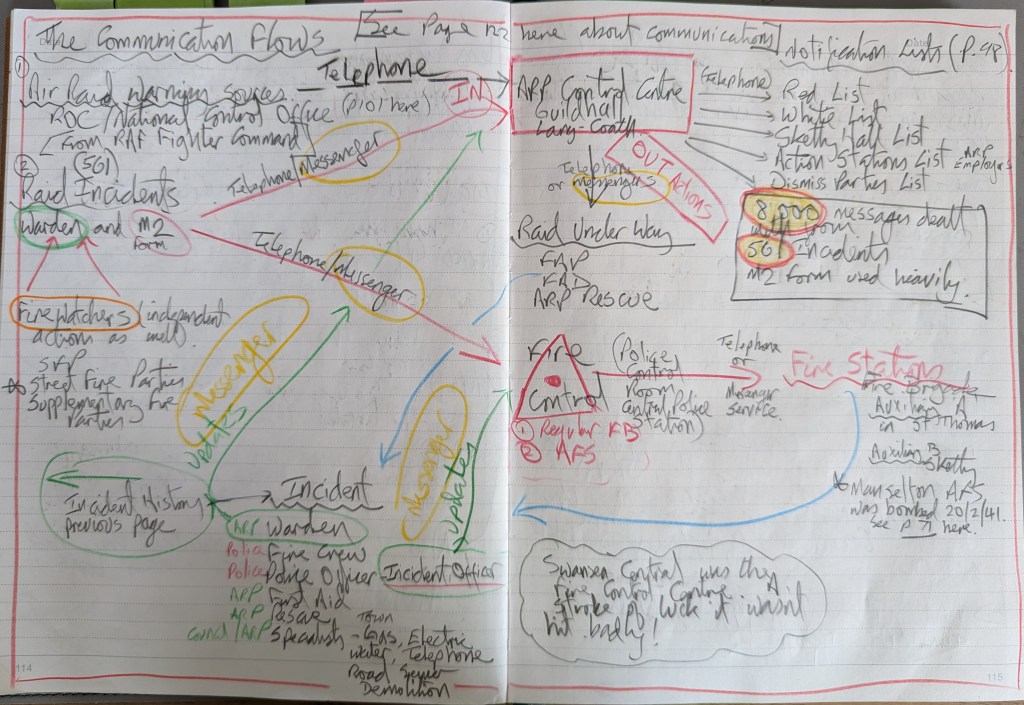
Understanding his role and effectiveness relies on understanding his communication flows and processes as he managed the ARP response from his control room in the Guildhall in Swansea. The dearth of contemporary records has meant I have had to reconstruct the communication flows from a wide range of local sources. Here’s my first pass through the information. Imagine having a small team of secretaries having to deal with over 8,000 messages for 561 incidents and controlling First Aid, Alarms, ARP staff, Rescue, Ambulances, Gas, Electricity and Water supply in an era where communications were unreliable telephones and a network of messengers in cars and on bicycles (often teenagers).

The police forces of the country were unwilling to share or modify their status and their responsibilities even during the hardest times of the war and a dual response method was imposed on the country where ARP and Fire services were managed separately. The success of this approach depended on the personal  qualities of the ARP Wardens. You can see this on the diagram with different communication flows to ARP Control (at The Guildhall) and the Fire Control Centre (at Central Police Station).

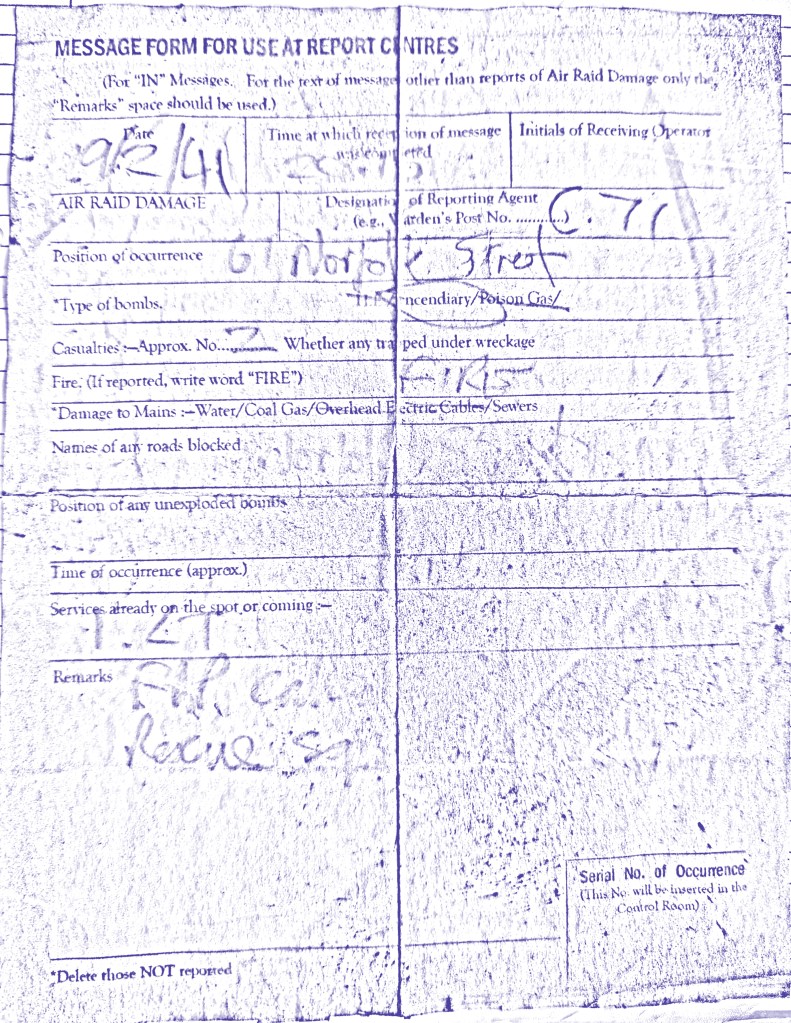
One of the surprises was the efficiency of the ARP M2 Reporting Form which allowed structured information at the correct level of detail to be quickly transmitted or passed to the staff andv the ARP Control Centre.

Alban, J.R. 1994. The Three Nights’ Blitz: Select Contemporary Reports Relating to Swansea’s Air Raids of February 1941, Studies in Swansea’s History, 3 (Swansea: City of Swansea)

O’Brien, Terence H. 1955. Civil Defence (London: HMSO)

Wareham, Evonne Elaine. 2020. ‘Serving the City: Cardiff County Borough in the Second World War’ (unpublished PhD, Cardiff: Cardiff University)

Above: The story so far on understanding the relationships between ARP Warden, Police, AFS, and the ARP Control Centre.

Above: A rough copy of the ARP M2 Reporting Form which was instrumental in allowing effective incident communication. People gave their lives moving these forms through the streets of the blitzed town in February 1941.

Swansea: Looking at Castle Gardens, Ben Evans and the Blitz fires

Castle Gardens appears to be unlovely and unloved. I know it is the target of a proposed refurbishment ‘after consultation’. The plan I saw promises small (cheap) changes.

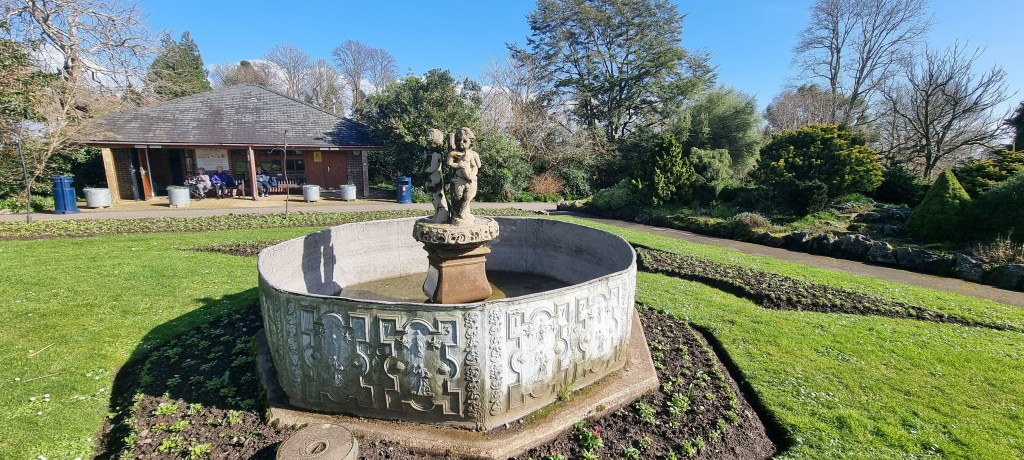
I grew up wandering around the original Castle Gardens in the 1960s. Chasing the army of pigeons that lived on the roofs of the Sidney Heath’s buildings. It was full of green spaces and the Sidney Heath fountain, and the covered area was always full of (to me) old men sitting and drinking. The fountain seems to now be in the gardens in Singleton.

I think this is the remains of the Castle Gardens Fountain ?

The open space originated as a ‘Garden of Rest’ site after the Blitz. (Evans 2019). It eventually (after the inevitable Swansea Council arguments!) became the open space of some grass, some paths and the fountain, which stayed until 1990 when it was obliterated for the ghastly makeover we see today.

The plot of land is fascinating. It was the site of the famous Ben Evans store and, before that, the Plas manor house. As one of the most significant urban areas of the medieval town, it may be that significant archaeology lies underneath the northern side close to where the Plas and Temple Street were.

In my latest research on the Blitz, the plot is helpful to study the impact of incendiaries on the wider town and it’s become a case study in my next book.

Understanding the site that once held Ben Evans entails delving back into the past to look for the Plas manor house and the rebuilding of Cae Bailey Street between 1840 and 1850. The maps are poor, but we do have a fantastic model of the area made in the 1840s, which is now in Swansea Museum, and Gerald Gabb has examined all the paintings and prints in his books (Gabb 2019: 199–207).

The model of the centre of Swansea made in the 1840s. Damaged in the Blitz and repaired by Bernard Morris. Now in Swansea Museum.

I’m digitising the various stages of buildings in the Castle Gardens site as part of the background for understanding the Swansea fire catastrophe of February 1941 (Alban 1994). I’m lucky in that there is a detailed survey of the area from 1852, which is the basis for establishing the area that eventually became Ben Evans in the 1890s.

Alban, J.R. 1994. The Three Nights’ Blitz: Select Contemporary Reports Relating to Swansea’s Air Raids of February 1941, Studies in Swansea’s History, 3 (Swansea: City of Swansea)

Evans, Dinah. 2019. A New, Even Better, Abertawe: Rebuilding Swansea 1941-1961 (Swansea: West Glamorgan Archive Service)

Gabb, Gerald. 2019. Swansea and Its History Volume II: The Riverside Town (Swansea: Privately published)

Above: My digitising of 1840 to 1852 properties that were Castle Gardens. The grey block at the top of the image is the location of the Plas manor house. The area was heavily resculpted after 1945 to create Princess Way and the David Evans shops.

The Natural History of Destruction

Last Saturday, I discussed publishing my newest book, Eye of the Eagle. The venue was the Discovery Room at Swansea’s Central Library, which has become a focus of contemporary local studies and research for Swansea’s residents.

My research on World War Two goes back decades and is primarily concerned with the bombing of Welsh towns and cities and, of course, the maps and images used. All in answer to the questions of how and why.

There is still a massive interest in Swansea’s war years. Many of us lost family members, and many who experienced it are still eager to listen and share their memories. The continuing wars in Ukraine and Gaza ensure images of destruction and suffering are still with us and not confined to history books. In setting the scene for the talk on my research, I mentioned a book that I feel strongly highlights the horrors of modern war and its direct impact on civilians (and particularly children). The book is ‘The Tree of Gernika’, written in 1938 by a journalist witnessing the horrors of the Spanish Civil War as they affected people in Spanish towns and cities. It’s as powerful a book today as it was then (Steer 1938). The author describes the reality of terror bombing and mass slaughter and destruction to a European audience looking on with horror and assuming it was something too horrible to be replicated across the Continent. Of course, we all know that what happened in Spain would be eclipsed hugely by mass attacks on civilians in the following years. The parallels with the Ukraine war are incredible. Despite the media hype about precision weapons, both the Russian and Israeli governments have concluded that terror attacks on vulnerable civilians are more effective and satisfying…particularly when their armies are finding it hard to get a decisive battlefield result . The same happened in 1918 in Germany,  Iraq in 1923,  Spain in 1936, and South Wales in 1941-43 (Saundby 1961; Alban 1994). You can’t blame Russians or Israelis for today…they took their lessons from the RAF, the United States air forces,  and the Luftwaffe.

The title of this post is challenging. Nowadays, Natural History is associated with an Attenborough TV programme. The expression was coined in 1944 by Solly Zuckerman, a renowned war scientist who, upon seeing the blasted remains of buildings and people in Aachen, planned to write an article on the nature of the destruction. On seeing the enormous damage to Cologne in 1945, Zuckerman decided he could never write a sufficiently eloquent piece covering the loss of life in the most awful of circumstances, and he quickly forgot about the idea (Zuckerman 1978: 322).

The phrase was resurrected in the controversial lectures of W G Sebald (One of the finest writers of the post-war years) in his famous book (Sebald 2004). The ethics and issues of mass murder of civilians resurfaced and have never gone away since, particularly after the release of ‘The Fire’, a haunting review of civilian deaths in wartime Germany (Friedrich 2006), and Derek Gregory’s review of Sebald’s work on the true nature of the air war against British and German civilians (Gregory 2011).

I concluded my talk on the bombing of Swansea with this…

“In twenty-five years of research on the bombing of Swansea and the other South Wales ports, I never saw a single piece of evidence that the deaths on the ground (or in the air), and destruction of the towns, resulted in military or strategic benefit for the Nazi government.”

Alban, J.R. 1994. The Three Nights’ Blitz: Select Contemporary Reports Relating to Swansea’s Air Raids of February 1941, Studies in Swansea’s History, 3 (Swansea: City of Swansea)

Friedrich, Jörg. 2006. The Fire: The Bombing of Germany 1940-1945 (New York: Columbia University Press)

Gregory, Derek. 2011. ‘“Doors into Nowhere”: Dead Cities and the Natural History of Destruction’, in Cultural Memories: The Geographical Point of View (New York: Springer), pp. 249–83

Saundby, Robert. 1961. Air Bombardment: The Story of Its Development (London: Chatto & Windus)

Sebald, W.G. 2004. On the Natural History of Destruction (Penguin Books)

Steer, G.L. 1938. The Tree of Gernika: A Field Study of Modern War (London: Hodder and Stoughton)

Zuckerman, Solly. 1978. From Apes to Warlords 1904-46 (London: Hamish Hamilton)
Bombs on Llandarcy, 1940

The technical problems of bomb aiming were massive for all air forces. The Luftwaffe began the war with an ambition of pinpoint accuracy for key targets and expected electronic systems to guide their attacks.

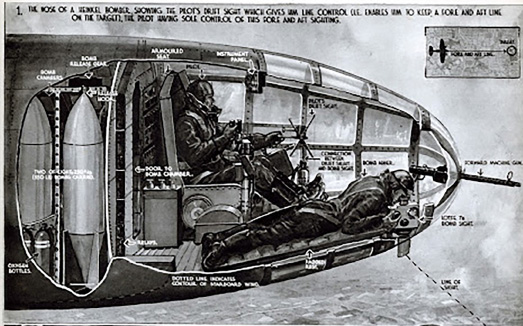
The Heinkel He 111 aircraft was an interim bomber that carried a light bomb load and had a cramped crew cabin making space for the bomb aimer challenging, as can be seen from this early illustration. The main Luftwaffe bomb sight was technically advanced for the 1930s but less effective in the more demanding flying conditions over wartime Britain.

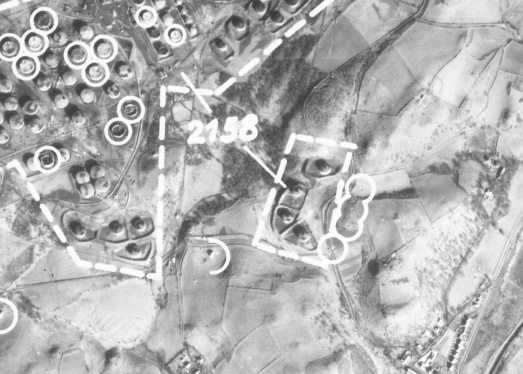
The early attacks on the ports were daylight raids and allowed for accurate bombing. This near miss of four bombs at Llandarcy oil storage (below) was from a daylight raid in 1940. The switch to night time bombing and the need to bomb from higher altitudes led to more inaccuracy and error. Pinpoint targets such as grain mills, lock gates and warehouses, or ships in the docks were missed but the surrounding streets of the Welsh ports suffered badly from the inaccurate bombs.

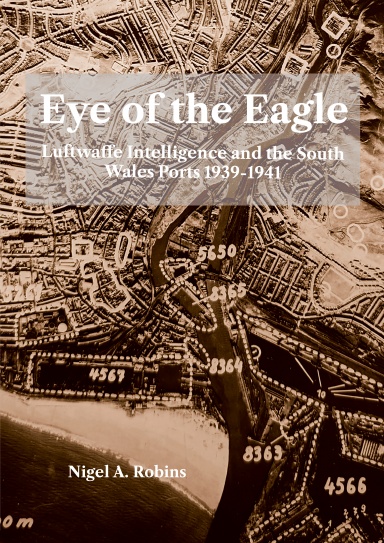
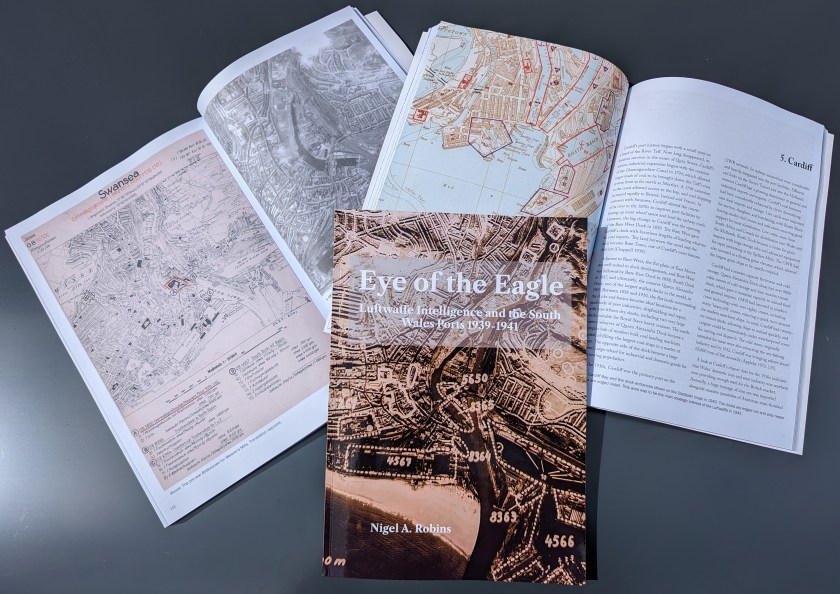
P24-25 Eye of the Eagle: Luftwaffe Intelligence and the South Wales Ports 1939-1941.

A near miss. Bombs dropped on Llandarcy in 1940.

Incendiary bombs and the Welsh Ports

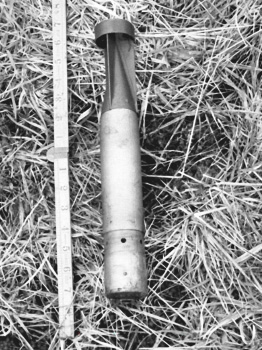
The Luftwaffe had a wide range of weapons available to drop on urban areas in the early years of the war. Lock gates, coal mines, and food storage all had buildings with varying levels of resilience and required different tactics to destroy them. The ports were susceptible to damage in some aspects such as power stations or cranes but generally quite hardy in the face of attack. Larger bombs over five hundred kilogrammes in weight with hardened steel noses were need for the power stations and lock gates. The Luftwaffe was always short of these types of bombs. However, the real terror weapon was the incendiary bomb shown below.

Page 20 of Eye of the Eagle: Luftwaffe Intelligence and the South Wales Ports 1939-1941.

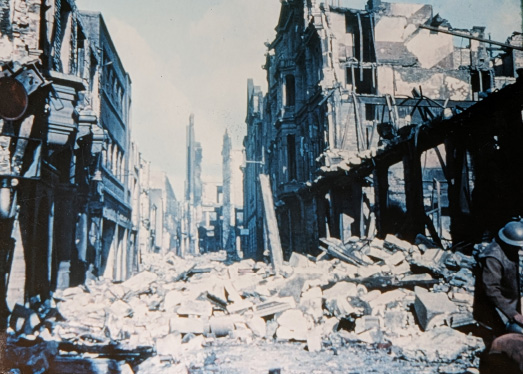
This one kilogramme bomb (the ‘Elektron’) was dropped in thousands on the Welsh ports but it was only ever effective in destroying houses and shops. Creating a firestorm to kill civilians was eventually developed by the RAF and perfected by the US Army Air Forces. The Luftwaffe were experimenting in firestorm tactics in late-1940 and the raid on Swansea in February 1941 shows the early firestorm approach with early arrival of incendiary bombing followed up by high explosive bombs to kill firemen and civil defence staff. The damage to Swansea (shown below) was typical of intensive firestorms which could not be extinguished because firemen were killed and their pumps destroyed. Burning buildings collapse and obliterate the streets with rubble.
The RAF intensively investigated these early Luftwaffe raids and based their own strategic campaign against Germany on the nature of these early raids.

Above: Fire damage in Swansea immediately after the attacks of February 1941.

The Luftwaffe attacking Welsh steel

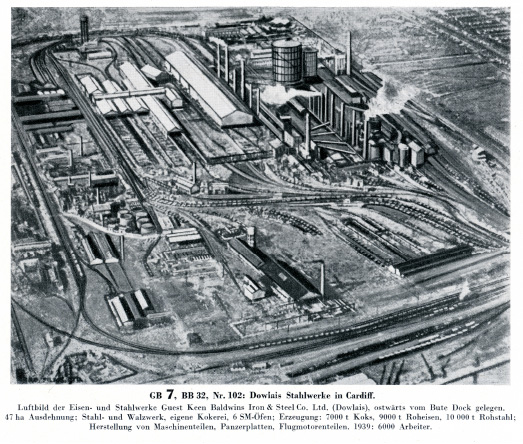
The steelworks of the Welsh ports were of obvious interest to the early Luftwaffe investigators. Iron and steel were strategic materials for all sides. The Dowlais steelworks in Cardiff was a huge target. In fact it was so big that it was difficult to work out exactly where to hit it to cause most damage. The largest high quality bombs were reserved for targets like this (500kg or more), with hard steel noses to penetrate concrete roofs. Incediary bombs were not very effective against industrial targets.

I cover Cardiff as a Luftwaffe target in Chapter 5 of Eye of the Eagle: Luftwaffe Intelligence and the South Wales Ports 1939-1941.

Above: The Dowlais steelworks as depicted in the Militärgeographische Einzelangaben from 1940. A difficult target to attack which required special bombs of larger size and hardened casings to penetrate concrete walls and floors. Incendiaries were practically pointless against a steelworks. There was also a need to attack at a lower altitude to increase accuracy. The presence of a couple of barrage balloons would frequently discourage crews from flying al lower altitudes.

Port Talbot and the Luftwaffe

Port Talbot is covered in Chapter 8 of Eye of the Eagle: Luftwaffe Intelligence and the South Wales ports, 1939-1941.

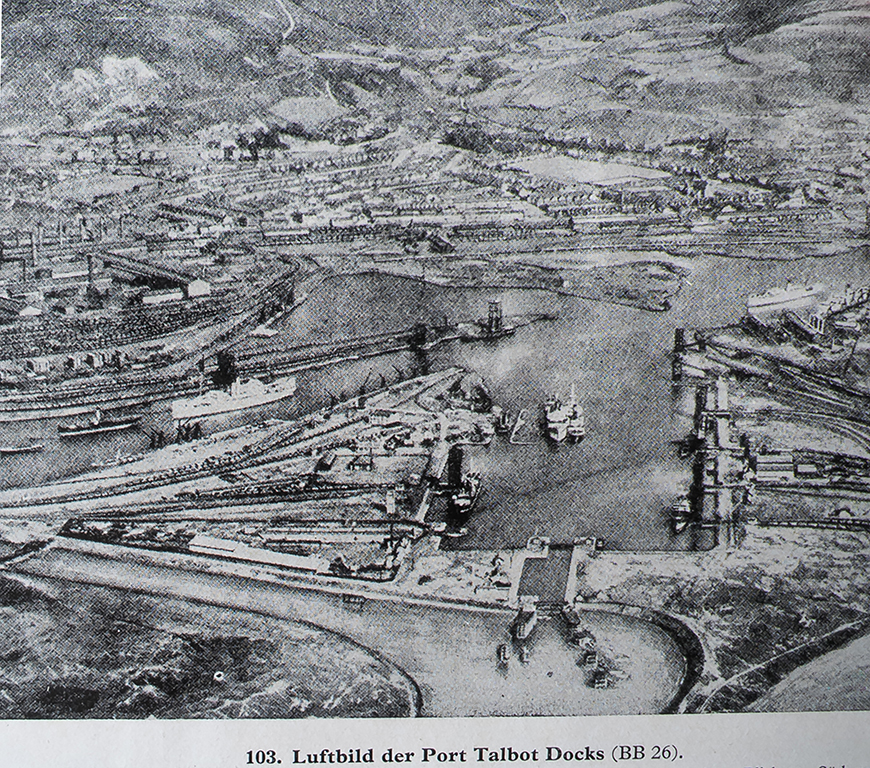
Port Talbot (Aberafan) has a long history as a port, although much of the town’s historic identity is swallowed up by the dominant steelworks . Coal was moved down the Afan Valley to a site originally known as Llewellyn’s Quay, probably from the 1600s or earlier. By the 1750s, a tram line had replaced the pack horse route, and by 1811, iron was also being moved through the valley. Copper ore was imported for the copper works at Cwmafan by the 1830s, and a wharf near Llewellyn’s Quay was built to handle ore (the original Copper Works Wharf).

Port Talbot was identified as a port of interest because of the two large integrated steelworks. The dock was also considered vulnerable because it could be destroyed by bombs on the lock gate and entrance.

Above: Port Talbot from Luftwaffe intelligence records created in 1938-39.

Swansea 1940, the first Luftwaffe images

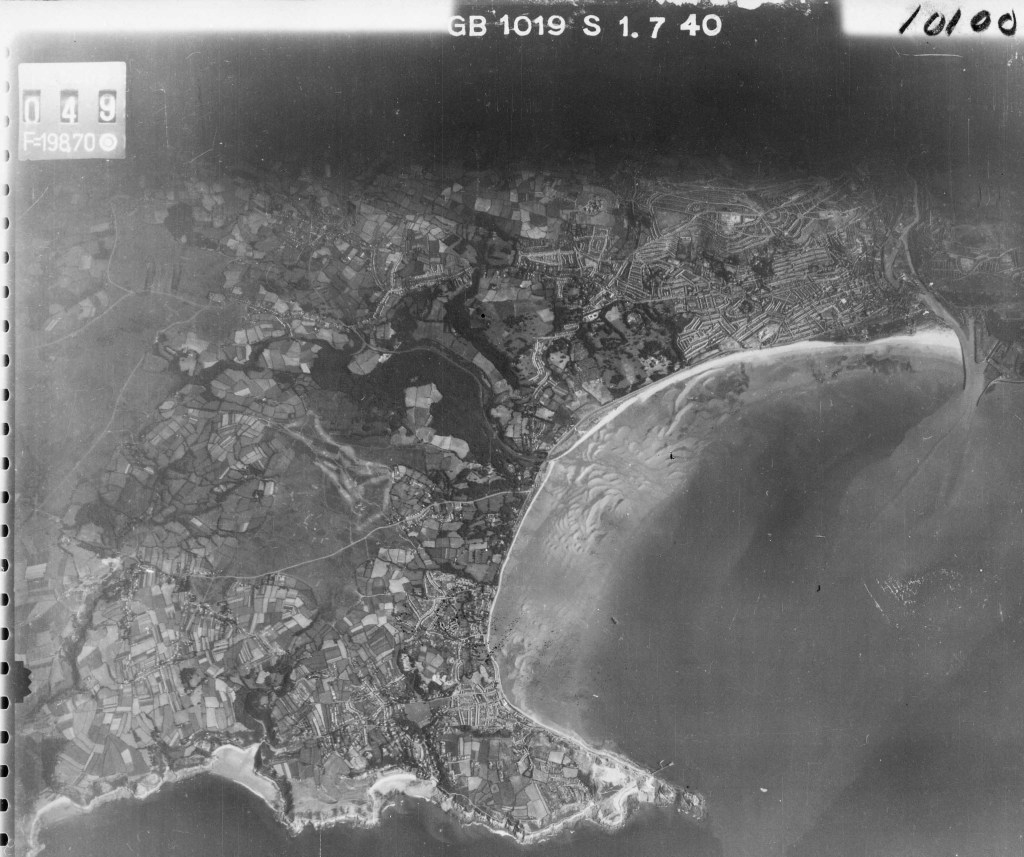
The first direct reconnaissance images of Wales were taken on 1 July 1940 from Luftwaffe reconnaissance aircraft taking off from Jersey only hours after they had actually occupied the airport after the surrender off France.

The aircraft was a Do 17P from second Staffel of Fernaufklärungsgruppe 123 Der Adler mit dem Fernrohr,(The Eagle with the Telescope). This image is from that initial mission. The open fields of Mumbles are seen in the fine summer of 1940 with the open lands of the commons on the left side. The wreck of the SS Protesilaus can be seen on the sands at West Cross in the Bay.

Clyne Valley is still intensely wooded and the fields and gardens of western Swansea are still free from the urban density that we see today.