
Subscribe to continue reading
Subscribe to get access to the rest of this post and other subscriber-only content.
I was particularly struck by a recent opinion piece in The Lancet Planet Health on the links between human health and wellbeing and diverse nature.2 It’s an approach that remains at the centre of my use of Kilvey/Cilfái as a landscape for teaching. Early on, I could see that an overemphasis on biodiversity to the exclusion of other aspects of the environment would inevitably lead to a partial appreciation of the landscape.
Subscribe to get access to the rest of this post and other subscriber-only content.
In the autumn of 2022, the local Council announced their plans to remodel the ancient Kilvey Hill landscape for a new tourism development, which would destroy the traces of thousands of years of human habitation and endeavour. The impending destruction led me to do what I could to record the history, ecology, biodiversity and Geoheritage of what is a significantly under-recorded landscape with considerable potential for education, well-being and climate change management.
Documenting the history and biodiversity was relatively straightforward, albeit a challenge to perceptions regarding a large area of land that many people see but few have experienced and even fewer understand. I remember one comment from the local authority about ‘there is nothing up there’. A comment I later understood as a self-serving phrase to make the destruction and loss more comfortable for planning permissions.

I suppose my perceptions were different, having had the advantage of a geological education at school and undergraduate level, including a hectic month of field mapping coastal regions of the Isle of Wight back in the day. I hadn’t appreciated how much of that had stuck with me until I needed to explore the Geodiversity of the Hill through documents, fieldwork and the wonderful archive of the British Geological Survey.
The fact that the natural heritage of any country includes its geological heritage is now slipping away from us. The wonderful naturalists’ clubs of the early twentieth century, such as the Swansea Scientific and Field Naturalists’ Society, were a broad church to all aspects of nature, including geology. But they have disappeared in the swing towards wildlife rather than general nature conservation, which has permanently obfuscated much of our wonderful Welsh geological heritage. The process accelerated as Naturalists’ Societies changed their names to Wildlife Trusts.
The collapse of geology as a subject deemed worthy of learning and the dissolution of the geological part of the National Museum for Wales have meant that describing the significance of geological sites has become challenging, as basic literacy in the nature of rocks and the landscape is in freefall.
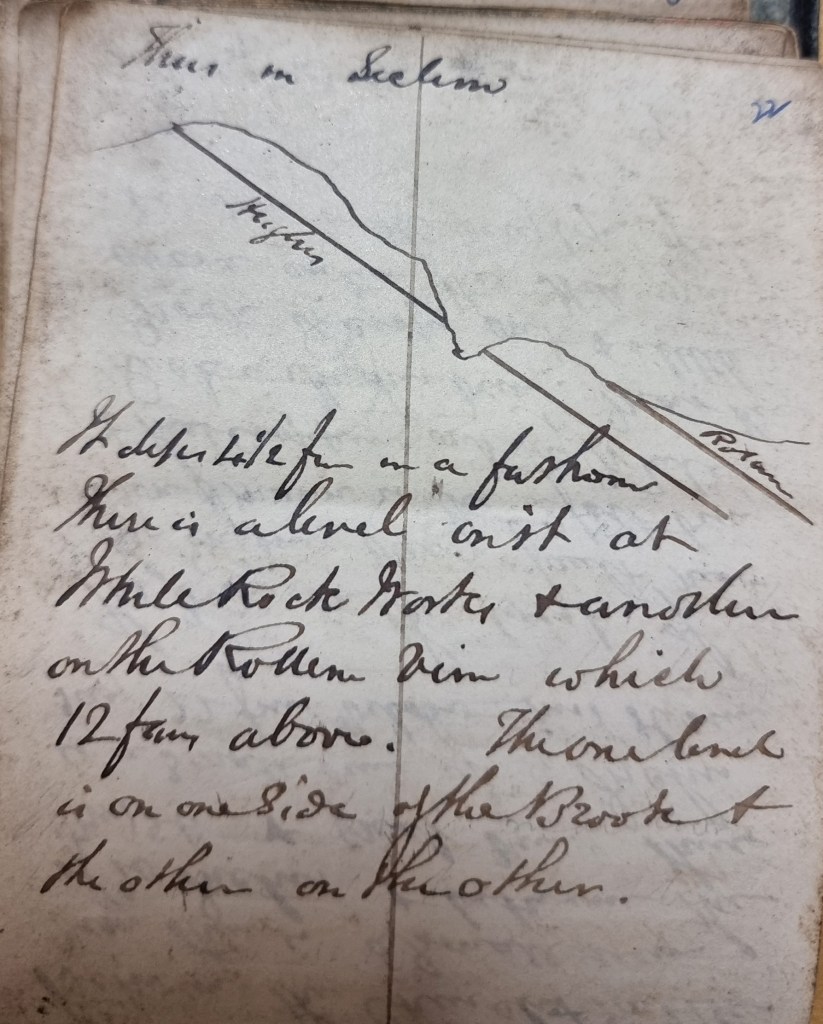
Geoheritage and Geodiversity featured strongly in my first book on the history of Cilfái, not least because it was good history as well as good geology (Robins 2023a). I sought to highlight the significance to local heritage of the geology by separating ecology, biodiversity and climate change into the second Cilfái book (Robins 2023b). However, I felt my treatment of Geoheritage in the first book was not enough. I included a more substantial piece on Swansea’s coal history in my book on the Swansea Foxhole Coal Staithes, but the rich history of William Logan, Hendry de La Beche and Aubrey Strahan clearly deserves more (Robins 2025).
‘Every outcrop has the potential to be great’ (Clary, Pyle, and Andrews 2024) was an opening line to a recent special publication from the Geological Society. It’s a great opening line, and it sets a very positive note for a lively discussion on Geoheritage on a landscape scale. It’s a sentiment that is less positively upheld in Wales where our process of listing or recording sites of geological interest is haphazard and starved of interest and funds.
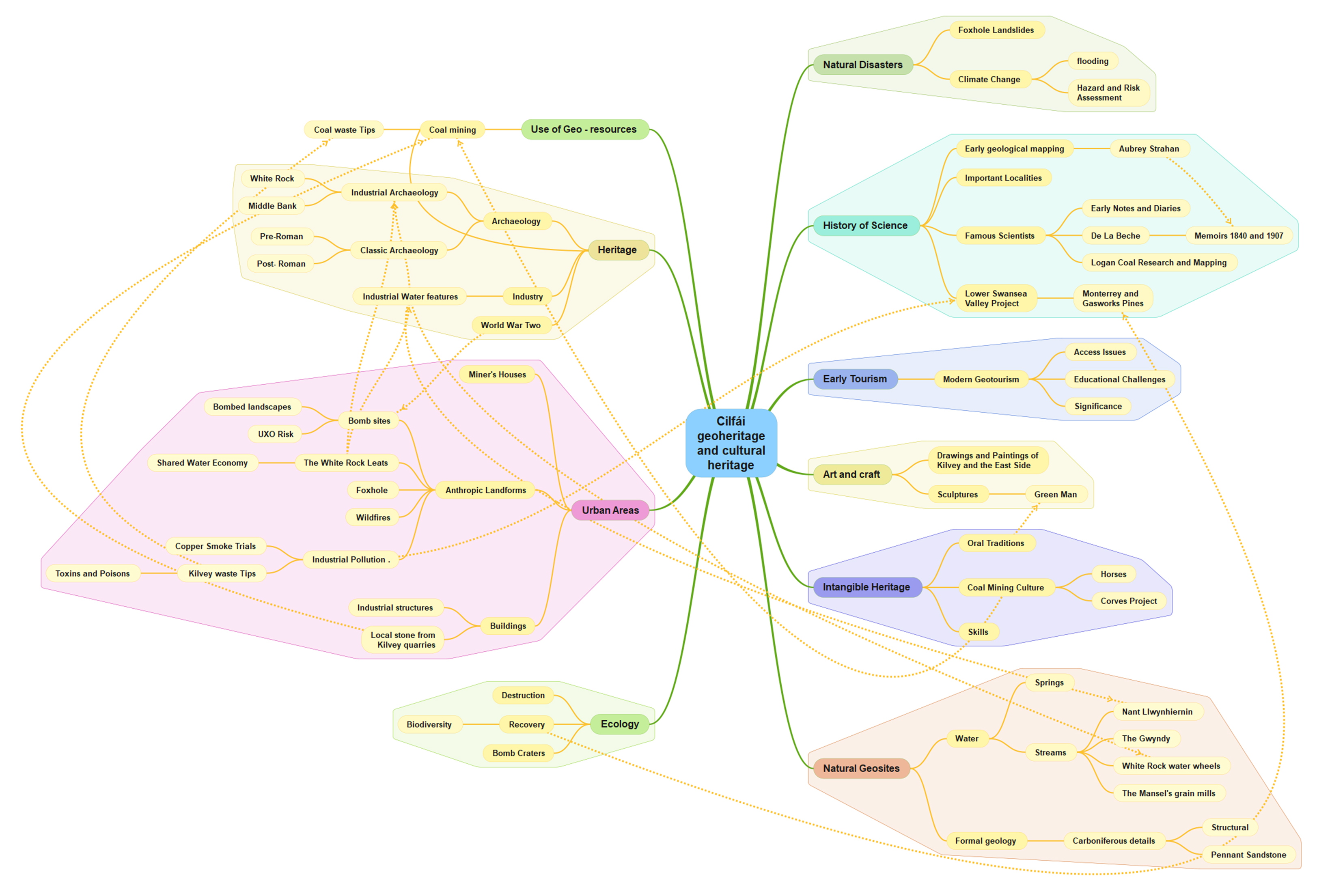
Nevertheless, the listing of a Kilvey site visit on the coming UNESCO International Geodiversity Day is a good opportunity to explore and reassess local Geoheritage. In preparing information for the International Geodiversity Day, I was particularly struck by a recent article linking Geoheritage and Cultural Heritage (Pijet-Migón and Migón 2022). The authors have introduced a model of themes at the Geoheritage-Cultural Heritage ‘interface’. It’s a very useful summary of what to explore or be aware of when revisiting geological sites. It helps move forward from traditional geological guides and texts (Owen 1973), which, although very useful, need to be modernised and broader in scope and engagement for a new generation.
Although the Pijet-Migón model doesn’t fit everything, for example, it can be broadened to explore the link between Biodiversity and Geodiversity, it is very useful. Here’s the Cilfái Geoheritage Landscape filtered through an amended model:
Clary, Renee M., Eric J. Pyle, and William Andrews. 2024. ‘Encompassing Geoheritage’s Multiple Voices, Multiple Venues and Multi-Disciplinarity’, Geology’s Significant Sites and Their Contributions to Geoheritage, no. Special Publication 543, pp. 1–7, doi:10.1144/SP543-2024-34
Owen, T.R. 1973. Geology Explained in South Wales (David & Charles)
Pijet-Migón, Edyta, and Piotr Migón. 2022. ‘Geoheritage and Cultural Heritage – A Review of Recurrent and Interlinked Themes’, Geosciences, 12.98, doi:10.3390/geosciences12020098
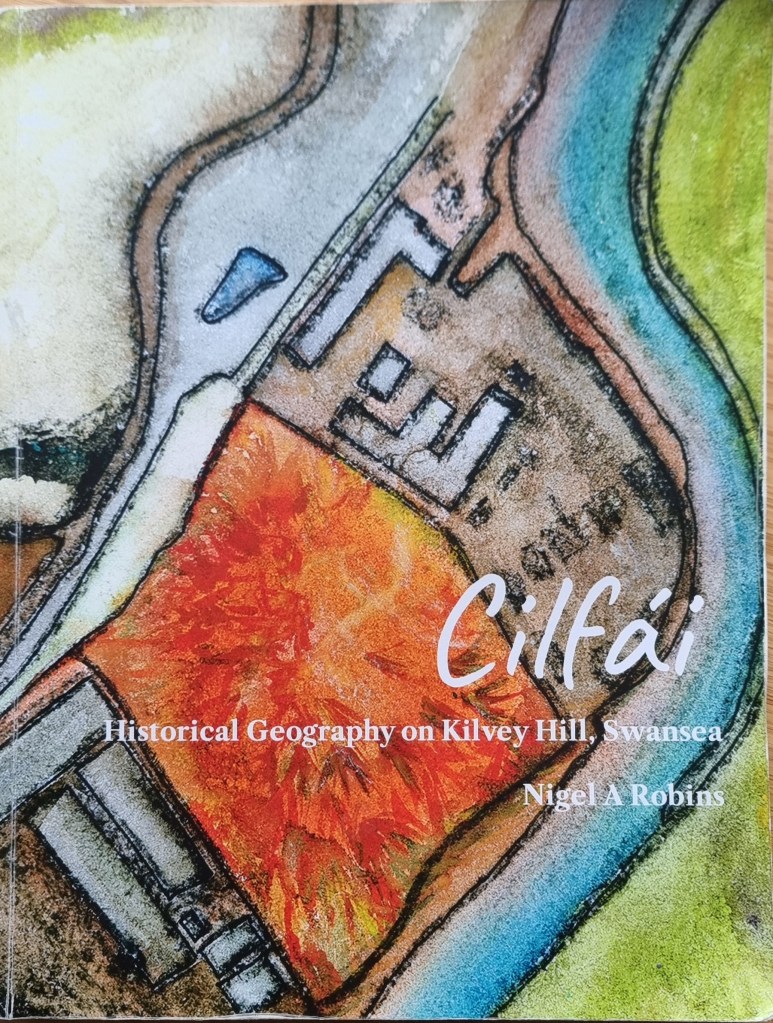
Robins, Nigel A. 2023a. Cilfái: Historical Geography on Kilvey Hill, Swansea (Nyddfwch)
——. 2023b. Cilfái: Woodland Management and Climate Change on Kilvey Hill, Swansea (Nyddfwch)
——. 2025. Foxhole River Staithes and Swansea Coal (Nyddfwch)
‘I don’t know why you all get worked up about it…there’s nothing up there’
(Swansea Council employee 2022)
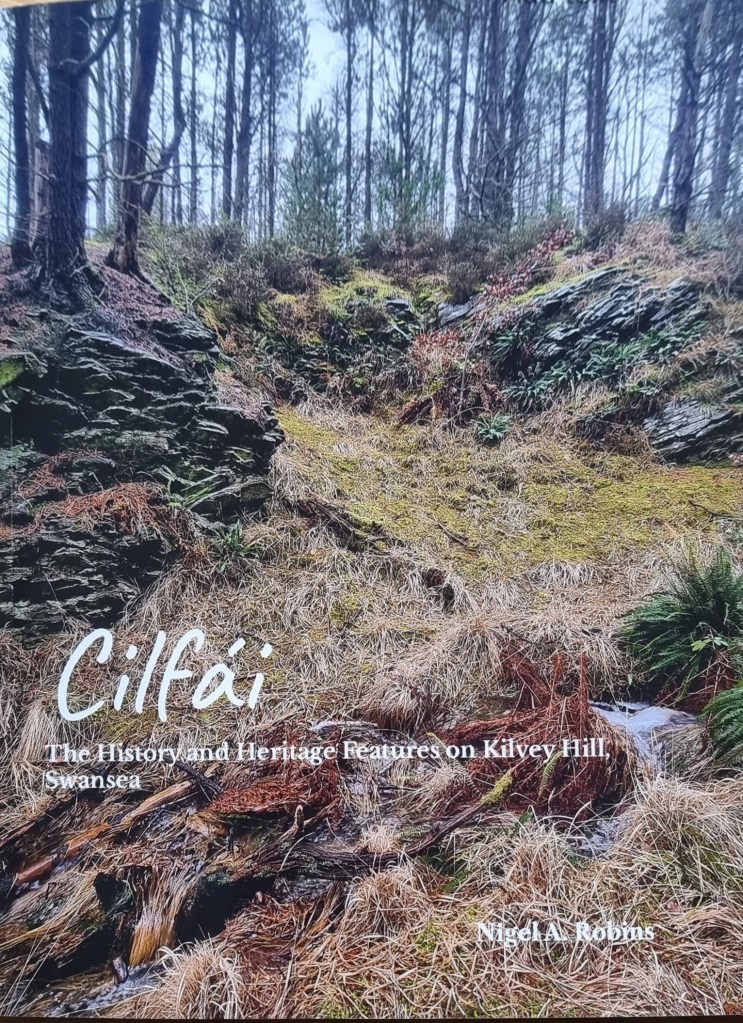
This final Cilfái study was a bit more challenging than I first realised. I thought I had a good impression of the hill’s history and landscape. That was until I consulted the official records that were sadly inconsistent or often compiled with little knowledge or experience of the hill. This meant that this book and its lists were far more of a collaborative effort than the earlier books. This was no bad thing as I made or renewed friendships far and wide as spent more time on the hill connecting with the land and people. My grateful thanks and appreciation go out to all those who gave freely of their time to talk to me about their views and ambitions for the hill. This is particularly true of the features listed in the Modern History chapter, which, for many, is their whole experience of the hill. Unfortunately, the hill’s archaeological knowledge is poor, but that may be because there is more to discover, and we can be optimistic about that, as archaeologists frequently must be.
The Kilvey Woodland Volunteers are the lifeblood of the Cilfái community, and I’d like to thank Marian Francis for her support and commitment to all of us who work on the hill. Equally, the wider community who have planted so much and built The Glade and the Roundhouse and who contribute to so many well-being and craft activities on the hill have been truly inspiring in their unsung work on the hill for local people.
Once again, I need to acknowledge the help of Gerald Gabb in some of the Gwyndy story for me, and the support of library and archive services has been invaluable. The conversations with my old archaeologist friend John Andrew are always supportive. At the time of writing, I have no idea when or if the destruction threatened by Swansea Council will occur. I hope the lists in this book guide and support everybody who wants to care for and preserve what is on the hill. And yes, in answer to that nameless person who I quoted at the top of this page, there is plenty up there. You just have to care enough to look, and talk to the local community.
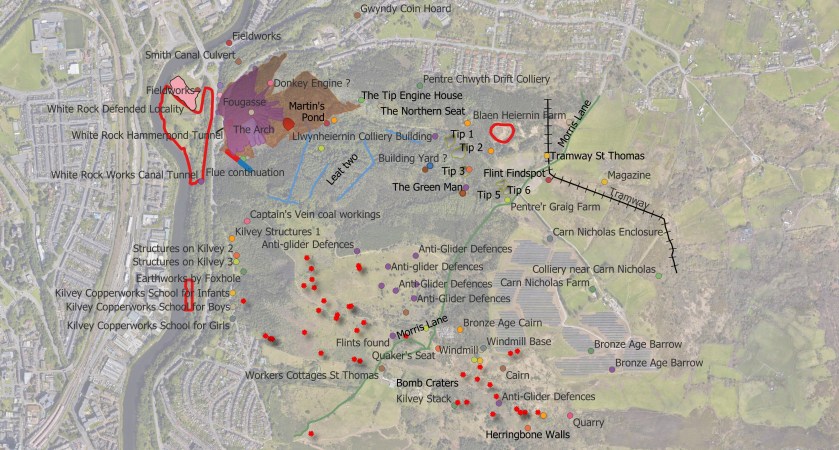
This has now been reprinted as a 2025 Second Edition with some updates I’ve also updated the copyright for AI constraints, and EU product compliance details.
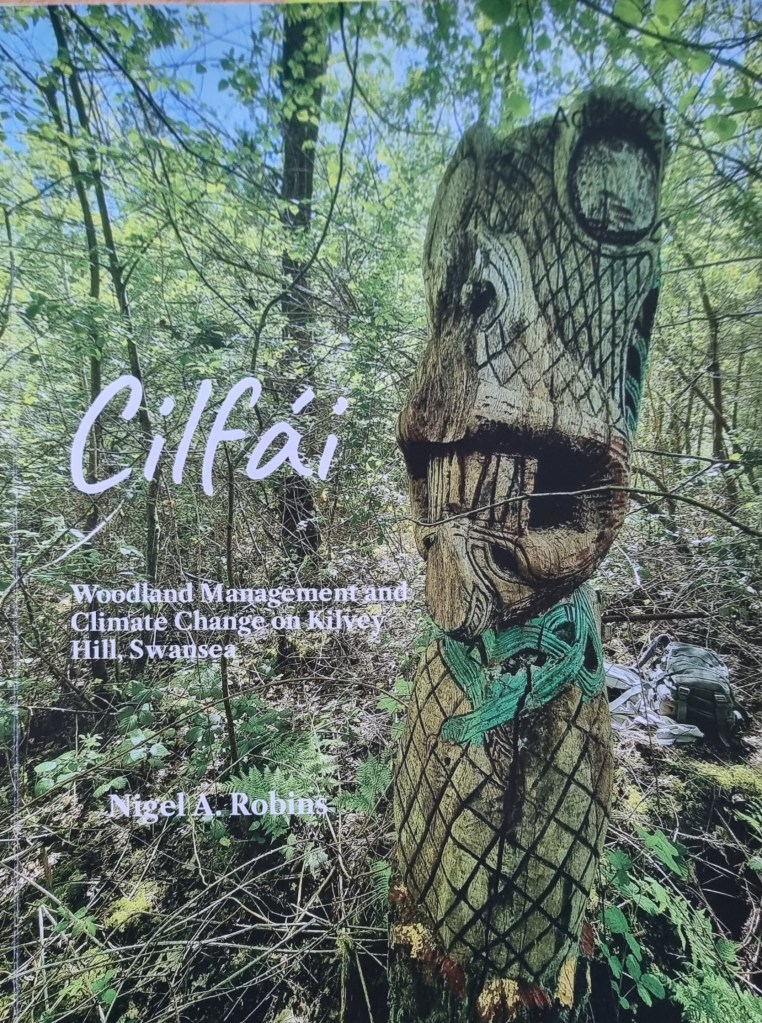
This book started out as a collection of notes made over more than a decade of surveys in Welsh woodlands. What started out as a historical investigation into industrial archaeology in woodlands transformed into a catalogue of what climate change, government policy and local politics is doing to our landscape. As I write this Cilfái is threatened once more with proposed transformation that increasingly looks like destruction.
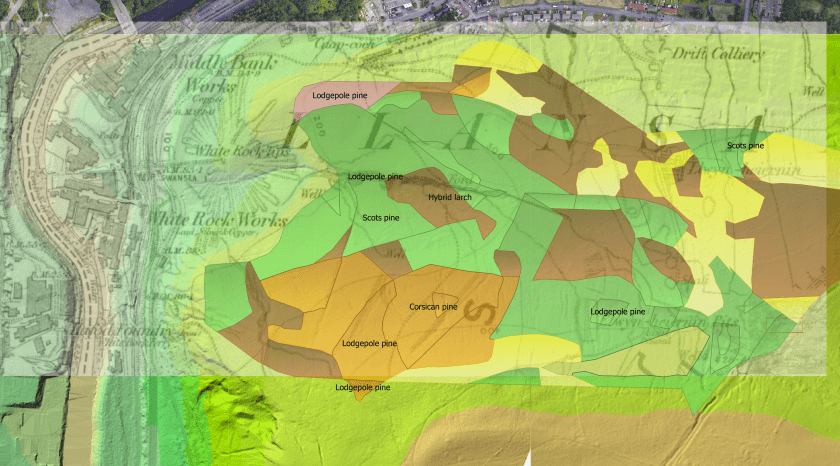
This is a companion volume to Cilfái: Historical Geography on Kilvey Hill, Swansea. But this one is more about the environment of the woods and the climate change that is already changing the nature of the land. Climate change is now part of life and the next generation will be challenged with adaptation to what is happening. This book is my chronicle of what some of that means for Cilfái (Kilvey), this most special part of Swansea’s character that has been abused, ignored and loved…depending on where you live and what your politics are. Some of this work is based on my government experience as a programme reviewer of many environmental and cultural projects across the UK where I experienced the good, the bad, and the ugly of politicians, the Civil Service and successive government policies or the lack of them.
Authors always have inspiration from somewhere and I am no different. My inspiration has been in the conversations and actions of many colleagues in my time working in UK Government in Defra, MOD, Cabinet Office, and Parliament. They all contributed, sometimes unwittingly. You can often learn a lot about a topic by listening to people who know very little about it but who never feel restricted in holding an opinion. Climate change is one of those topics.
I have been privileged to have had the company of experts in many conversations about the topics covered here. But notably, the Forestry Commission was laid bare to me by veteran forestry man David Connick. Equally, the passion of my friend Keith Clement in worrying about where we are going has constantly coloured my sense of urgency.
The commitment and enduring engagement of the Kilvey Woodland Volunteers never ceases to amaze and inspire, and I regularly see incredible generous acts of sharing and care for the Hill that should be an example to all volunteer groups.
I’ve now completed the information project for the Cilfái/Kilvey Hill landscape and surrounding area. The three books covering history, environment, climate change and heritage have all done phenomenally well. I’m sure that almost everyone who wanted copies of any or all of the books in the trilogy now has them. I remain amazed at the level of interest from the USA, Canada, and Australia!
I’ll be teaching Cilfái in several local places in 2025 alongside my World War Two books on South Wales and Swansea Blitz. I will also be offering open-air classroom sessions up on the Hill when the weather allows me to! I’ll post those details in the New Year.
I still have no idea about the future of the Hill, and I guess Swansea Council’s threatened destruction of the environment is about to enter the next phase in 2025. Meanwhile, I’ll continue to use the Hill and/or what survives of the woodlands as my outdoor classroom. A wonderful environment to examine heritage, climate change, woodland biodiversity and geology.
Interest in the history and geography of Cilfái continues to rise, and I’d like to thank the many educational (FE and HE) establishments and organisations for their continued support and engagement with me (and the outstanding Kilvey Woodland Volunteers) in seeking to understand the hill’s value for our local communities and as an educational and wellbeing resource.
One of the fascinating backstories of Cilfái has been the significance of the Hill in the history of coal exploration. Swansea has a particularly special place in the history of the British coal industry. Much of that rich history has been forgotten or discarded, but my next book will be about bringing that fantastic history back to life.
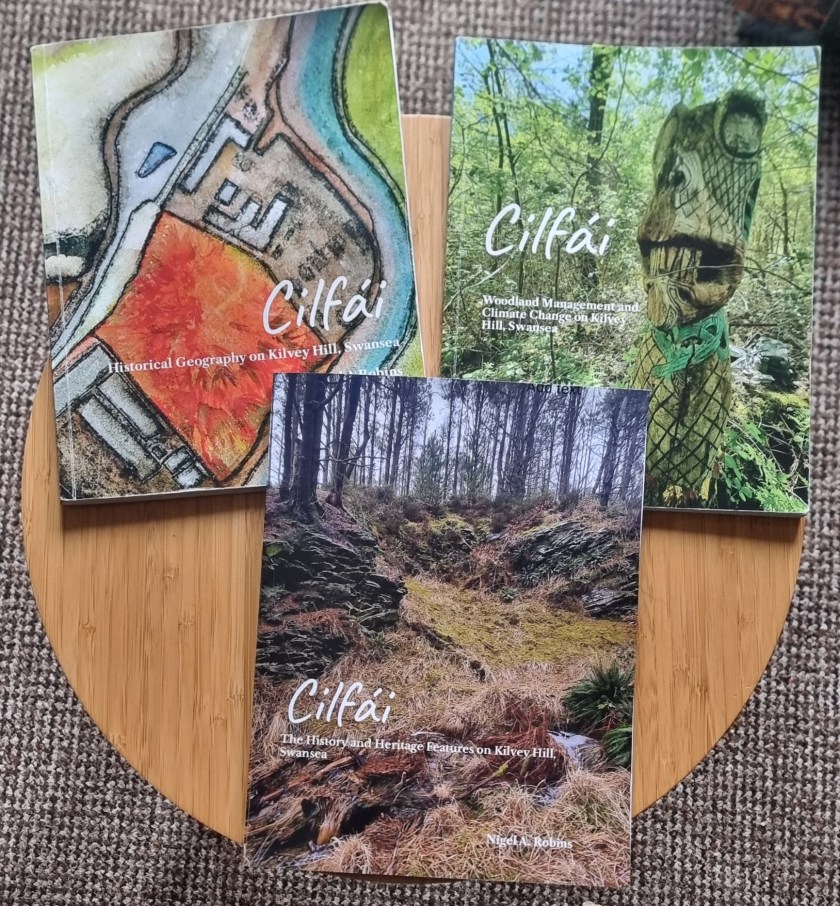
The Cilfái Trilogy. Bringing the uniqueness of the Hill to a wider audience!
Swansea was bombed about forty times during World War Two. Many of the bombs dropped didn’t explode and many are still out there under the ground on Cilfái.
The most imfamous bombing event was Swansea’s Three Nights’ Blitz of 19-21 February 1941. People assume that Cilfái’s bombs came from that event, but the main damage to the Hill was caused by the heavy bombing raid of 17 January 1941. On this night the Luftwaffe dropped a lot of heavy bombs. Many of which missed the Docks and ended up on the hill.
Bombs that landed on the marshy ground on the town side of the hill sank into the ground and never exploded. They are still there, but a long way underground (maybe five metres or more). Others did explode when they hit the hill leaving large craters, some of which have filled with water and are now biodiversity hotspots.
The Skyline development raises the risk that some of the unexploded bombs will be disturbed by excavators and diggers. This is a common ocurrence in areas that were heavily bombed. When I worked in construction in London, we all had to be trained in recognition and procedures if one of the diggers brought a bomb up in a bucket. The risk on the hill is real and has already been recognised in planning documents, and precautions will be essential.
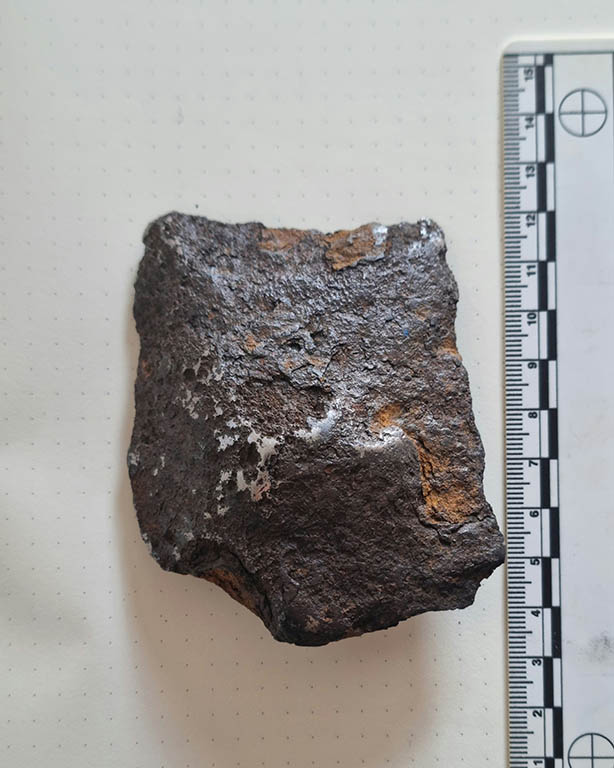
The bombs that did explode produced a lot of metal fragments of all sizes. In some places bomb fragments have become part of Cilfái’s archaeology. Fragments were incredibly dangerous. A piece of a bomb weighing about half a gramme (a fiftieth of an ounce) would be enough to smash through an arm or leg destroying the bones. The bigger fragments could kill instantly or easily destroy a vehicle.
Some parts of the hill were peppered with this kind of shrapnel. The photo below is of a big piece (aqbout 9 cm) I found. The sides of this fragment are still as sharp as a Stanley knife.
The World War Two remains are part of the wider collectiion of heritage and archaeology remains listed in the third Cilfái book Cilfái: History and Heritage Features on Kilvey Hill Swansea.
No matter how old they are or how rusty they look, bombs will still explode and kill.
 Nigel Robins