Swansea: Looking at Castle Gardens, Ben Evans and the Blitz fires

Castle Gardens appears to be unlovely and unloved. I know it is the target of a proposed refurbishment ‘after consultation’. The plan I saw promises small (cheap) changes.

I grew up wandering around the original Castle Gardens in the 1960s. Chasing the army of pigeons that lived on the roofs of the Sidney Heath’s buildings. It was full of green spaces and the Sidney Heath fountain, and the covered area was always full of (to me) old men sitting and drinking. The fountain seems to now be in the gardens in Singleton.
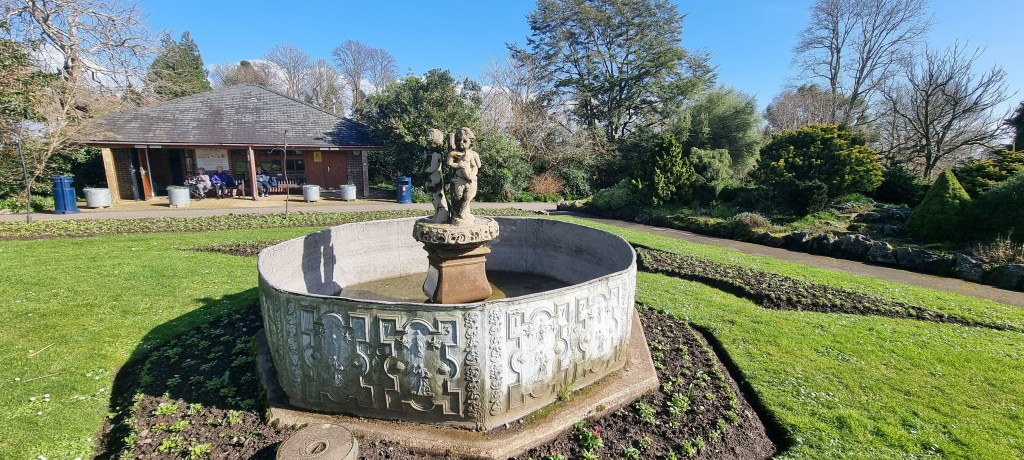
I think this is the remains of the Castle Gardens Fountain ?

The open space originated as a ‘Garden of Rest’ site after the Blitz. (Evans 2019). It eventually (after the inevitable Swansea Council arguments!) became the open space of some grass, some paths and the fountain, which stayed until 1990 when it was obliterated for the ghastly makeover we see today.

The plot of land is fascinating. It was the site of the famous Ben Evans store and, before that, the Plas manor house. As one of the most significant urban areas of the medieval town, it may be that significant archaeology lies underneath the northern side close to where the Plas and Temple Street were.

In my latest research on the Blitz, the plot is helpful to study the impact of incendiaries on the wider town and it’s become a case study in my next book.

Understanding the site that once held Ben Evans entails delving back into the past to look for the Plas manor house and the rebuilding of Cae Bailey Street between 1840 and 1850. The maps are poor, but we do have a fantastic model of the area made in the 1840s, which is now in Swansea Museum, and Gerald Gabb has examined all the paintings and prints in his books (Gabb 2019: 199–207).
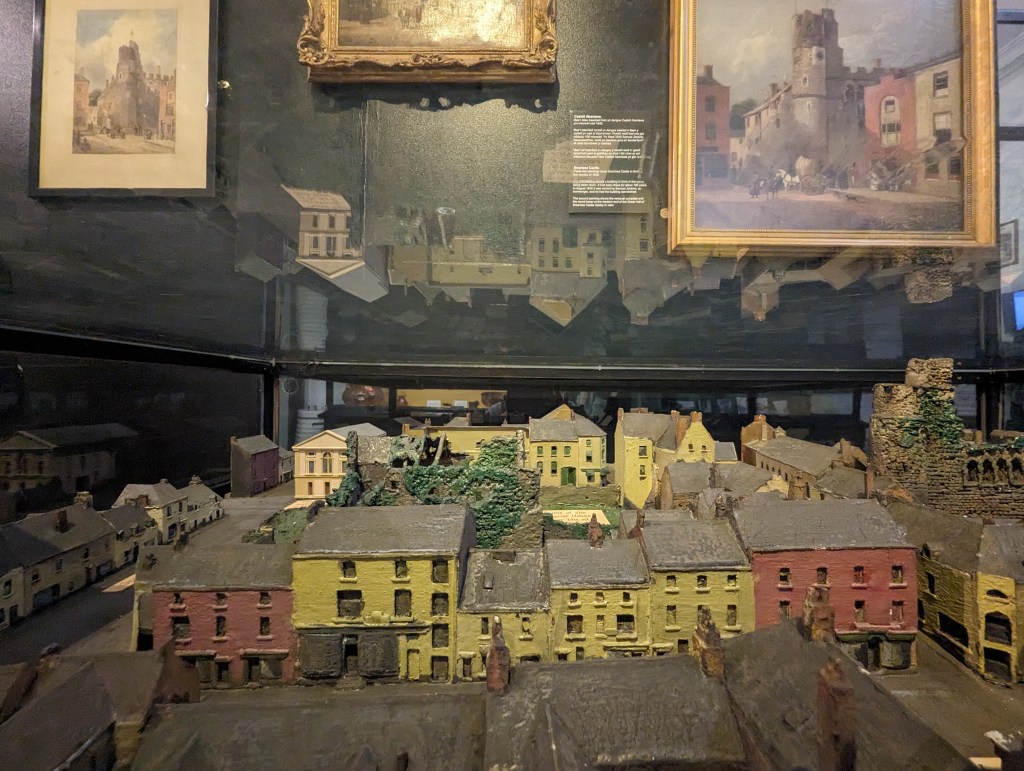
The model of the centre of Swansea made in the 1840s. Damaged in the Blitz and repaired by Bernard Morris. Now in Swansea Museum.

I’m digitising the various stages of buildings in the Castle Gardens site as part of the background for understanding the Swansea fire catastrophe of February 1941 (Alban 1994). I’m lucky in that there is a detailed survey of the area from 1852, which is the basis for establishing the area that eventually became Ben Evans in the 1890s.

Alban, J.R. 1994. The Three Nights’ Blitz: Select Contemporary Reports Relating to Swansea’s Air Raids of February 1941, Studies in Swansea’s History, 3 (Swansea: City of Swansea)

Evans, Dinah. 2019. A New, Even Better, Abertawe: Rebuilding Swansea 1941-1961 (Swansea: West Glamorgan Archive Service)

Gabb, Gerald. 2019. Swansea and Its History Volume II: The Riverside Town (Swansea: Privately published)
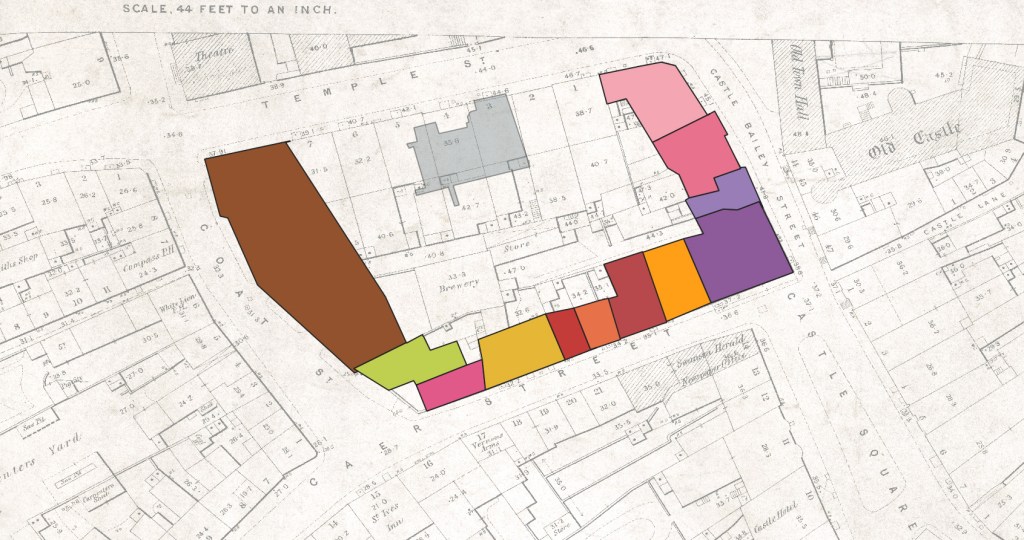
Above: My digitising of 1840 to 1852 properties that were Castle Gardens. The grey block at the top of the image is the location of the Plas manor house. The area was heavily resculpted after 1945 to create Princess Way and the David Evans shops.

The Natural History of Destruction

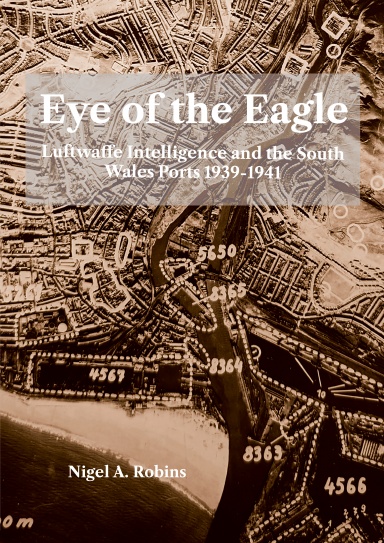
Last Saturday, I discussed publishing my newest book, Eye of the Eagle. The venue was the Discovery Room at Swansea’s Central Library, which has become a focus of contemporary local studies and research for Swansea’s residents.

My research on World War Two goes back decades and is primarily concerned with the bombing of Welsh towns and cities and, of course, the maps and images used. All in answer to the questions of how and why.

There is still a massive interest in Swansea’s war years. Many of us lost family members, and many who experienced it are still eager to listen and share their memories. The continuing wars in Ukraine and Gaza ensure images of destruction and suffering are still with us and not confined to history books. In setting the scene for the talk on my research, I mentioned a book that I feel strongly highlights the horrors of modern war and its direct impact on civilians (and particularly children). The book is ‘The Tree of Gernika’, written in 1938 by a journalist witnessing the horrors of the Spanish Civil War as they affected people in Spanish towns and cities. It’s as powerful a book today as it was then (Steer 1938). The author describes the reality of terror bombing and mass slaughter and destruction to a European audience looking on with horror and assuming it was something too horrible to be replicated across the Continent. Of course, we all know that what happened in Spain would be eclipsed hugely by mass attacks on civilians in the following years. The parallels with the Ukraine war are incredible. Despite the media hype about precision weapons, both the Russian and Israeli governments have concluded that terror attacks on vulnerable civilians are more effective and satisfying…particularly when their armies are finding it hard to get a decisive battlefield result . The same happened in 1918 in Germany,  Iraq in 1923,  Spain in 1936, and South Wales in 1941-43 (Saundby 1961; Alban 1994). You can’t blame Russians or Israelis for today…they took their lessons from the RAF, the United States air forces,  and the Luftwaffe.

The title of this post is challenging. Nowadays, Natural History is associated with an Attenborough TV programme. The expression was coined in 1944 by Solly Zuckerman, a renowned war scientist who, upon seeing the blasted remains of buildings and people in Aachen, planned to write an article on the nature of the destruction. On seeing the enormous damage to Cologne in 1945, Zuckerman decided he could never write a sufficiently eloquent piece covering the loss of life in the most awful of circumstances, and he quickly forgot about the idea (Zuckerman 1978: 322).

The phrase was resurrected in the controversial lectures of W G Sebald (One of the finest writers of the post-war years) in his famous book (Sebald 2004). The ethics and issues of mass murder of civilians resurfaced and have never gone away since, particularly after the release of ‘The Fire’, a haunting review of civilian deaths in wartime Germany (Friedrich 2006), and Derek Gregory’s review of Sebald’s work on the true nature of the air war against British and German civilians (Gregory 2011).

I concluded my talk on the bombing of Swansea with this…

“In twenty-five years of research on the bombing of Swansea and the other South Wales ports, I never saw a single piece of evidence that the deaths on the ground (or in the air), and destruction of the towns, resulted in military or strategic benefit for the Nazi government.”

Alban, J.R. 1994. The Three Nights’ Blitz: Select Contemporary Reports Relating to Swansea’s Air Raids of February 1941, Studies in Swansea’s History, 3 (Swansea: City of Swansea)

Friedrich, Jörg. 2006. The Fire: The Bombing of Germany 1940-1945 (New York: Columbia University Press)

Gregory, Derek. 2011. ‘“Doors into Nowhere”: Dead Cities and the Natural History of Destruction’, in Cultural Memories: The Geographical Point of View (New York: Springer), pp. 249–83

Saundby, Robert. 1961. Air Bombardment: The Story of Its Development (London: Chatto & Windus)

Sebald, W.G. 2004. On the Natural History of Destruction (Penguin Books)

Steer, G.L. 1938. The Tree of Gernika: A Field Study of Modern War (London: Hodder and Stoughton)

Zuckerman, Solly. 1978. From Apes to Warlords 1904-46 (London: Hamish Hamilton)

Incendiary bombs and the Welsh Ports

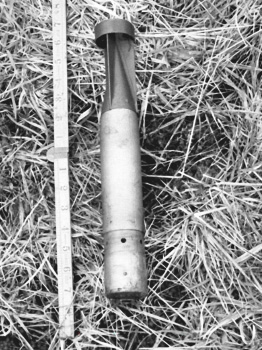
The Luftwaffe had a wide range of weapons available to drop on urban areas in the early years of the war. Lock gates, coal mines, and food storage all had buildings with varying levels of resilience and required different tactics to destroy them. The ports were susceptible to damage in some aspects such as power stations or cranes but generally quite hardy in the face of attack. Larger bombs over five hundred kilogrammes in weight with hardened steel noses were need for the power stations and lock gates. The Luftwaffe was always short of these types of bombs. However, the real terror weapon was the incendiary bomb shown below.

Page 20 of Eye of the Eagle: Luftwaffe Intelligence and the South Wales Ports 1939-1941.

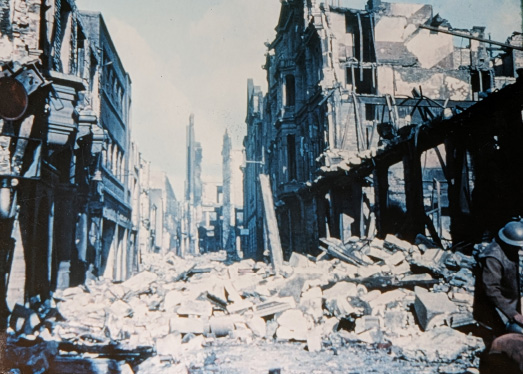
This one kilogramme bomb (the ‘Elektron’) was dropped in thousands on the Welsh ports but it was only ever effective in destroying houses and shops. Creating a firestorm to kill civilians was eventually developed by the RAF and perfected by the US Army Air Forces. The Luftwaffe were experimenting in firestorm tactics in late-1940 and the raid on Swansea in February 1941 shows the early firestorm approach with early arrival of incendiary bombing followed up by high explosive bombs to kill firemen and civil defence staff. The damage to Swansea (shown below) was typical of intensive firestorms which could not be extinguished because firemen were killed and their pumps destroyed. Burning buildings collapse and obliterate the streets with rubble.
The RAF intensively investigated these early Luftwaffe raids and based their own strategic campaign against Germany on the nature of these early raids.

Above: Fire damage in Swansea immediately after the attacks of February 1941.

Cilfái: Copper Smoke

I write about the copper smoke in Chapter Four of Cilfái: Historical Geography on Kilvey Hill, Swansea.

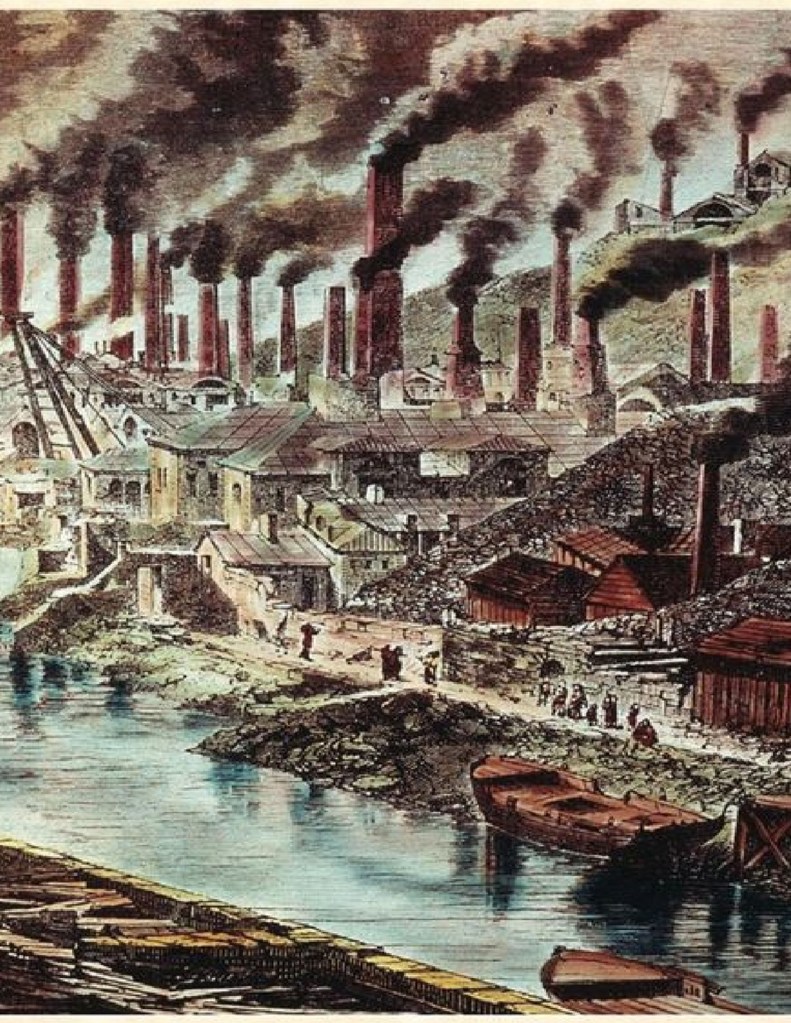
The copper smoke from White Rock was horrendous. Black, acrid, greasy and opaque. It killed everything it touched. The chemical composition of the Cornish copper ore meant that once burnt with Kilvey’s bituminous coal, released vast quantities of sulphur dioxide, hydreogen fluoride, sulphrous and sulphuric acids. in the 1840s, the Vivian’s Hafod Works were releasing 188 tons of Sulphuric Acid daily into the Swansea Valley.

Above: An extract from a rare coloured version of an image commonly used to show the forest of chimneys at White Rock in the 1860s The toe of the Cae Morfa Carw slag tip is left of centre and the mass of chimneys of Middle Bank is to the left. The drawing was commissioned by the French travel journal ‘Le Tour du Monde ‘ and the artist was Jean-Baptiste Henri Durand-Brager (Le Tour du Monde) 1865) (Author’s collection).

Housing history in Swansea

I’m taking a University class out tomorrow to look at some industrial housing history around Hafod and Landore. Housing history was the central theme of my research in the 1990s amd I must have surveyed and mapped hundreds of Glamorgan houses as I worked to understand industry, landscape and the housing needs of the early coal and metal industries.

Shape is one of the most important features of early (pre-1919) houses and it became a bit of a party trick when I could guess for other people the decade in which their original house was built. Although many of Swansea’s earliest industrial houses were swept away in the 1920s as part of slum clearance, quite a few of the classic examples still remain. Beyong the boundary of the original County Borough of Swansea, neighbouring local authorities did not clear their older houses and many survive in villages, cwms, and valleys near the pits and factories they served.

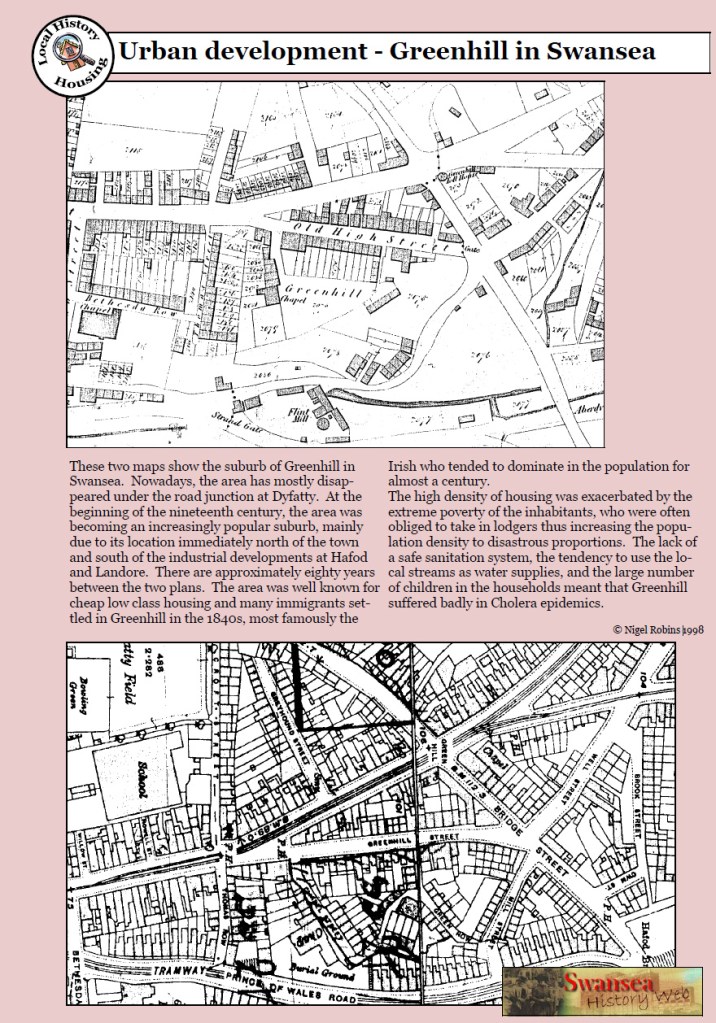
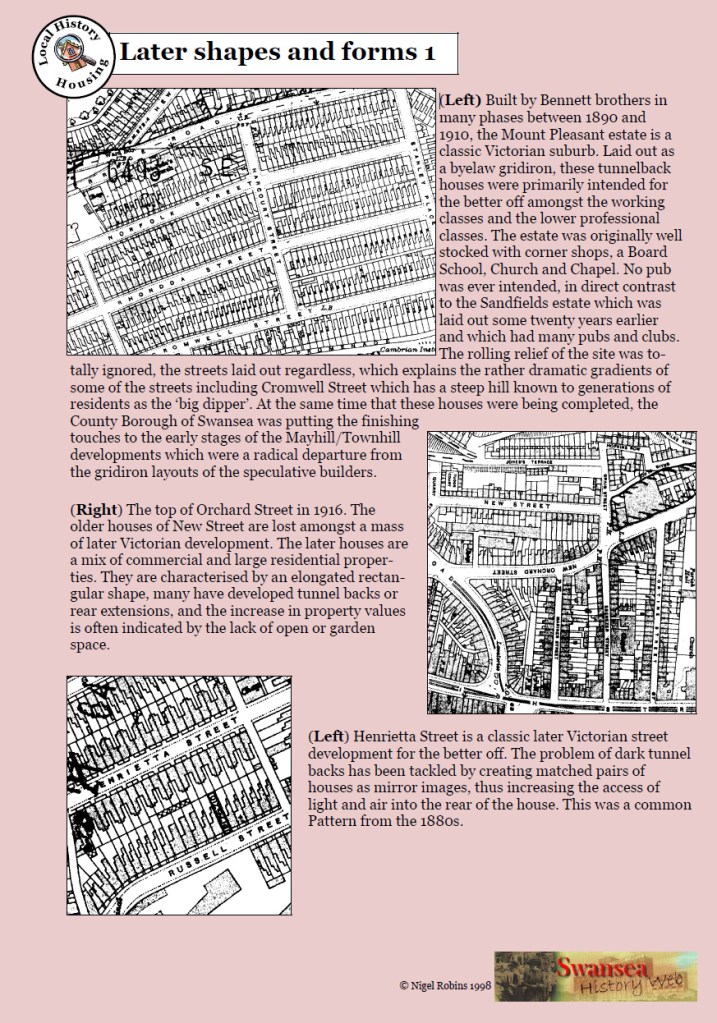
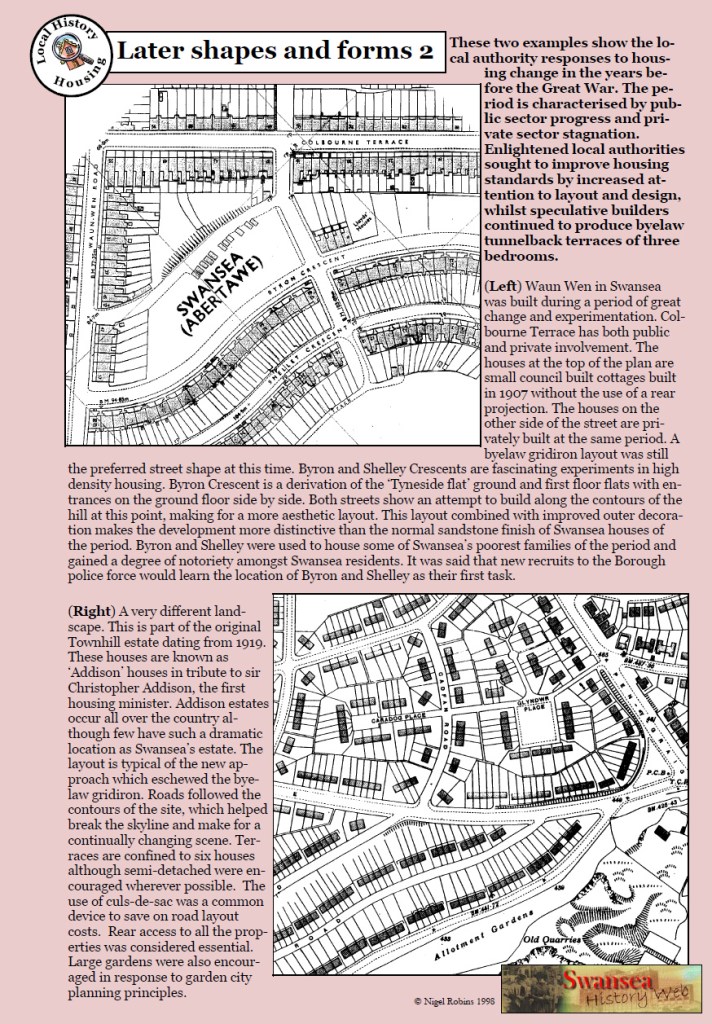
These are the handouts fr0m ‘Housing History 101’ from my teaching days. I suppose these types of documents (and clip art!) are history themselves now LOL.