The Reptile Mitigation begins

Tuesday, 29 July 2025, saw the arrival of contractors on the Hill to begin implementation of the Reptile Mitigation Strategy. The firm brought some mowing equipment, heras fencing and robotic sentries to the summit. The Reptile Mitigation Strategy is comprehensive, although I don’t accept the supporting survey information on the presence/absence of reptiles in the area. I think the original reptile survey was hastily completed (if it actually happened at all).

The job is big and probably lucrative for someone. The protocol as described in the Mitigation Strategy is adequate for the site, and captured reptiles are to be released on the hill in safer areas.

Above: My survey of the cleared areas on Saturday, 2 August 2025. They are pretty big areas. The red circles are the first three refugia to be built on the verges of the construction site.

Kilvey: Recent storms and Windthrow

Kilvey Hill experiences frequent storms and high winds, which are a major threat to woodlands and any buildings or structures. The risk of wind damage and windthrow is expected to increase with climate change, with more frequent storms, wind speed, winter rainfall, and faster tree growth.

The projected increase in our winter rainfall is likely to increase wind risk, as rooting depth and root anchorage are both reduced in waterlogged soils. An increase in tree growth rate due to warmer temperatures is possible in areas where moisture availability is not limiting, this could increase wind risk with stands reaching a critical height earlier.

The presence of the TV and phone masts on the hill means that we know a lot about the wind speeds and weather on the hill. However, getting hold of the data is sometimes hard as it can be regarded as a ‘secret’. Anybody who walks the hill will know the signs of wind damage and constant high winds, which are now increasingly common around the year, no longer just the winter months.

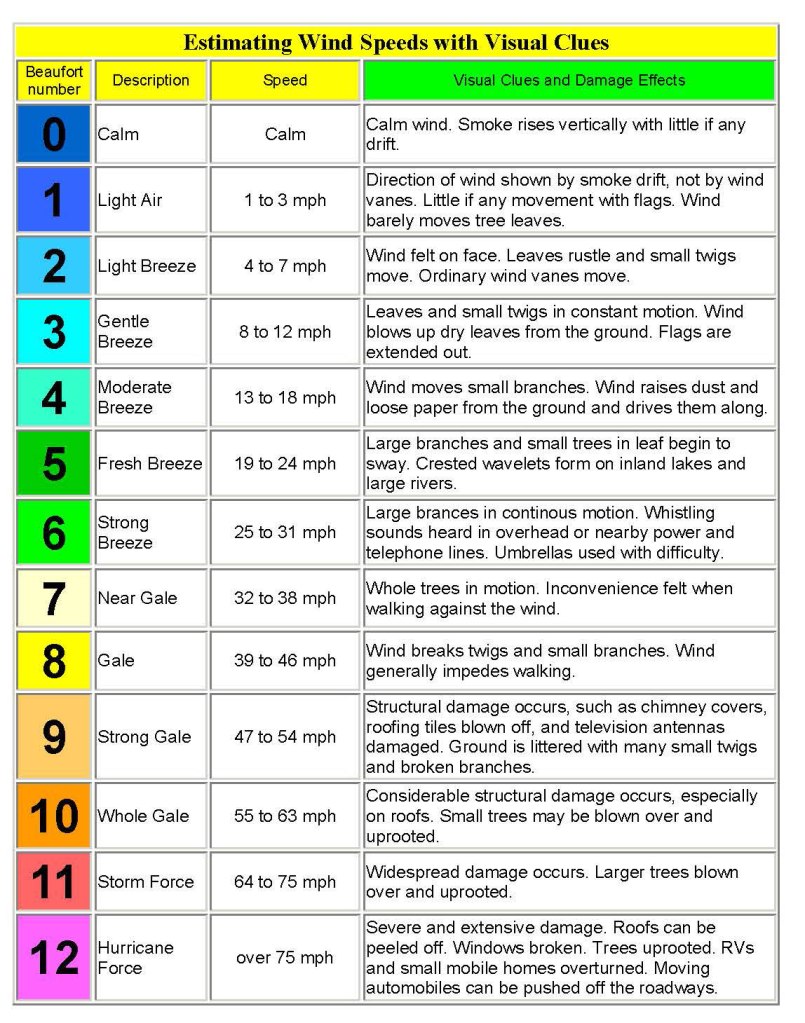
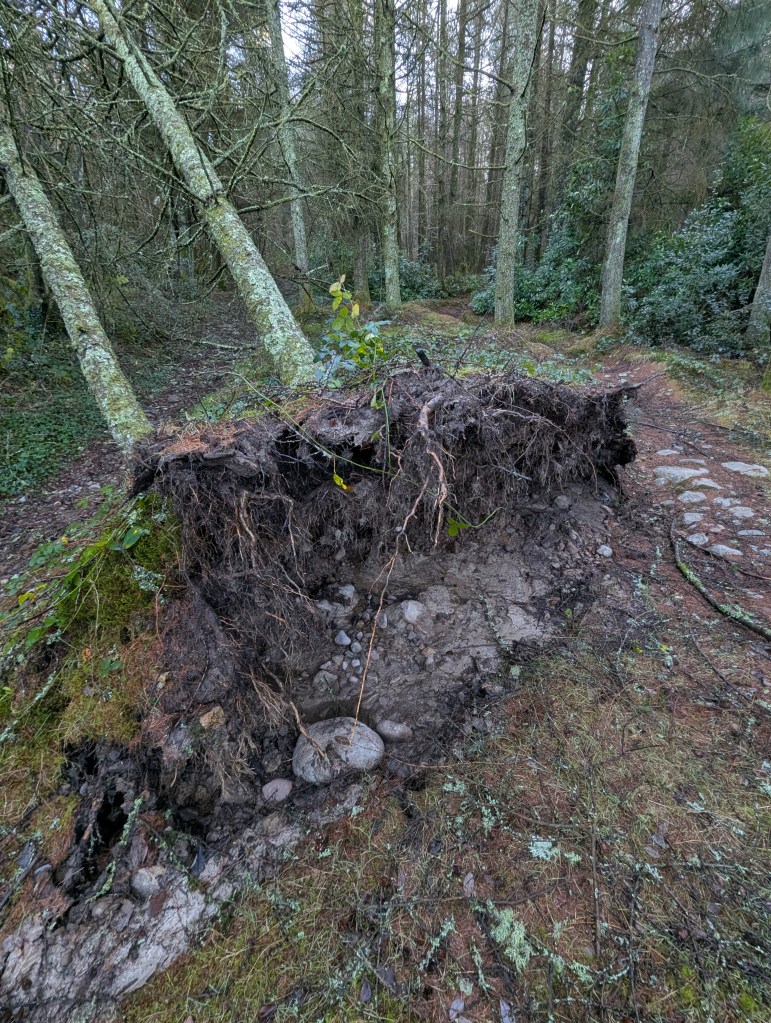
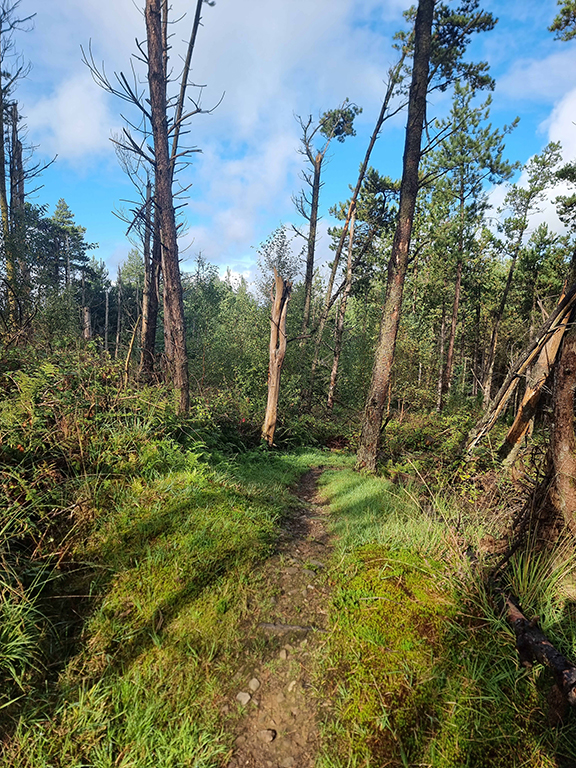
We can use the table below to assess wind speeds and damage based on the evidence we see after the storm is over. This table is based on expert fieldwork from the US Forest Service and is used all over the world. Look at the damage in the photos here and see where it is on this list…

It doesn’t matter what your viewpoints are on who or what causes climate change. The evidence is out there, and the question is how to interpret it and design for the future. It might, for instance, be an incredibly risky act for Swansea Council to risk millions of pounds (of money they apparently don’t have) on supporting a risky tourism venture on a Welsh coastal hill that is increasingly exposed to dangerous windspeeds and disruptive weather.

Those who walk the hill regularly know of the health and safety responsibility of taking walkers out on Kilvey in deteriorating or unsettled weather. We never take the risk. Would a profit-centred tourist firm be equally responsible? Would you get in cable cars and zip wires in the bad weather? Equally, how many days a year is Kilvey safe for adventure tourism? I’m not sure, but I can be confident that climate change means that the number of days of safe weather is declining as the climate changes.

Storm damage above White Rock works in January 2025.
Above wind and wildfire damage in the ‘Skyline Zone’ 2023.

Ecological Constraints and Opportunities (using Kilvey in Swansea)

In December 2022, several senior councillors and council planning staff met in the Swansea Environment Centre with a group of concerned local people about the proposed Skyline developments on Kilvey Hill. The meeting had been prompted by the leak of information concerning a clandestine operation by Council staff to assemble a portfolio of landholdings on Kilvey Hill, which was to be leased to the Skyline investment company. Some of the land was not owned by the Council, and the authority had made strenuous efforts to obtain the land, not least because key parts of the Skyline development were planned to be built on the top of the Hill. The Council presented a series of rather mendacious arguments and ‘mistruths’ describing why they think they should acquire the land for no charge.

The meeting kickstarted a series of legal events about the unowned land and the broader picture of how the Council were dealing with the entire hill. Controversies over legal entitlement and determining a 999-year lease originally made to the Forestry Commission in 1970 abounded. The legal melee was made even worse by revelations that the hill was a designated quiet area, that there had been inconsistencies in how open access land and footpaths were being managed and a further deterioration in relationships between the Labour Council and local residents. If indeed, such a thing was possible.

The Council Leader(Robert Stewart) promised to ‘share as much as we know’ about the scheme. However, it turned out that he didn’t actually know too much, although he was obviously unwilling (and unable) to share what he did know about dealings inside the Welsh Government, an unfathomable business plan, and millions of pounds of public money being donated to a private-sector tourism venture.

I thought the meeting went as well as could be expected. Which is to say it didn’t go too well. How could it have when the questions (the good, bad, and ridiculous) were batted away with a flourish of ‘it’s too early for that’ or ‘we don’t know yet’. As the atmosphere deteriorated, Stewart descended into the understandable tactic of making stuff up, such as saying a council ecologist had been appointed, all pathways had been comprehensively mapped, and Ecological Impact Analysis had been completed, and a gradual awareness among the audience that this wasn’t a proposal in its early stages, but a carefully planned campaign of several years since local tourism consultant Terence Stevens had come up with the idea. Perhaps Terry got the idea when he became an officer of ‘Skyline Luge Sheffield Limited in 2018.

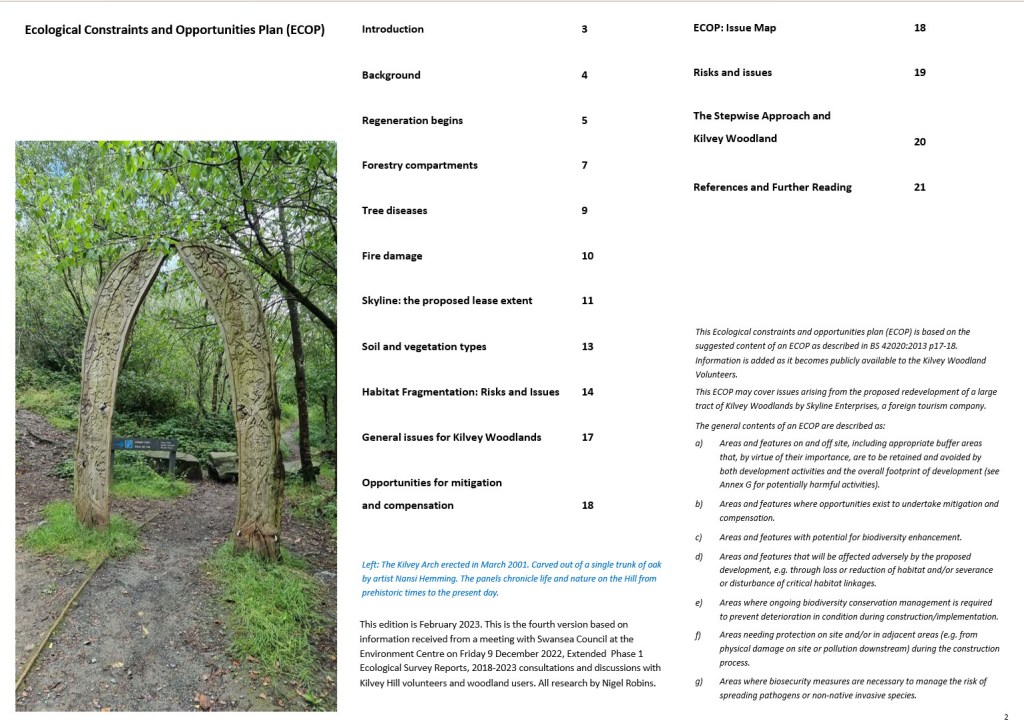
To try to fill the information gap, I created my own Ecological Constraints and Opportunites Plan (ECOP), something I used to do when I worked for the Civil Service. I was trained to follow the common standard BS42020 in structuring a document that brought together the essentials of a building plan that affected the environment.

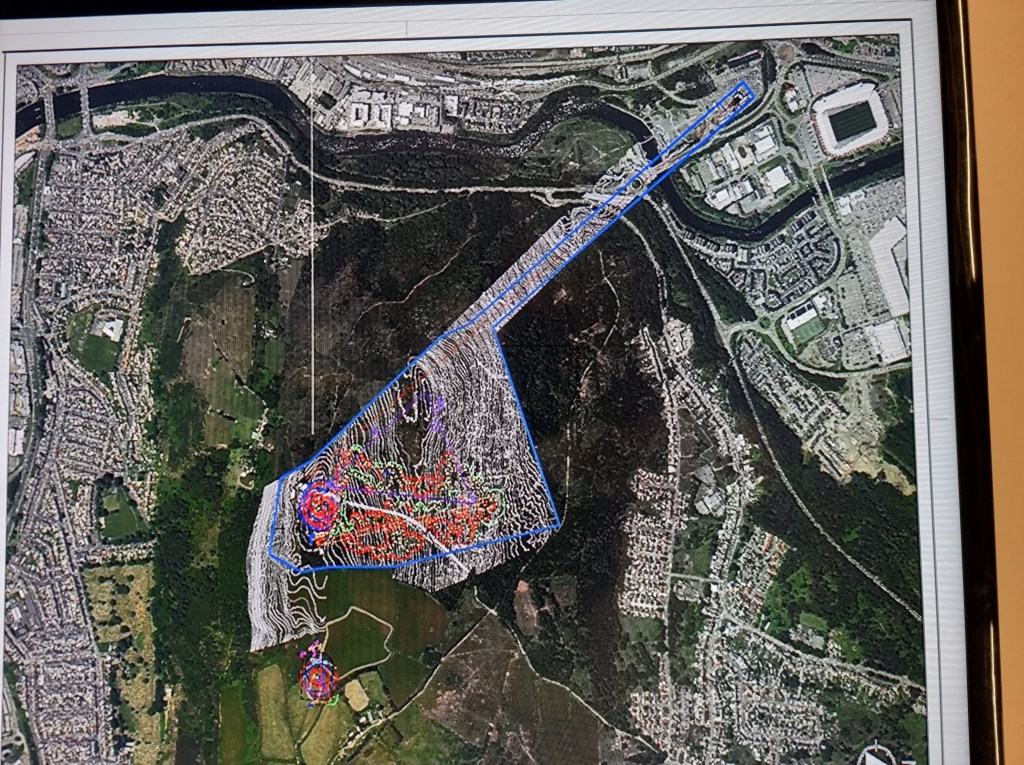
I took a photo of one of the slides on the PowerPoint shown to the meeting on the TV screen they had there. I used that as the basis for investigating the land.

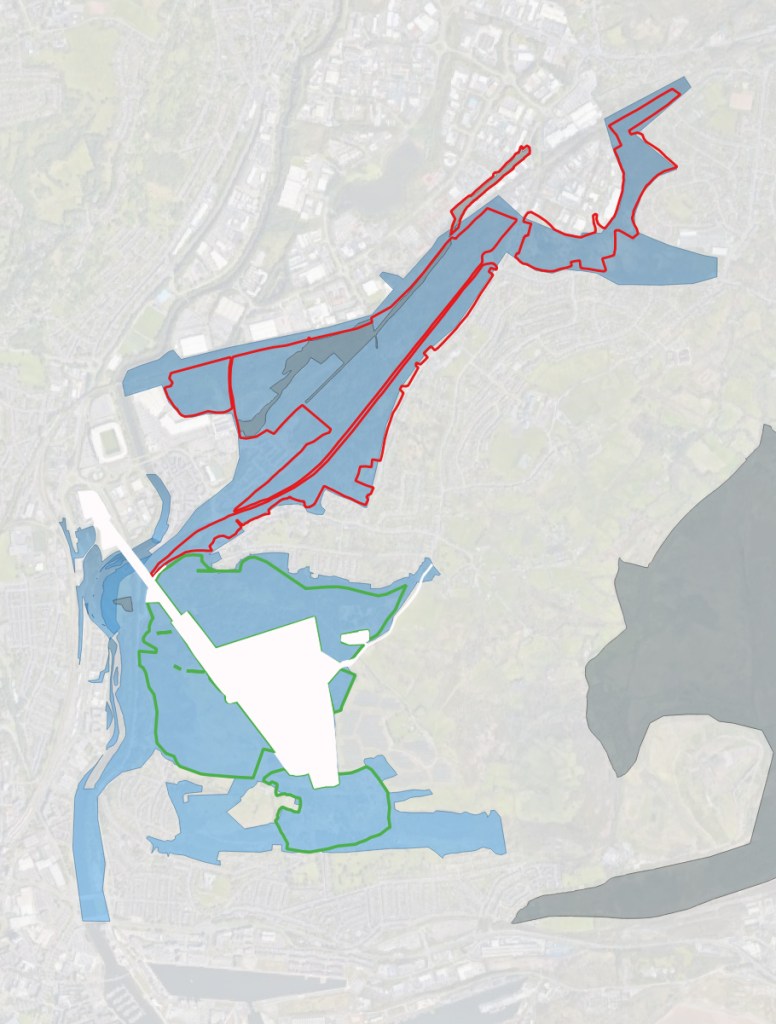
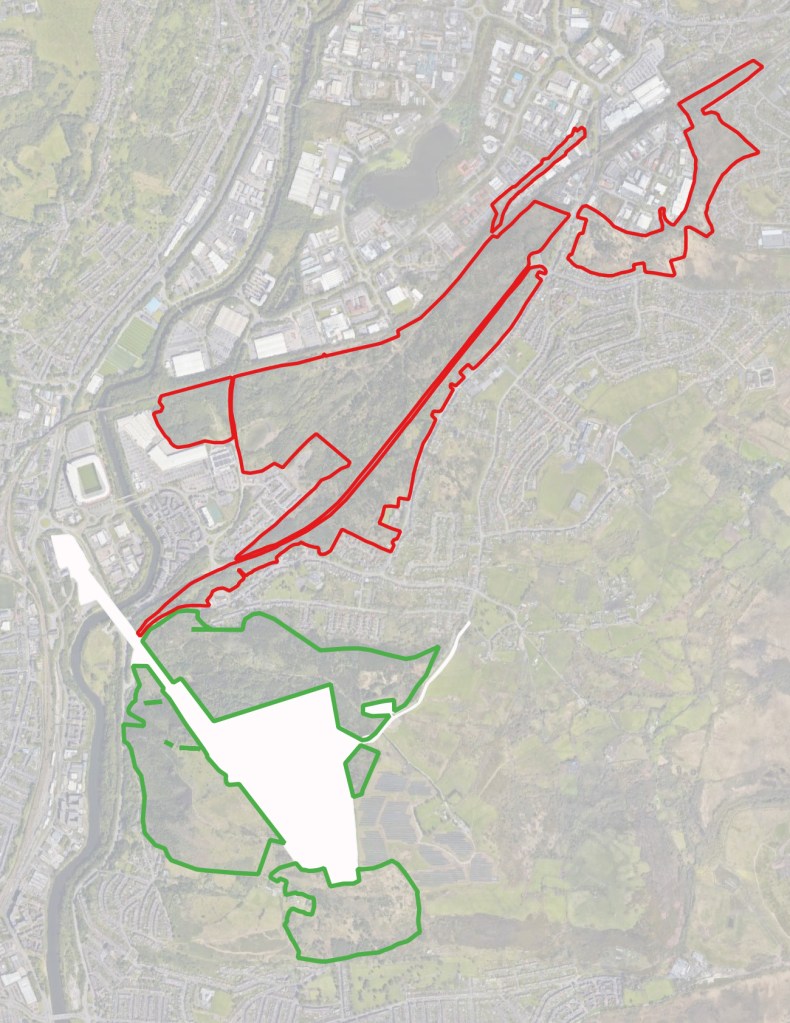
Above: The original picture of the Skyline extent shown to the Environment Centre meeting in December 2022. )

I built up an ECOP over four versions one each month (Jan -April 2023), each building on information I could interpret, but all versions were incomplete. I remember having several aggressive emails from Council staff as I asked for information. I could never work out if they were upset with me for asking or Rob Stewart for giving out vague or misleading information. We’ll never know.

Eventually the ECOP turned into the Cilfái Trilogy of books which have formed a solid basis of information on history, woodland management and heritage for me to teacvh the landscape history of the hill.

As is my habit, I posted the last (fossilised) version of the ECOP on my Academia page. What amazes me is the massive number of downloads of this document (including USA and various African countries) and local authorities. So, I guess my structure is being used as a template elsewhere. Which is great.

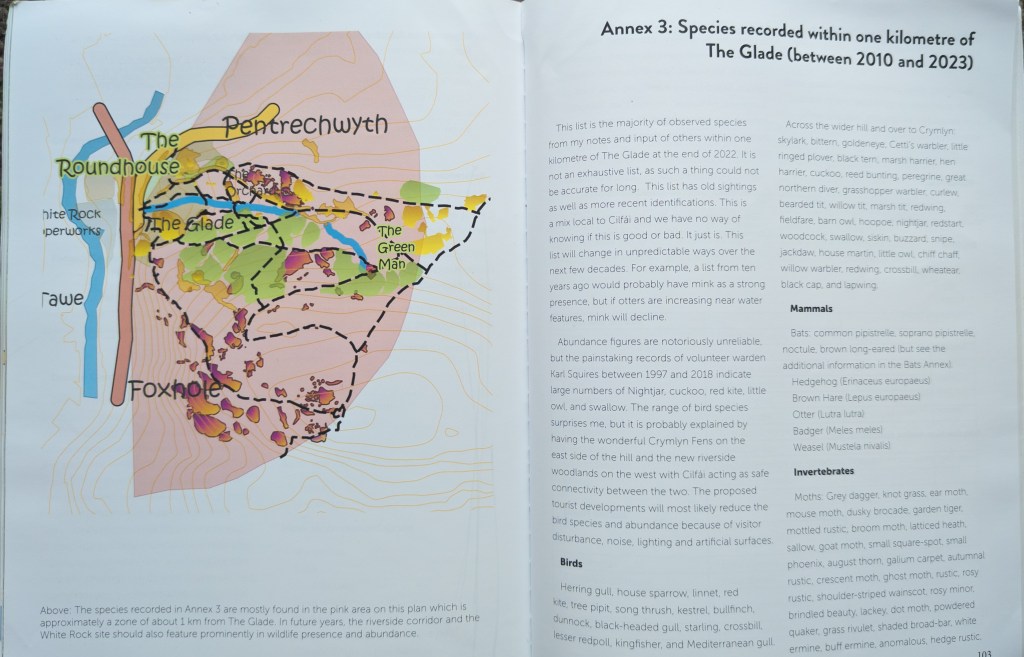
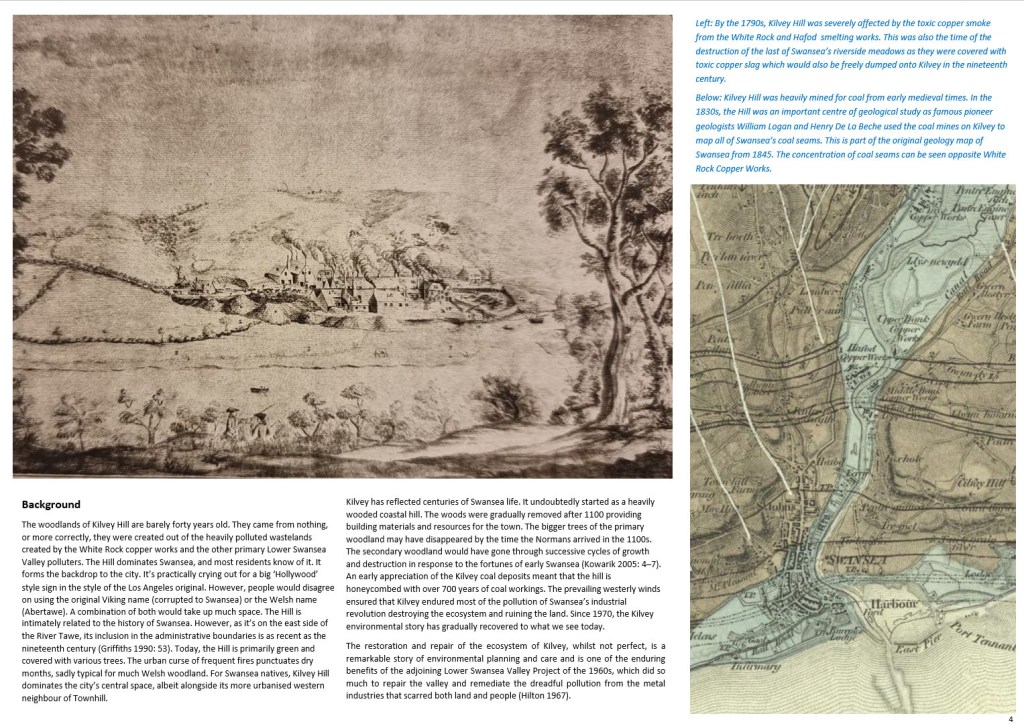
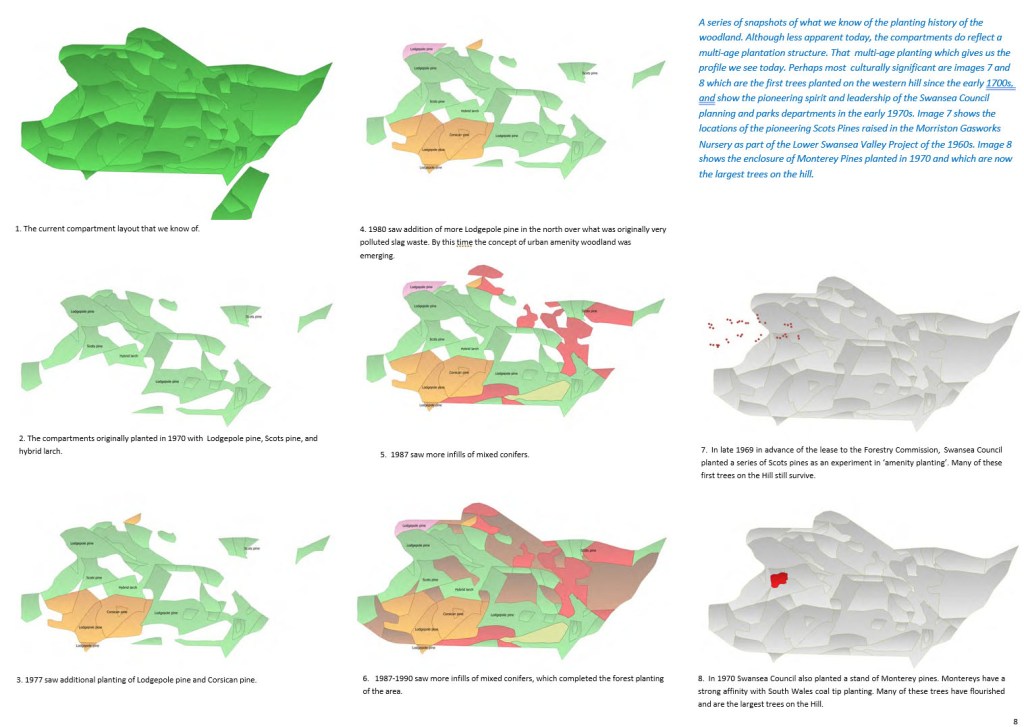
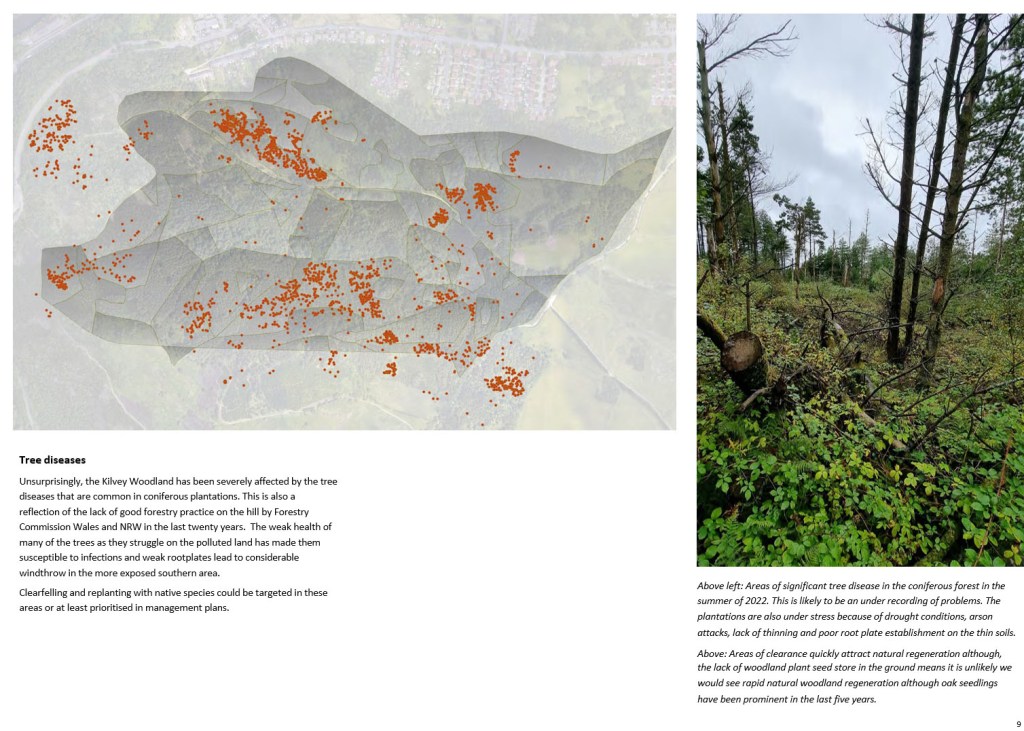
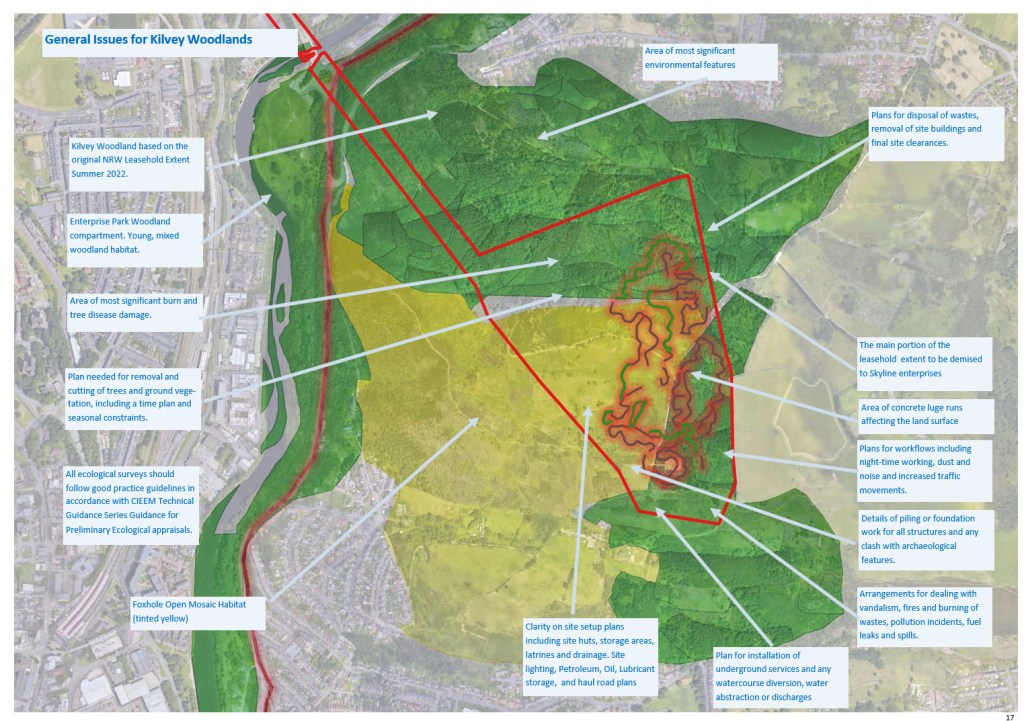
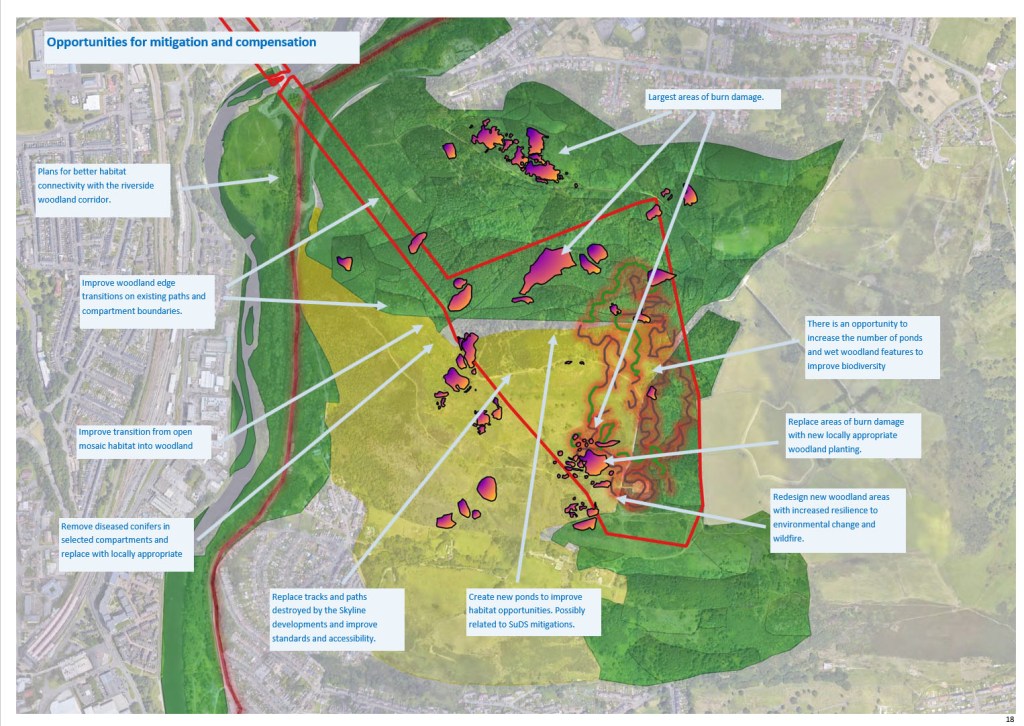
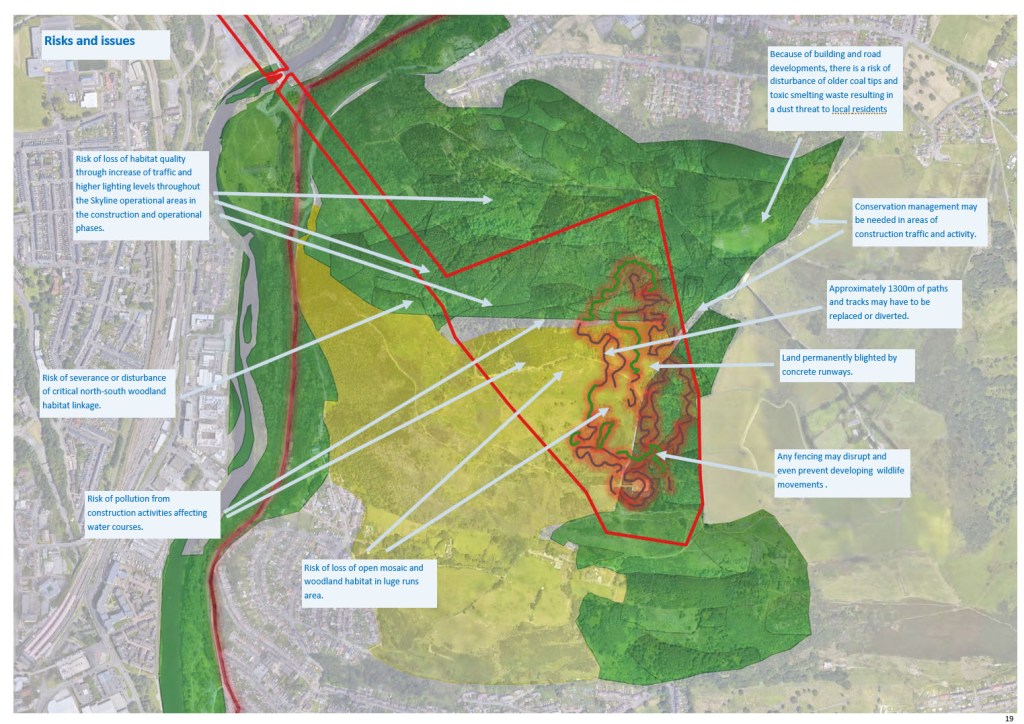
Below are screen shots of one of the versions…

My books: latest…

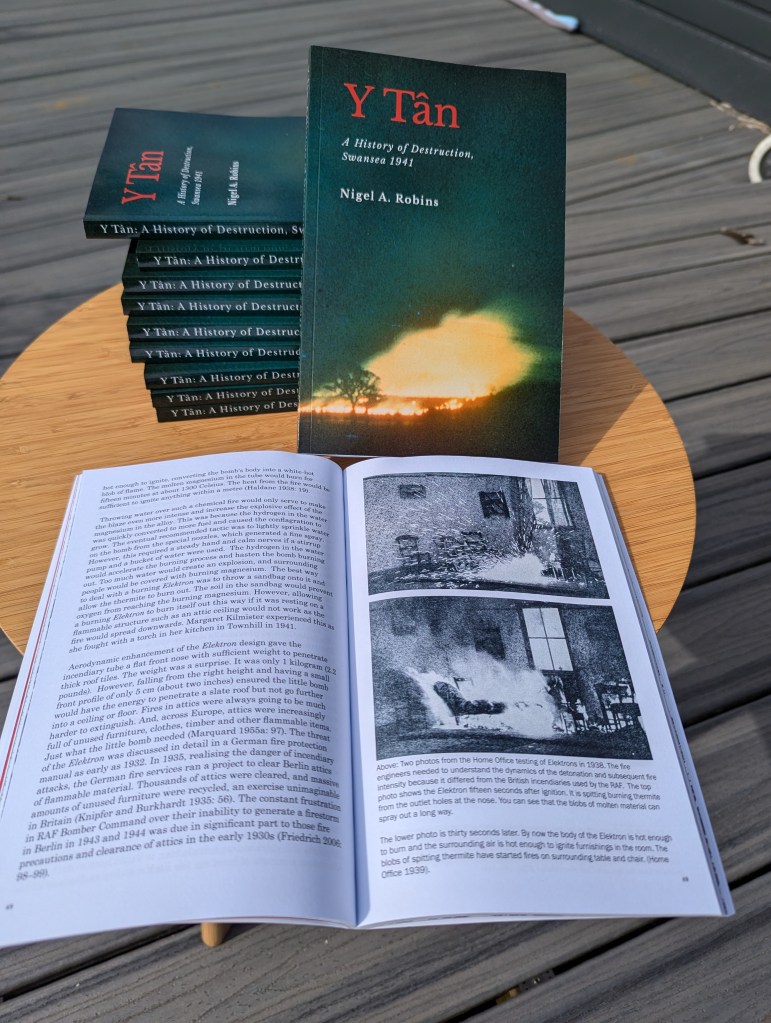
I’ve now got a stock of my latest book Y Tân.

Y Tân: A History of Destruction, Swansea 1941 is about my history of the Three Nights Blitz in February 1941. The town suffered appalling damage, and many argue it has never recovered. My grandfather died fighting the fires on the last night of the Blitz in Castle Street which was the site of a number of tragedies on that dreadful Friday.

In Y Tân I examine the situation in Swansea in the month before the attacks and look at the vulnerability of Swansea to German bombs and incendiaries. I examine the history of the weapon that destroyed the town and explain why Ben Evans was so vulnerable to fire. I examine the history of Castle Gardens and the reasons it became so dangerous. I also reconstruct the events of the three nights with eyewitness testimony from local people, war diaries and German air force sources. A chapter explains what happened to the piles of rubble in the town that eventually gave way to the redevelopments we see today—copiously illustrated with photos, maps and archive records from the author’s collections. Fully academically referenced.

Y Tân complements the groundbreaking examination of Luftwaffe intelligence maps and plans published earlier this year, Eye of the Eagle: Luftwaffe Intelligence and the South Wales Ports 1939-1941.

Y Tân is £16.99, easily available from the author, or you can buy it online here.

Also available from me or online:

Eye of the Eagle: Luftwaffe Intelligence and the South Wales Ports 1939-1941: A4 170 pages with over a hundred illustrations and map extracts.

The Cilfái Trilogy

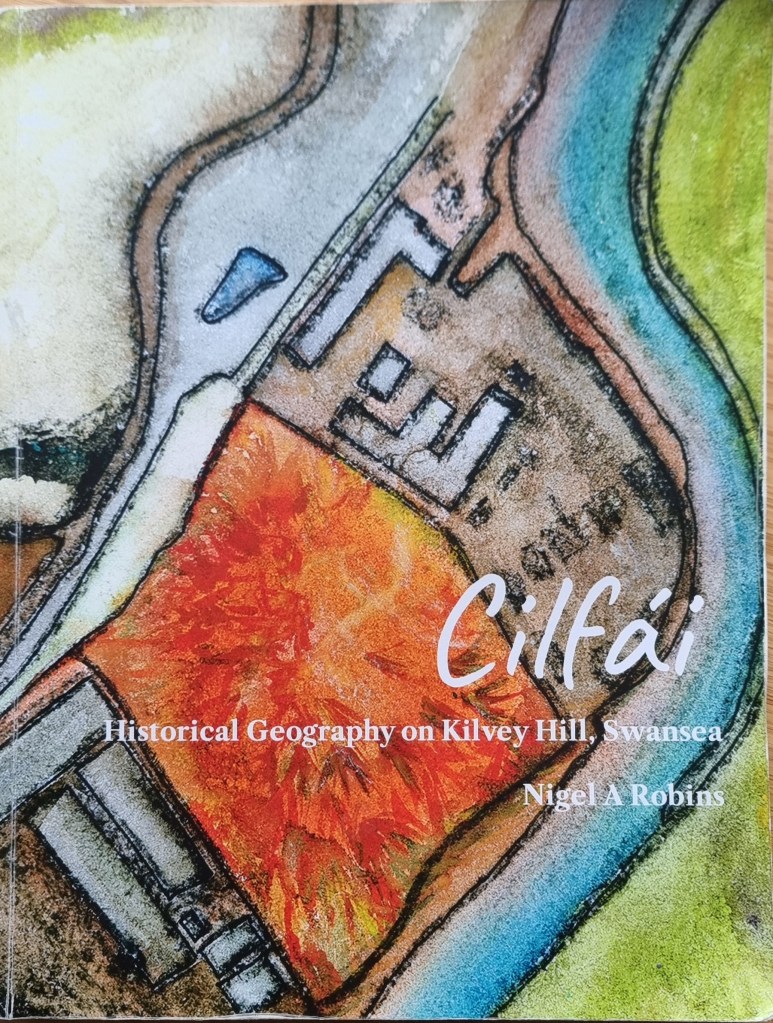
Cilfái: Historical Geography on Kilvey Hill, Swansea: £15.99, many colour illustrations and maps, 126 pages

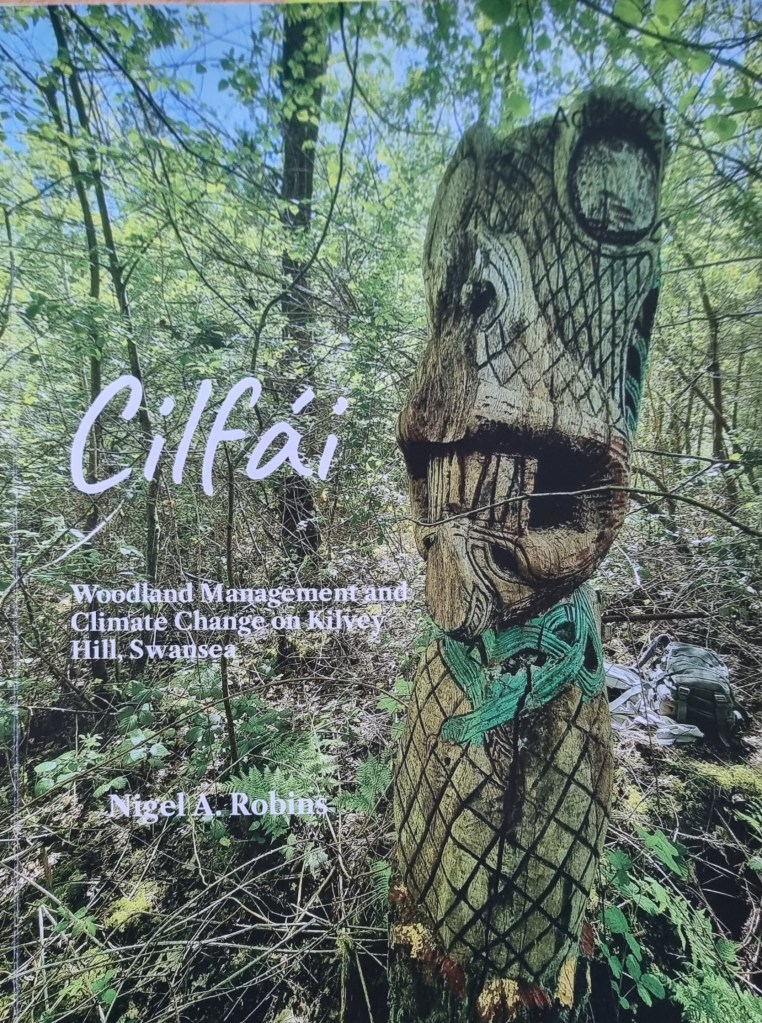
Cilfái: Woodland Management and Climate Change on Kilvey Hill, Swansea: £15.99, many colour illustrations and maps, 130 pages.

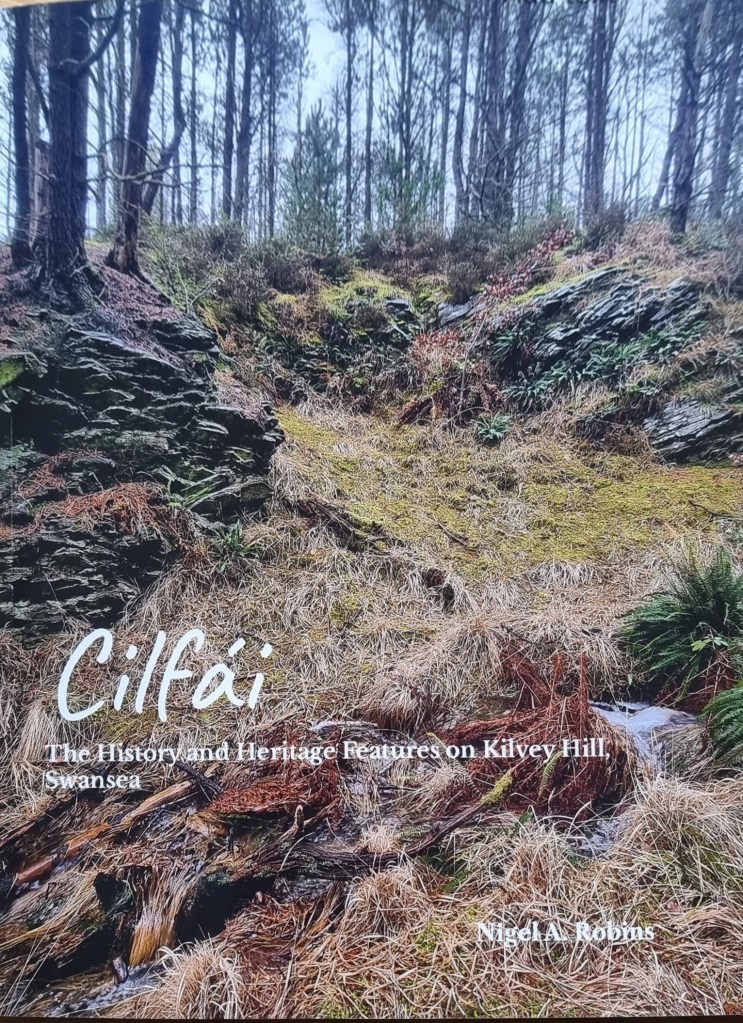
Cilfái: The History and Heritage Features on Kilvey Hill, Swansea: £14.99, many colour illustrations and maps, 98 pages.

Contact me via email at nyddfwch@gmail.com or message me. All payments are made easily with Paypal.

Or you can order from my bookshop at Nigel A Robins: Geographer – Books and Publications Spotlight | Lulu

Cilfái: The Importance of our History.

Who owns history?

Last Saturday, I talked about the history of Cilfái as part of our National Local History Month celebrations.

I had a packed room in the Central Library, not to see me… but to listen to the topic. Concern over losing our history and heritage is mounting as more threats from local Council plans get closer. I knew many of the audience, some of my old colleagues, heritage and environmental workers, and my past history teachers. There were a lot of local people as well who made an effort to come and sit in a warm teaching room on one of the hottest days of the year.

The combined years of experience in the room were amazing. People who had worked on the hill researched and cared for it, and a newer generation is taking on the challenge of future care. There was an unbroken chain of partnerships and friendships dating back to the pioneer historians Clarence Seyler and George Grant Francis.

The talk and the questions session afterwards led me to reflect on the history I was talking about. Much of the past fifty years of Cilfái history is not documented and runs a significant risk of being ‘reinterpreted’ by an unmindful local authority and a foreign tourism company. That risk of deliberate amnesia was one of the reasons I wrote the Cilfái volumes.

But who ‘owns’ the history? It is always an important question. In 1891, Oscar Wilde penned an often-quoted phrase, ‘The one duty we owe to history is to re-write it.’ Although Wilde was likely thinking more of fine art criticism, the statement holds up in modern times with the revision of colonialism and racism prominently featured in research and popular histories. I’m part of that process as I talk of the environmental pollution and ecocide that accompanied the explosion of industrialisation and exploitation in the Swansea Valley.

As good as the Wilde observation is, I felt I was always led by this statement from George Santayana in 1905…’ Those who cannot remember the past are condemned to repeat it.’ I suppose the ‘remembering’ or ‘forgetting’ can be both wilful and accidental. In the past month, I have had conversations with senior Council officers over Cilfái, where officials were adamant that records and land titles were entirely in order concerning the hill (and officially stating that was the case) whilst not checking anything about the truth and validity of those statements. The main reason behind their indolence was an intention to wilfully ignore the hill’s history. After my pushback, the senior planning officer had to retract those silly statements. The worst part of the episode was the inherent untruths and misrepresentation of vague facts advanced by Council employees who may be qualified but are rarely experienced. The injured parties are us as the public.

In books and talks about the history of Cilfái, I have tried to open ownership of our history to the broader public to combat the apparent desire of some to shut down debate, consultation, and knowledge. It is also important to remember that some of the most vocal Facebook warriors in unquestioning support for foreign tourism company plans have never been on the hill.

Above: Coal mine workings on Cilfái after 40 years of uninterrupted recovery. The Council and the foreign tourism company want us to believe this is worthless and they can do better. Really?

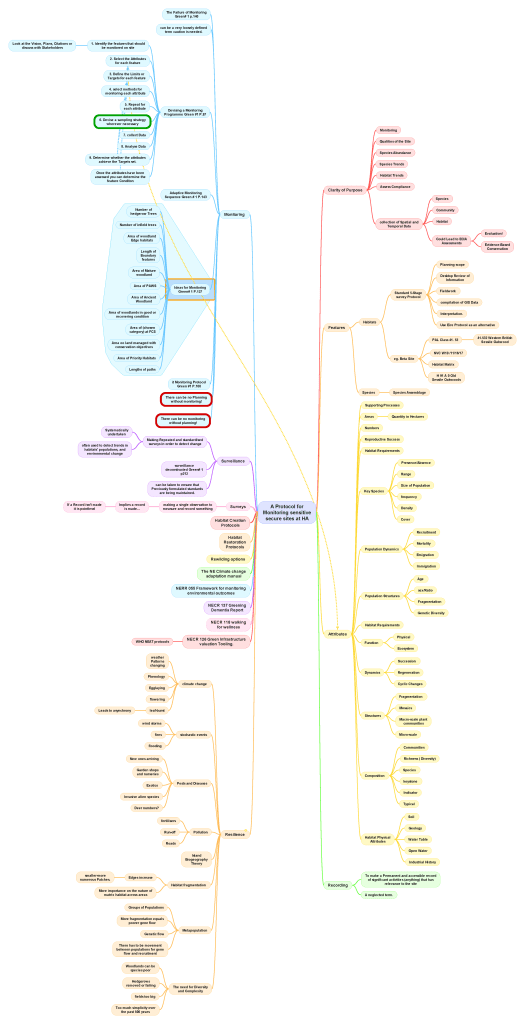
Ecological Monitoring: My complete protocol

This is my protocol from my civil service days. I used this (in whole or part) to educate, plan, or review monitoring programmes. Monitoring is hard to plan and very hard to do. In the UK, funding is often rewarded for a ‘project’ but the concept of understanding whole life costs is rarely appreciated. The money wasted on community lottery funding schemes is heartbreaking as projects are devised, money spent, and then there is no conception of maintenance or longer-term costs. Locally, I know of over £3m in lottery funding that has been wasted in ill conceived schemes with no oversight and unqualified charities signing cheques with no regard for quality or care.

As a Gateway Reviewer I was often brought in too late in a failing scheme, and my role then was merely to record the errors and failures. If we had been brought in at strategic planning or business case, it was better.

This plan was my basic script for programme oversight and I found I could frequently reverse engineer it to interpret what had gone wrong or explain how a programme failed.

I experienced three types of monitoring:

  1. Curiosity or passive monitoring. As I often undertake on Cilfái, and became the output in Cilfái: Woodland Management and Climate Change.
  2. Mandated monitoring. Imposing a requirement on a programme as part of their funding and appraisal system.
  3. Question-driven monitoring. The dreaded ‘research question’ approach of many academic bodies, often a waste of talent and time and merely to get a tick in a box. This is the stuff that is funded, completed, and locked away for ever. The best use of resources is through good quality research questions. However, I used to read questions that were long and incomprehensible…so how do you answer them…or better yet learn from them?

As a reviewer for government, I saw monitoring programmes that were ineffective or failed completely. It doesn’t help that many in the biodiversity sector see monitoring as a ‘management activity’ which is unrelated to scientific research.

The failures I saw

  1. Short-term funding preventing planning. Question-driven monitoring pushed staff to plan backwards…data first, question later. Also, data management was often dreadful with no structure or futureproofing for reviewers. A monitoring timescale can be a decade…who stays around for ten years on a program in biodiversity? Nobody…which makes succession planning vital, but never done. Loss of key personnel and the corporate amnesia that follows was harmful for staff and quality, but often treasured by politicians and managers who want a predecessor to own mistakes.
  2. The Shopping List approach. An impossibly long list of monitoring topics instead of a sharp defined monitoring objective. It is backlog planning in programme speak.
  3. Failure to agree on what to monitor. Often politicians and managers want career-enhancing metrics…not realities.
  4. Flawed assumptions. A very human desire to compare one set of data to something elso or associate with something else that looks good, but has incompatible data. The temptation to ‘salt’ data on key metrics (e.g. bats, reptiles, invasive speciers) was overpowering. An overclaim is more likely to get published etc.

It is a big graphic, so you may need to enlarge it.

Cilfái: The Principles of Diversity and Resilience

Cilfái’s connectivity to other wildlife and natural habitats is not just a concern, it’s a massive issue. The dangerous main roads dominate the wider extent, west towards the river and north towards what was the Enterprise Zone. Within the woodlands, further development for bike paths, walking trails and cable car routes are all immediate risks for ruinous fragmentation. The width of paths and firebreaks and cableways and how we manage the woodland edge habitats are crucial. Cilfái’s wider nature network must be urgently mapped and managed using the ten well-known best practice principles (Crick and others 2020a: 91–101).

1. Understand the Place. Understanding the community and the natural networks that are in place.

2. Create a Vision. Create a future that is understandable and engages the biggest stakeholders, usually the local communities, animals and plants, and those responsible for caring for and maintaining the land.

 3. Involve People. Communication, engagement and consultation are tremendously important. Do we see that commitment from local politicians?

4. Create Core Sites. The central Cilfái woodland is our core site.

5. Build Resilience. This is protection against climate change-related events such as drought, torrential rain, wildfires, and temperature extremes. I describe some of these in the book.

6. Embrace Dynamism. Nature changes constantly. Change can happen in a matter of minutes: a tree blows down, a stream bursts its banks, or a rockfall changes the shape of the land. We can’t keep spending money on keeping things ‘as they are’. Is expensively recreating a nineteenth-century landscape that relies on money, gardening, water and stable weather and climate  (as they do at Penllergare Country Park) even possible in the modern world? We must accept and adapt to our situation, not the situation we would like to be in.

7. Encourage Diversity. There is genetic variabilityspecies diversityecosystem diversity and phylogenetic diversity. Diversity is not distributed evenly on Cilfái. The ecosystem we see building on the hill results from 50 years of growth and change.It should be allowed to develop naturally. The notion that a local Council or a private tourism company can care for the land is an outrageous conceit.

8. Think ‘Networks!’ Plants, animals, and people move and live in connected networks.

9. Start Now, but Plan Long-term. Short-term is about 3 years, long-term is about 50 or more. Nobody knows what the world will be like in 50 years.

10. Monitor Progress. We can’t understand change if we don’t observe it constantly. A 3-day ecological survey by a non-local contract ecology firm on behalf of a foreign tourist company doesn’t cut it.

However, there will always be uncertainty about what Cilfái can contain because it is always prone to extreme disturbance.

Crick, H.Q.P., I.E. Crosher, C.P. Mainstone, S.D. Taylor, A Wharton, and others. 2020. Nature Networks: A Summary for Practitioners (York: Natural England)

Above: The western part of the woodland with areas of particular attraction to birds and wildlife highlighted in shades of Brown. These areas are open or semi open and also show strong characteristics of ‘woodland edge’ or ‘Stand A’ structures (see Annex 7). These areas have their origin in polluted soils from slag tips or fire damage from wildfire attacks. The old coal adits and leats provide damper cover than the surrounding woodland and frequently act as biodiversity hotspots because they retain moisture in drought conditions. These Brown areas are the current centres of natural regeneration. The woodland cover in these areas will not be necessarily native species, it is far more likely to be the ‘Cilfái mix’ of coniferous, native and invasive non-native. These areas are rapidly becoming reptile hotspots and also very strong presences of foraging bats.
 

Woodland Resilience

I talk about ‘Resilience’ in Chapter Three of the second Cilfái volume.

The term ‘resilience’has become a key concept in our landscape management. Resilience in woodland is becoming a broader and more important topic as climate change starts to bite.

In its current form, Cilfái is resilient. Yes, people burn it every year, but that results in more biodiversity hotspots as the burnt patches grow back with local species of trees and vegetation that are much more resilient to fire and drought.

Anything done to the woodland should be to enhance resilience…not knock it back with imported plants, plastic tree tubes and high maintenance planting schemes.

Diversity in the Cilfái woodlands can range froim genes and species to habitats and landscapes. The complexity of the Cilfái woodlands ecosystem will always be limited compared to a woodland that is older or has not been polluted. Still, the pollution history of the hill makes the ecosystem special and probably even unique.

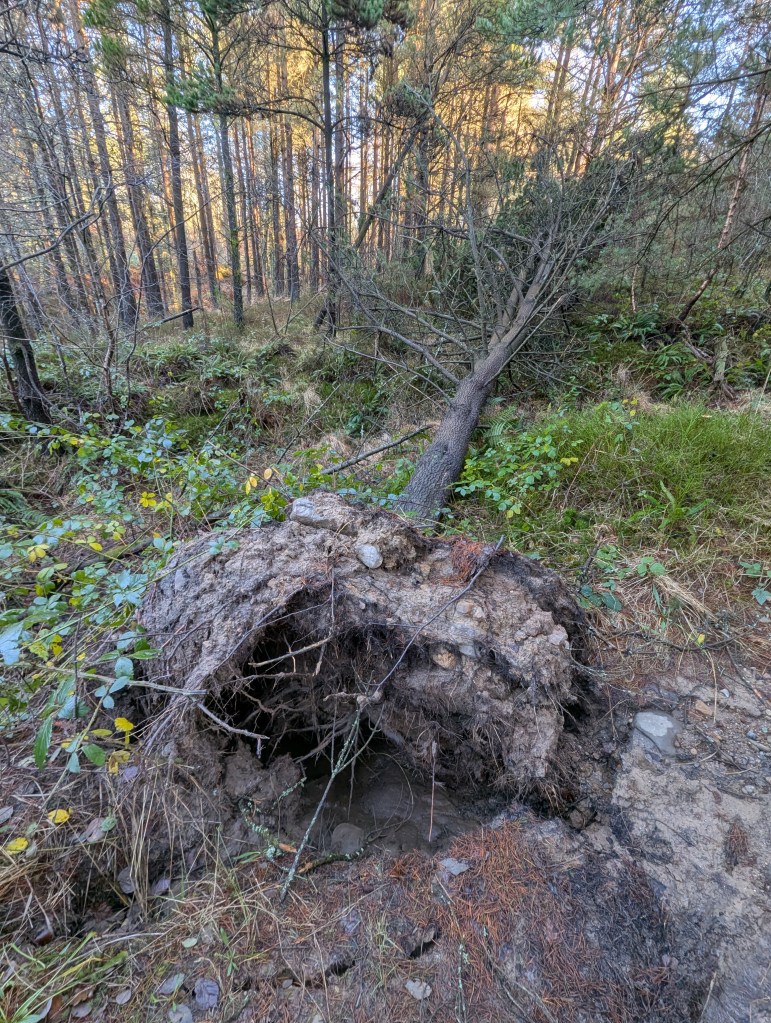
Above: The seaward slopes of Cilfái are increasingly susceptible to windstorms which easily topple the trees that often have poor anchorage because of the soil conditions. The resulting deadwood (both prone and standing) provides useful food and shelter for many animals and insects. The natural regeneration quickly takes over a windblown space and colonises fast with the ‘Cilfái mix’ of local species. Incredibly, this site on the proposed tourism development is a bat hotspot. (Author’s collection).

Cilfái: The legacy in the soil

The industrial pollution phase of Cilfái’s history has left a permanent mark in the nature of the landscape. Industrial smelting waste forms a large part of the soil for over twenty percent of the woodlands around The Glade, Roundhouse, and up to Martin’s Pond. Slag takes its place amongst the native sandstone and the glacial debris from the last ice age. The structure and chemical profile of the soil is permanently altered and many trees eventually succumb to the toxicity. This is a good reason why natural regeneration should be favoured over massive new plantation of native species. Natural regeneration allows plants that are resilient to the poisons to develop. I explain more in the second Cilfái book.

P.50 Cilfái: Woodland Management and Climate Change

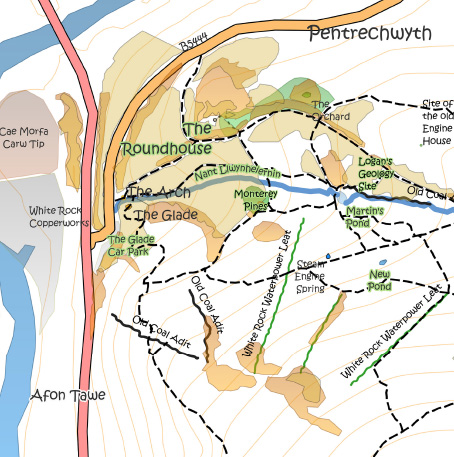
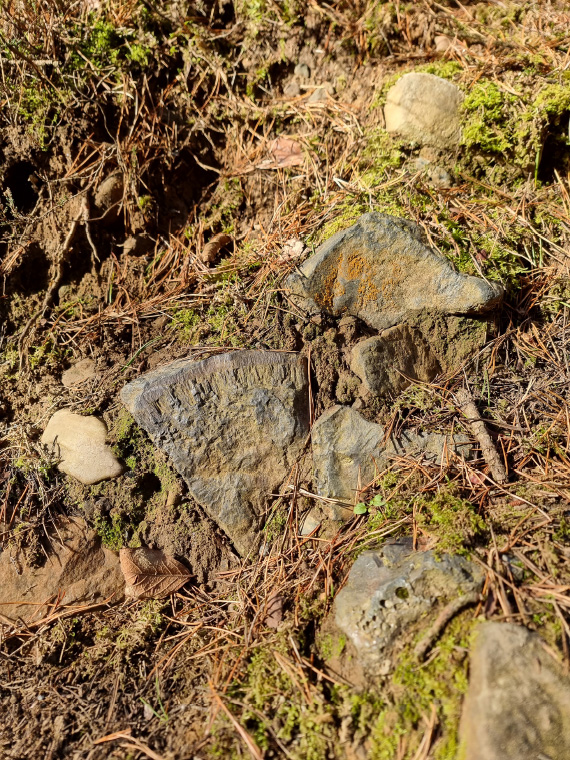
Copper slag in the soil at Martin’s Pond 2022.

Cilfái: The importance of dead wood.

As Climate Change accelerates, the conifers are increasingly susceptible to higher windspeeds and many trees will snap forming ‘snags’ such as this one near the Steam Engine Spring.

Snags allow insects, birds, and bats into holes and crevices in the dying wood providing much needed habitat. Where it is safe to do so, features like this must be maintained.

Dead wood is a vital part of biodiversity and a recovering ecosystem. Wherever possible, we don’t ‘tidy it up’ or sell it for firewood as the Penllergare Trust used to do.

Dead wood is part of life.

See pages 28-32 of Cilfái:Woodland Management and Climate Change on Kilvey hill, Swansea.