One of the big threats to a recovering woodland is habitat fragmentation. This is a huge problem for wildlife in Wales. I covered this in the second Cilfái book (Cilfái: Woodland Management and Climate Change on Kilvey Hill, Swansea). It is reasonable to assume that a big woodland is better for biodiversity and the environment than a small one. After two thousand years of habitat destruction in Wales we are left with one of the poorest environments in Europe. The woodlands we have are constantly being threatened with further subdivision as roads and houses are built in ever remote or pictureesque areas.
The woodland that has recovered since 1970 will now be fragmented further by the foreign tourism development which will cut through the centre of the biodiversity area. The impact on the recovering wildlife will be immense. The impact will be change and a reduction in opportunities for wildlife and plants on the vital central area of the hill. Fewer opportunities to live will result in fewer species and reduced biodiversity. That is habitat fragmentation.
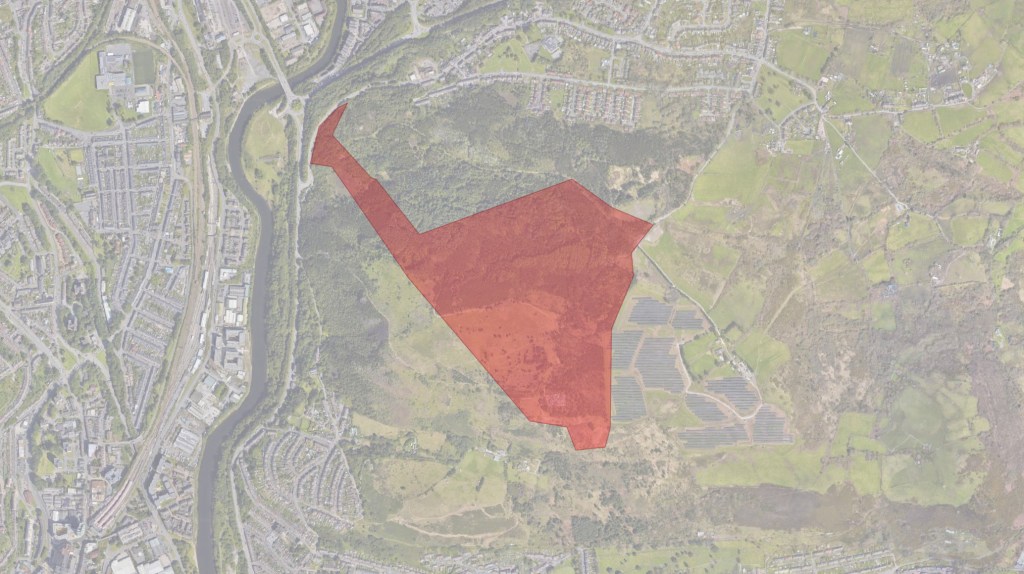
In numbers, the 102 hectares of woodland and open access space we now have on Cilfái will be reduced to about 29 hectares of woodland. As a comparison, the country park of Penllergare (near Junction 47 on the M4), has about 67 hectares of mixed woodland and Singleton Park has about 11 hectares of (badly fragmented) woodland. So, yes, the loss of Cilfái woodlands is significant.
It may not necessarily be all doom and gloom. Swansea Council and the tourism developers will hopefully be obliged to produce a series of habitat recovery and restoration plans for various tracts of land that may be leased to the Company but will not be built upon. I assume pressure will be put on Welsh Government to provide a large sum of money for ‘native’ woodland restoration. As everybody who has a say is committed to cable cars and adventure tourism, I’m sure the money will come…it has to.
Below: The area of concern on Cilfái is coloured red here. A large chunk of this is the original Forestry Commission land (now NRW). A mixture of coniferous forest, fire damage and fantastic natural regeneration. Full of bats and birds. The contract ecologists bought in by the tourism firm will seek to devalue the quality of the environment and frame it as a place that is worthless and ripe for redevelopment.

 Nigel Robins