I’m still working on the history of geological exploration in and around the Swansea area. Some of it was included in the first Cilfái book, where I wrote about the early work history of William Logan, who learned much of his early geology studying the coal veins of Cilfái.
Knowledge of every coal vein in the area was once the lifeblood of the Industrial Revolution. It is hard to believe now when we can walk through the lush green vegetation of Cilfái without seeing any evidence of the past unless we make an effort to dig to find some.
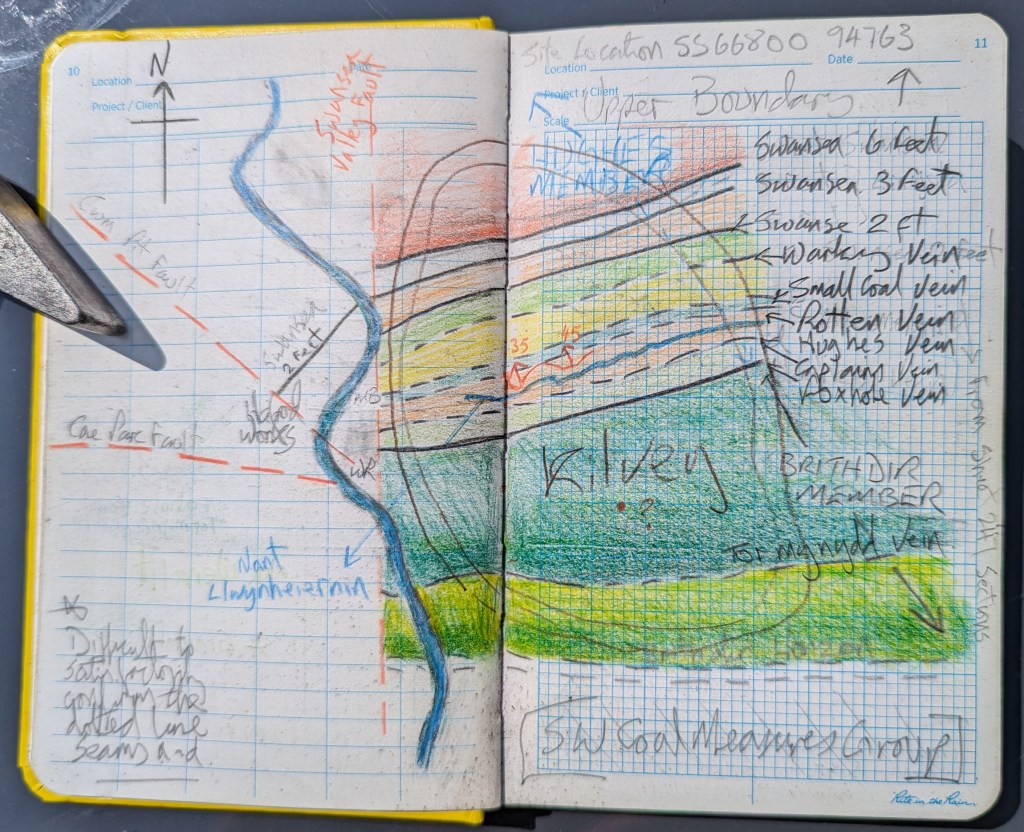
During our ITV filming on Monday, I was asked about the Tormynydd coal seam. This substantial coal layer, which extends from the seaward side of the hill to Neath and Port Talbot, played a pivotal role in the Industrial Revolution. Like all Cilfái coals, it is bituminous or binding coal that can burn with a cloud of thick black smoke and tends to stick in big lumps when it burns down. (Conybeare and Phillips 1822: 426). The Tormynydd vein is at the bottom of the sketch map and is marked today by a line of big quarries and tunnels across the front of the hill.
Knowledge of the coal veins of Cilfái and wider Swansea was passed from father to son for generations and it wasn’t until the 1790s that people started to think seriously about understanding the nature and relationship of the underground coal veins. The first map of coal in the area is William Smith’s map dated 1815 (but based on considerable local knowledge). There’s an extract of it below (Macfarlane 2020).
My sketch plan is based on diaries and memoirs from various times. It is incredible to think that Cilfái had about 10 coal veins providing coal for White Rock and Middle Bank in the 1790s

Conybeare, William Daniel, and William Phillips. 1822. Outlines of the Geology of England and Wales: With an Introductory Compendium of the General Principles of That Science, and Comparative Views of the Structure of Foreign Countries … (W. Phillips)
Macfarlane, Robert. 2020. STRATA: William Smith’s Geological Maps, 1st edition, ed. by Oxford University Museum of Natural History (London: Thames and Hudson Ltd)

 Nigel Robins